Full text rendered from the published PDF. The PDF is the version of record; if the two differ, the PDF governs.
Background: In December 2021, the Nigerian federal government declared a compulsory COVID-19 immunisation for all employees of government. This declaration by the government has been viewed by some Nigerians as a contravention of the fundamental rights of Nigerian citizens.
Aim: This study was aimed at identifying the human rights concerns surrounding vaccination mandates from the perspective of legal practitioners in Nigeria.
Methods: This study was a cross-sectional study that used a semi-structured self-administered questionnaire to interview legal practitioners practicing in Uyo, Nigeria. The survey focused on identifying human right concerns surrounding vaccination mandates.
Results: One hundred and five legal practitioners participated in the study. Data analysis revealed that 79 (75.2%) of our respondents agreed that vaccination mandates to prevent an epidemic is well within the powers of the state, while 97 (92.4%) asserted that the Nigerian constitution gives the state authority to enact health laws including quarantine and vaccination laws to protect its citizens. According to 59% (n=62) of our respondents, the only exception to a mandatory vaccination is an offer of apparent or reasonably certain proof to the state’s board of health that the vaccination would seriously impair health or probably cause death.
Conclusion: In the opinion of majority of the legal practitioners interviewed, the Nigerian constitution gives the state the power to implement measures established by legislation to protect the health of her citizens. Thus, coercive vaccination policies by the state to protect the public from an epidemic outbreak of a disease which threatens the safety of citizens may be legally binding on the citizens.
Keywords: Citizens’ Rights, Coercive, Legal Perspectives, Vaccination
The introduction and widespread use of vaccines have profoundly affected the occurrence and spread of several infectious diseases. For instance, vaccines have been used effectively to eradicate smallpox from the world. The onset of the last naturally occurring case of smallpox was in 1977 and vaccination against the smallpox virus has been discontinued globally [1]. Also, high vaccination rates have been shown to reduce the incidence of infectious diseases, hospitalisations, and deaths and this has promoted calls for the implementation of measures to achieve high vaccination coverage among members of communities [2]. Vaccines are often given to healthy individuals and accrues benefits beyond the vaccinated subjects by significantly benefiting the general public through creation of herd immunity. However, during an epidemic or pandemic, vaccines can only be effective in curbing the spread of the infectious disease if a sufficiently large number of people are vaccinated leading to the herd immunity. Thus, by getting vaccinated, an individual also helps reduce the risk of infection for others [3]. The social benefits of vaccination includes the protection of vulnerable groups, i.e., persons who cannot receive vaccines due to medical reasons (such as pregnant women, critically ill patients, etc.). Such persons are particularly vulnerable as they cannot protect themselves even if they wanted to, hence, they depend on others to protect them by preventing the spread of the virus through their vaccination [3 - 5]. Children are also a potentially vulnerable group during
infectious disease outbreaks because they cannot give informed consent for voluntary vaccination on their own, and thus rely on their parents who may be unwilling to receive the vaccine or get them (the children) vaccinated [3 - 5]. Oftentimes, during the outbreak of a vaccine- preventable infectious disease, many citizens do not seem to have a sense of obligation to get vaccinated against the disease for the common good of the general population, and as such coercive vaccination policies appear to be a viable option for government to protect the live and wellbeing of the general population. The implementation of coercive vaccination policies by government is usually resisted by many citizens who feel that mandatory vaccination affronts the bodily integrity of individuals and violates their constitutionally guaranteed fundamental rights as human beings [1]. Vaccination policies become coercive when it attracts penalties for non-vaccination. The two terms “compulsory vaccination” and “mandatory vaccination”, often used interchangeably, are both coercive vaccination policies. An attempt has been made by Navin and Largent to distinguish between both terms. Based on their definition, mandatory vaccination entails depriving the non-vaccinated population (besides those who are not vaccinated for medical reasons) from having access to certain valuable social goods and services, while compulsory vaccination refers to the criminalisation of vaccine refusal. Nevertheless, both terms are often perceived as being synonymous [5 - 7]. Coercive vaccination policies do not necessarily imply that people would be compelled to get vaccinated via the use of physical force. Rather, it imposes negative consequences on persons who decline receiving vaccines. The scale and nature of such consequences vary. For instance, the presentation of evidence of vaccination may be used as a pre-condition to access certain services such as education, health insurance, and employment opportunities or to gain access to certain public spaces [2]. Non-compliance with mandatory vaccination policies may attract payment of fines or other forms of financial penalties. In some extreme cases it may result in criminal conviction. Such
policies may potentially interfere with a number of human rights, including the right to liberty, to work, education, bodily integrity, privacy, freedom of movement, freedom of assembly, and the right to equal treatment [2]. In December 2021, the Nigerian federal government declared a compulsory COVID-19 immunization for all employees of government [8]. This declaration by the government has been viewed by some Nigerians as a contravention of the fundamental rights of Nigerian citizens. This study was thus aimed at identifying the human rights concerns surrounding coercive vaccination policies from the perspective of legal practitioners in Nigeria. To the best of our knowledge, no similar study has been conducted in Nigeria.
Study design and setting:
It was a cross-sectional survey carried out among legal practitioners practising within Uyo metropolis in Akwa Ibom state, Nigeria. Uyo is one of the 31 Local Government Areas and the capital city of Akwa Ibom state in Southern Nigeria. Participants who met the eligibility criteria were recruited into the study and interviewed. The interview session focused on identifying human right concerns surrounding coercive vaccination by government from the perspective of legal practitioners in Nigeria.
Eligibility criteria:
All legal practitioners practising within Uyo metropolis (who were duly identified using a register of certified legal practitioners in Uyo Local Government Area) who provided informed consent to participate in the study.
Sample Size:
All persons who met the eligibility criteria for participation in the study and provided consent were recruited into the study.
Data collection instrument:
A suitably designed, pre-piloted, semi- structured, self-administered questionnaire was used to obtain data from the legal practitioners via a face-to-face meeting. The instrument had two sections. The first section was used to obtain
data on the sociodemographic details of the respondents while the second section comprised of ten questions. The first 9 questions assessed the perspective of the legal practitioners regarding coercive vaccination by government. The tenth question assessed the respondents’ opinion on who would be held liable in event of a serious adverse reaction following compulsory vaccine administration. Most of the questions were drawn from Sarah Fujiwara’s publication in the Ethics Journal of the American Medical Association [9]. The developed questionnaire was thoroughly reviewed and subjected to content validation by an expert panel comprising of healthcare providers and legal practitioners; then a pilot study - to ascertain its readability and lack of ambiguity; before administration to the study participants.
Data Analysis:
Quantitative data was analysed using the IBM Statistical Program and Service Solutions (SPSS) version 25.0 computer package. Descriptive statistics was used to summarise data. Pearson’s Chi-square test was used to assess association between the COVID-19 vaccination status of the
Table 1. Sociodemographic characteristics of respondents. Variable Frequency Percentage (%) Gender Male 53 50.5 Female 52 49.5 Age in years 21 -30 32 30.5 31 - 40 39 37.1 41 - 50 18 17.1 51 - 60 12 11.4 >60 4 3.8 Years of practice 1 - 5 25 23.8 6 - 10 43 41.0 11 - 15 21 20.0 16 - 20 10 9.5 > 20 6 5.7 Sector of practice Government 32 30.5 Private 73 69.5
respondents and their views on coercive vaccination policy of government. Statistical significance was set at p<0.05.
Ethical Considerations:
Ethical approval for this research work was obtained from the Akwa Ibom State Health Research Ethics Committee (AKSHREC) - Reference number: AKHREC/10/3/22/082. In addition, informed consent was obtained from study participants before recruitment.
Demographic details of the respondents:
A total of 131 legal practitioners were recruited into the study, however, only 105 of the study participants completed in the questionnaire. We thus achieved a response rate of 80.15%. Majority of the respondents (73; 69.5%) practiced in the private sector. The sociodemographic details of the study participants is presented in Table 1 below.
COVID-19 vaccination status of respondents:
Fifty-four (51.4%) of our respondents were vaccinated against the virus. The COVID-19 vaccination status of the respondents and its
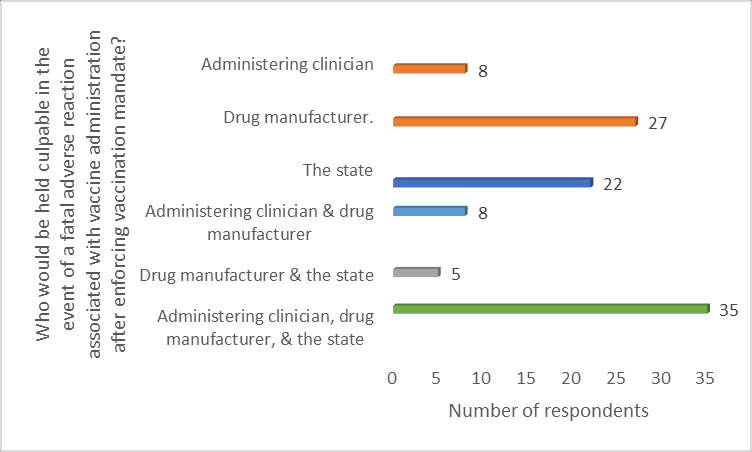
third of the respondents (35; 33.33%) opined that the administering clinician, the drug manufacturer, as well as the state would all be culpable in the event of a serious adverse reaction associated with vaccine administration following a coercive vaccination policy by government; while 27 (25.71%) were of the opinion that only the drug manufacturer is culpable.
Policy decisions on the use of vaccines are usually influenced by the relative balance of the risks and benefits of the vaccine. This is so because although approved vaccines are safe and effective, they are neither perfectly safe nor perfectly effective [1]. Almost all our respondents agreed that a country has the right to protect itself from an epidemic outbreak of a disease which threatens the safety of its citizens. Litigation challenging state coercive vaccination policies exist in several countries including Italy, New Zealand, France, South Africa, United States, and the United Kingdom. Cases are also brought against private employers of labour who make vaccination a requirement for employment [2]. In 1905, the Supreme court of the United States had ruled that the state had the power to implement measures established by legislation to protect public health and safety [9]. According to the court, such legislation do not violate the
following compulsory vaccine administration.
citizens right to liberty as it falls within the restraints to which every person is necessarily subjected to for the common good of all [9]. In the context of this legal position, real liberty cannot exist if people are allowed to act without regard to the fact that such actions may cause injury to others. On the other hand, over three-quarter of our respondents agreed that the Nigerian constitution protects citizens against arbitrary executive orders. On this, the proponents of coercive vaccination policies often argue that a mandatory vaccination policy is remarkably analogous to the compulsory use of seat belt by users of motor vehicles and that if the laws mandating the use of seat belts are justifiable, then coercive vaccination policies are equally ethically justified for the same reasons [10]. It is often posited that the courts do not become involved in legislation formed under the state’s power as long as it pertains to public health or safety and is not a plain, palpable invasion of rights secured by fundamental law [9]. Majority
of our respondents did not agree with this position, as only about one-third of the legal practitioners agreed that the court is not involved in litigation surrounding such legislation. It is important to note that not all opponents of compulsory vaccination laws have negative attitudes towards vaccination. Some people may be proponents of the use of vaccines to curb the spread of an infectious disease but are opposed to coercive vaccination by the state because it infringes on citizens’ freedom to choose healthcare interventions. To improve vaccine uptake among children, the Australian government implemented the “No Jab, No Pay” legislation. This legislation required parents to provide proof of immunisation before being eligible to receive certain welfare benefits. A survey among Australian parents by Trent et al ., reported that about 82% of the 411 respondents interviewed were supportive of the “No Jab, No Pay” legislation [11]. More than half of the legal practitioners agreed that the only exception to compulsory vaccination is an offer of proof to the state’s health board that the vaccination would seriously impair health or probably cause death. Alberto Giubilini in his published article argued that compulsory vaccination is justifiable and needs to be strengthened by considerations of fairness. He further opined that vaccine refusal is illegal and morally equivalent to a case of tax evasion and as such offenders should be legally treated in a similar manner as one who evades taxes [6]. A major reason offered by persons averse to compulsory vaccination is that of the risk of adverse reaction to vaccines [10, 12 -14]. Sometimes, it is erroneously believed that vaccines pose a greater risk to the public than the infectious disease for which the vaccine is said to prevent [15]. Although vaccines, like most other pharmacological interventions, are associated with potential risk of adverse reactions, they rarely cause serious adverse events as most adverse events associated with vaccines are minor and usually involve local soreness or redness at the injection site or perhaps fever for a day or two [12, 16]. It can further be argued that although many drugs (including over-the- counter medicines) are associated with some
form of untoward reactions, their continuous use do not raise ethical problems. Thus the use of vaccines (which are largely safe interventions) should not be seen as particularly ethically problematic. About half of our respondents agreed that opposing a vaccination mandate by the state due to a religious objection, would most likely be dismissed by the courts because a compelling state interest would likely abridge religious freedom. The European Court of Human Rights (ECHR) has posited explicitly that compulsory vaccination laws do not contravene the freedom of thought, conscience and religion [2]. While there are clear legal provisions for vaccination exemptions based on medical reasons (even during the enforcement of mandatory vaccination), exemptions on the grounds of religious beliefs may not be legally justifiable [2]. Opponents of coercive vaccination policies often insist that coercive vaccination policies raise ethical concerns as patients with prescription medications have the liberty to decide whether or not to take the risk associated with the prescribed drugs or to reject medical interventions such as surgery or blood transfusion (because of religious beliefs) without incurring any form of punishment from the authorities. According to them a coercive vaccination policy takes away the liberty to decide whether or not to take the risk, live with the medical condition, or seek alternative measures to treat the condition. Moreover, because vaccines are generally recommended for the healthy population, the absence of any obvious pathology in the recommended population for vaccination raises more controversy among the opponents of compulsory vaccination. When asked who would be held liable in the event of a serious adverse reaction or adverse event linked to the used of a vaccine that was administered while enforcing a mandatory vaccination law, about one-third of the legal practitioners posited that the administering clinician, the drug manufacturer, as well as the state would all be culpable. However, some of the respondents opined that the drug manufacturer alone would be culpable, while some others opined that only the state would be
culpable. In the event of the occurrence of a vaccine-induced injury, the victim may want to take legal action, particularly if the victim was coerced into receiving such vaccine. Vaccine producers have the ethical obligation of ensuring that vaccines are safe and efficacious and may be liable if vaccine safety was not satisfactorily established before released into the market [17]. Verweij and Dawson in their published report suggested that governments should accept responsibility for vaccine-induced injuries that occurred as a result of the implementation of a compulsory vaccination policy [18]. However, there appear to be no judicial consensus on who should be liable in the event of a vaccine-induced injury when mandatory vaccination is enforced.
In the opinion of majority of the legal practitioners interviewed, the Nigerian constitution gives the state the power to implement measures established by legislation to protect the health of her citizens. Thus, coercive vaccination policies by the state to protect the public from an epidemic outbreak of a disease which threatens the safety of citizens is legally binding on the citizens. The state should however accept responsibility for vaccine-induced injury resulting from compulsory vaccination requirements.
VI. STUDY LIMITATIONS/RECOMMENDATION
The selection and use of one district for this study may limit the generalizability of the research findings, nevertheless, the study brings to bear important ethical issues surrounding coercive vaccination in Nigeria. It also offers valuable insights into the legality of coercive vaccination policies. Although coercive vaccination policies appear vaccines, enhance immunisation rate, attain to be an effective strategy to optimise uptake of herd immunity, and prevent further transmission of an infectious disease; its implementation should be borne out of a scientifically established safety and effectiveness of the vaccine.
VII. DECLARATION O F INTEREST
The authors hereby declare that there is no conflict of interest.
| Gender | |
|---|---|
| Male 27 | 26 50.94 |
| Female 27 | 25 51.92 |
| Age | |
| 20 – 30 9 | 23 28.13 |
| 31 – 40 21 | 18 53.85 |
| 41 – 50 11 | 7 61.11 |
| 51 – 60 9 | 3 75.00 |
| >60 4 | 0 100.00 |
| Year of Practice | |
| 1 – 5 3 | 22 12.00 |
| 6 – 10 25 | 18 58.14 |
| 11 – 15 12 | 9 57.14 |
| 16 – 20 8 | 2 80.00 |
| >20 6 | 0 100.00 |
| Sector of Practice | |
| Government 20 | 12 62.50 |
| Private sector 34 | 39 46.58 |
| Total 54 | 51 51.4 |
| distribution across the demographic | authority to enact health laws of every |
| characteristics of the respondents is presented in | description, including quarantine and |
| Table 2. | vaccination laws, to protect its citizens. |
| Respondents’ policy of government: views on coercive vaccination | The participants item-by-item to questions response bordering of on our the legality study |
| of coercive vaccination policies of government | |
| Majority of our respondents (79; 75.2%) agreed | as well as the results of the Pearson’s Chi-square |
| that vaccination mandates to prevent an epidemic | test to assess association between the vaccination |
| is well within the powers of the state. Also, | status of the respondents and their views on |
| majority of the respondents (84; 80.0%) asserted | coercive vaccination policy of government is |
| that the Nigerian constitution gives the state | presented in Table 3. |
| 19 vaccination status. | |||
|---|---|---|---|
| Questions/COVID-19 vaccination status | Responses | Pearson | |
| Yes | No | Don’t Chi-square | |
| know test/p-value | |||
| It is of paramount necessity that a country has | 103 | 1 (1.0%) | 1 p = 0.34 |
| the right to protect itself from an epidemic | (98.1%) | (1.0%) | |
| outbreak of a disease which threatens the safety | |||
| of her citizens. | |||
| Vaccinated | 54 | 0 | 0 |
| Not vaccinated | 49 | 1 | 1 |
| E-mail: | unyimeeshiet@uniuyo.edu.ng | ||
| The Nigerian constitution protects citizens | 84 | 19 | 2 p = 0.013 |
| against arbitrary executive orders. | (80.0%) | (18.1%) | (1.9%) |
| Vaccinated | 39 | 15 | 0 |
| Not vaccinated | 45 | 4 | 2 |
| The Nigerian constitution gives the state | 97 | 4 (3.8%) | 4 p = 0.366 |
| authority to enact health laws of every | (92.4%) | (3.8%) | |
| description, including quarantine and | |||
| vaccination laws, to protect its citizens. | |||
| Vaccinated | 50 | 3 | 3 |
| Not vaccinated | 47 | 1 | 1 |
| Real liberty for all, as enshrined in the | 89 | 12 | 4 p = 0.017 |
| constitution, cannot exist if each individual is | (84.8%) | (11.4%) | (3.8%) |
| allowed to act without regard to the injury that | |||
| his or her actions might cause others; liberty is | |||
| constrained by law. | |||
| Vaccinated | 51 | 2 | 1 |
| Not vaccinated | 38 | 10 | 3 |
| Vaccination mandates to prevent an epidemic is | 79(75.2%) | 17(16.2 | 9(8.6%) p = 0.015 |
| well within the powers of the state. | %) | ||
| Vaccinated | 47 | 5 | 2 |
| Not vaccinated | 32 | 12 | 7 |
| The courts do not become involved in | 37 | 50 | 18 p = 0.072 |
| legislation formed under the state’s power as | (35.2%) | (47.6%) | (17.1%) |
| long as it relates substantially to public health, | |||
| morals, or safety and is not a plain, palpable | |||
| invasion of rights secured by fundamental law | |||
| Vaccinated | 24 | 24 | 6 |
| Not vaccinated | 13 | 26 | 12 |
| It is immaterial whether or not the vaccine is | 21 | 75 | 9 p = 0.183 |
| actually effective, so long as it is the belief of | (20.0%) | (71.4%) | (8.6%) |
| state authorities that the mandatory vaccine will | |||
| promote common welfare and is a reasonable | |||
| and proper exercise of the state power | |||
| Vaccinated | 11 | 41 | 2 |
| Not vaccinated | 10 | 34 | 7 |
| The only exception to a mandatory vaccination | 62 | 29 | 14 p = 0.004 |
| is an offer of apparent or reasonably certain | (59.0%) | (27.6%) | (13.3%) |
| proof to the state’s board of health that the | |||
| vaccination would seriously impair health or | |||
| probably cause death. | |||
| Vaccinated | 40 | 8 | 6 |
| Not vaccinated | 22 | 21 | 8 |
| Opposing a vaccination mandate by the state | 52 | 33 | 20 p = 0.050 |
| due to a religious objection, would most likely | (49.5%) | (31.4%) | (19.0%) |
| be dismissed by the courts because a compelling | |||
| state interest may abridge religious freedom. | |||
| Vaccinated | 33 | 13 | 8 |
| Not vaccinated | 19 | 20 | 12 |
| opinion on who would be held third | of the respondents | (35; | 33.33%) opined |
| in event of a serious adverse reaction that | the administering | clinician, | the drug |
| compulsory vaccine administration: manufacturer, | as | well as the | state would all be |
| l | bl i th | t f | i d ti |