Full text rendered from the published PDF. The PDF is the version of record; if the two differ, the PDF governs.
Background: High-quality cardiopulmonary resuscitation (CPR) is essential to improve survival rates in out-of-hospital cardiac arrest. Previous research suggests that the quality of CPR may decline during ambulance transport.
Aims: To evaluate the quality of CPR performed at the scene and during transport after out-of-hospital cardiac arrest.
Methods: A randomised, controlled, crossover trial was conducted to compare the performance of CPR on a manikin, both at the scene and in a moving ambulance. CPR quality was measured using a QCPR system, capturing parameters including compression depth, rate, recoil, and ventilation sufficiency. Participants alternated between the two scenarios after a one-hour recovery period.
Results: 18 participants were enrolled, with a mean score for CPR quality of 52.94% in the ambulance and 53.25% at the scene. A t-test revealed no statistically significant difference (t(34) = -0.033, p = 0.97) in scores; furthermore, we observed no statistically significant differences in relation to the following parameters: flow fraction, cycles performed, total number of compressions, compression score, percentage of compressions performed with proper release, percentage of compressions performed with adequate depth, total number of ventilations, and ventilation score (p>0.05).
Conclusion: The quality of CPR provided at the scene and in the ambulance is comparable, suggesting that competent CPR providers can deliver high-quality care in both settings.
Keywords: Emergency Medical Services, Manikins, Out-of-Hospital Cardiac Arrest, Patient Transport, Quality of Health Care, Randomized Controlled Trial
Throughout the world, out-of-hospital cardiac ar- rest (OHCA) is a significant public health con- cern, with outcomes differing significantly from one region to another [1]. Sudden cardiac arrest (SCA) is a leading cause of death, with an annual worldwide incidence of 55 per 100,000 adults, which is equal to 356,000 per year [2,3]. One im- portant survival factor following cardiac arrest is the quality of cardiopulmonary resuscitation (CPR) [4,5]; prior research has shown that high- quality CPR can improve the survival rate in out- of-hospital cardiac arrest [6]. High-quality CPR is defined as a chest compression fraction (CCF) of at least 80%, a compression rate of 100-120/min, and a compression depth of at least 2 inches [7]. The quality of CPR in cardiac arrest patients may be affected by the location (at the scene of out-of- hospital cardiac arrest vs. in the ambulance vs. in the ED) [8]. Previous studies have shown that pa- tients transported to the hospital following OHAC with ongoing CPR have a lower survival rate [8], while investigations on manikins showed that the quality of CPR in moving vehicles was reduced [9]. Hence, the American Heart Association
(AHA) guidelines recommend optimising onsite care to achieve Return of spontaneous circulation (ROSC), as approximately 2 in 5 OHCA patients who achieved prehospital ROSC survive hospital discharge. For those patients who have not reached ROSC in the field, outcomes are poor, and resuscitation of these patients is a challenge for emergency medical services (EMS). Whether these patients would benefit more from continued CPR on the scene or CPR in the ambulance during transport is controversial and remains an area of study [10]. Yet, there is evidence from prior re- search that high-quality CPR can be achieved even during transport [13]. Furthermore, a previ- ous study showed that mechanical CPR has higher quality outcomes than manual CPR during ambu- lance transport [12,13]. At present, it is unclear at what point in the resus- citation process the decision should be made to transfer a patient with ongoing CPR. Emergency medical services ought to consider the risk of transporting a patient with ongoing CPR in a moving vehicle, during which vehicle displace- ment may reduce the quality of CPR and the out- come, in comparison with achieving ROSC had CPR been prolonged on the scene [14]. In our study, we aimed to evaluate the quality of CPR performed at the scene and during transport after out-of-hospital cardiac arrest.
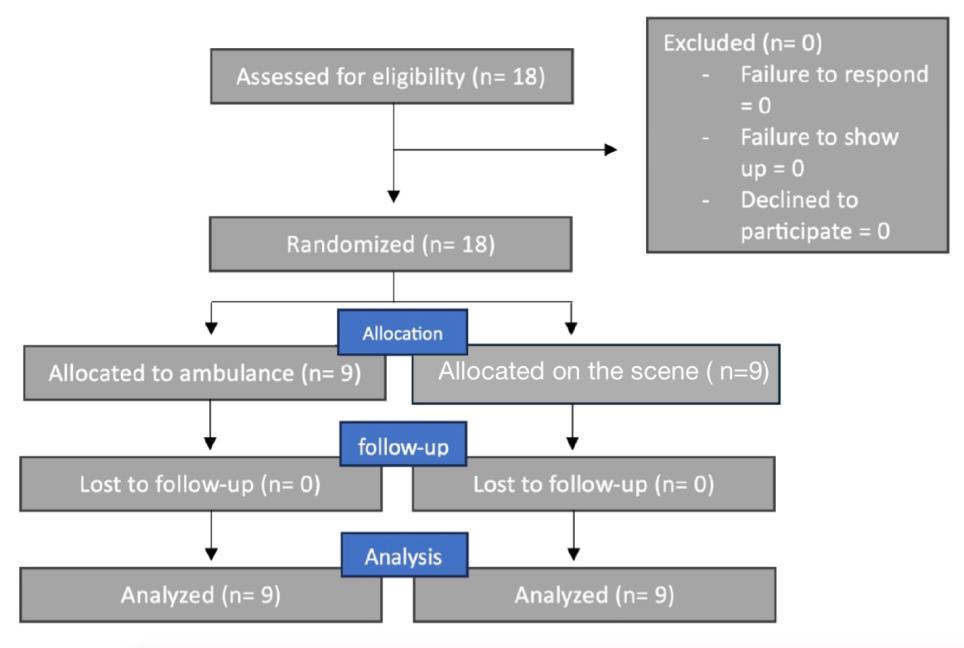
Study Design This randomised crossover manikin study com- pares the quality of cardiopulmonary resuscita- tion (CPR) performed at the scene with that per- formed during transport. The study was con- ducted in a tertiary hospital in Saudi Arabia, and employed a Little Anne CPR manikin as a simu- lated arrested patient.
Study Population The study participants were healthcare providers from the study hospital, including nurses, emer- gency medicine residents and paramedics with CPR training and basic life support (BLS) certifi- cation. A total of 18 individuals were selected: 13 males and 5 females, over the age of 18 years. Par- ticipants were invited via WhatsApp messages and in-person invitations during hospital shifts. Pregnant women, individuals who were hesitant
to participate, and those who had medical ill- nesses with physical limitations that could hinder their ability to perform adequate CPR were ex- cluded from the study. All participants provided informed consent before enrolling in the study.
Study Setting The study participants underwent two sessions with the same scenario, manikin, and duration, but in different environments (on the scene and in the ambulance). At the beginning of the study, they were blinded with regard to the environment in which they would begin. The authors conducted the recruitment, enrol- ment, and randomisation processes. Due to the in- herent characteristics of the manikin-based CPR simulation, it was impossible to completely blind the participants and those conducting the inter- ventions. The participants were aware of the sim- ulated environment, and complete concealment was impracticable due to the dissimilar settings of a hospital and an ambulance. To reduce the effect of awareness-induced biases in the participants, thorough measures were taken to ensure that instructions and procedures were consistent across both scenarios. Moreover, dur- ing the study, the assessment team tasked with gathering and analysing data remained blinded re- garding the initial intervention allocations of the participants. This methodology aimed to reduce observer bias and preserve the integrity of the crossover RCT structure, thereby enabling a rig- orous comparison of CPR performance among participants in both on-the-scene and ambulance conditions. The Little Anne CPR manikin was selected as a simulated arrested patient as this manikin is de- signed to closely resemble the anatomy of an adult, enabling trainees to practice CPR tech- niques using accurate anatomical landmarks with effective training feedback from the manikin, such as a chest raise after correct ventilations. Moreover, it is linked to the QCPR mobile appli- cation which provides feedback and guidance on the quality of CPR performed on the manikin. The Little Anne CPR manikin was fitted with ad- vanced sensors that captured and documented real-time data related to chest compression depth, rate, recoil, and ventilation parameters.
The manikin was positioned on a standard hospi- tal bed during the on-scene session. For the am- bulance session, it was secured to the ambulance bed. To simulate the scenario, the ambulance was driven at a speed comparable to that typically used during patient transport. The driver, with prior experience in patient transport, ensured a re- alistic and near-authentic simulation. A bag-valve mask was used for ventilation during CPR com- pressions, with a chest compression-to-ventila- tion ratio of 30:2 for both groups.
On the Scene Session During the on-scene phase, participants per- formed the CPR session in the Emergency De- partment of the study hospital for five minutes, within a controlled environment simulating a con- ventional resuscitation chamber. They followed standardised protocols for an on-scene cardiac ar- rest scenario.
Rest Period Participants were granted a one-hour rest period between the first and second sessions, to avoid any potential effects of fatigue. During this desig- nated time, participants were permitted to relax in a comfortable setting without engaging in any form of physical activity.
Ambulance Session The participants were transferred to the ambu- lance simulation and instructed to perform CPR for five minutes, on the same Little Anne mani- kin, during the simulated ambulance transport. CPR was conducted on the ambulance bed. The simulation vehicle was outfitted with motion technology to accurately reproduce the practical complexities and ever-changing circumstances of ambulance transport.
Environmental Controls Strict control measures were implemented in the on-scene environment to ensure uniformity and a standardised resuscitation setting throughout all sessions. To accurately simulate the interior of a real ambulance, the vehicle was configured in a such a way as to emphasise motion dynamics.
Simulation Configuration and Data Collection Compression parameters were collected through the QCPR application, a mobile application de- signed to provide feedback and direction on the
quality of CPR performance. It connects with sen- sors fitted to CPR training manikins to assess dif- ferent CPR elements such as compression depth, rate, recoil, and ventilation, enhancing the effec- tiveness of CPR training by providing immediate, objective feedback on technique. This application provides real-time data which is collected and analysed by the investigators to compare performance between on-scene and in- transport CPR.
Sample Size The sample size for our study was determined us- ing the Sample Size Calculator for Crossover De- sign, made available to us by the Biostatistics Center at Harvard University (http://hed- wig.mgh.harvard.edu/sample_size/js/js_crosso- ver_quant.html). 18 participants were required to detect a 10-unit difference, with 80% power and a 0.25 significance level. This calculation as- sumes a standard deviation of 10 for the response variable among participants, with the standard de- viation of the difference remaining undefined [15]. The selected sample size provides sufficient sta- tistical power to identify the hypothesised differ- ence, considering the participants’ variability and the intended level of statistical significance. The collected data was transferred to an Excel spreadsheet, and SPSS software was used for all processing of the exported, coded Excel data.
Table of variables Continuous data is presented as mean or median if not normally distributed. Nominal data is given as a percentage. Qualitative data is provided as mean and standard deviation if it is normally dis- tributed, or median and range if it is not normally distributed. For comparison between different groups, a t- test was used. All tests were 2-sided at a p-value of 0.05.
18 participants were enrolled in our study, all of whom participated in both arms. The number of females was 5 (28%). The mean score for quality of CPR was 52.94% in the ambulance versus 53.25% on the scene. We used a t-test to evaluate the quality of CPR in the ambulance versus on the scene. The findings were not statistically signifi- cant; [M = 0.52, SD = 0.26, (95% CI 0.40 to 0.66)]
and [M = 0.53, SD = 0.25, (95% CI 0.41 to 0.66)]; t (34) = -0.033, p = 0.97. The flow fraction for CPR performed in the am- bulance was 55.94%, versus 55.6% on the scene; thus, it did not differ significantly between the two settings; [M=0.56, SD=0.09, (95% CI 0.511 to 0.61)] and [M=0.56, SD=0.10, (95% CI 0.50 to 0.60)]; t (34) =0.10, p=0.92. A comparison of the other CPR parameters is il- lustrated in Table 1. The statistical analysis of CPR parameters is illustrated in Table 2.
Influence of gender on effectiveness of CPR We investigated the influence of gender on sev- eral CPR parameters, as illustrated in Table 3. We noted that females performed less efficient CPR than males; this was evident upon investigating the flow fraction, compression score and ventila- tion score. However, the number of cycles per- formed, total number of compressions provided, and total number of compressions with good re- lease and good depth did not differ by gender (p>0.05).
According to our data, the percentage of partici- pants delivering high-quality CPR varied from 52.94% in the ambulance to 53.25% on the scene. Prior research suggests that the quality of CPR provided in the ambulance setting is comparable to that offered on-scene, which challenges the be- lief that chest compressions during transport are less effective [6,9]. Nonetheless, our results are consistent with one research study that shows no variation in the quality of chest compressions (CC), including the mean CC rate, mean CC depth, and mean CC fraction in the ambulance compared versus on the scene [4]. Gender disparities in many aspects of healthcare have been well-documented, including differ- ences in treatment outcomes and access to medi- cal care. These variations extend to the realm of CPR, as proven by a study emphasising the vary- ing efficiency of male versus female CPR [16]. In our study, women performed less effective CPR than men; this is consistent with findings from other studies. This was apparent in the ventilation score, compression score, and flow fraction. Many studies have shown that men and women provide different OHCA care, which, in the raw data, results in a poorer prognosis for women
[17,18]. Our findings appear to corroborate this. It is important to note that gender disparities in CPR effectiveness may have various underlying factors, including differences in physical strength and training opportunities. CPR plays a critical role in the management of cardiac arrest, which is a life-threatening condi- tion requiring immediate intervention. Although manual CPR has been the standard approach for many years, recent studies have explored the use of mechanical CPR devices as an alternative. These devices, such as active compression-de- compression CPR, offer automated and consistent compressions, improving the quality and effec- tiveness of compressions during resuscitation ef- forts. While manual CPR requires active physical exertion by healthcare providers, mechanical CPR devices can deliver consistent compressions without fatigue. Machines have been demon- strated to follow the criteria and recommenda- tions of organisations such as the European Re- suscitation Council more closely than manual CPR, especially when administered during trans- fer on a stretcher [12]. However, a prior system- atic review found insufficient information to sup- port or refute the use of mechanical CPR equip- ment in cases of OHCA and when assessing fac- tors such as compression depth, rate, recoil, hand position, and ventilation volume [19]. One study that contrasted the effectiveness of QCPR and conventional CPR training found that both tech- niques were equally effective when used on QCPR and conventional manikins [20].
Our study had some limitations that are important to address. We analysed a manikin model, rather than real patients, which may not accurately re- flect real-life situations. Additionally, the unequal gender distribution may impact the results, as the number of males participants was higher than that of females (13 vs. 5, respectively). Moreover, while we used the QCPR app to assess CPR qual- ity both on the scene and in the ambulance, its ef- fectiveness in a moving vehicle may be influ- enced by factors such as motion or external dis- turbances, potentially affecting the accuracy of the assessment.
As a recommendation, we suggest incorporating the use of the QCPR application to assess CPR quality both at the scene and in the ambulance. This tool has the potential to significantly enhance the quality of CPR, particularly during transport in a moving ambulance, thereby increasing the likelihood of high-quality CPR during patient transport. Furthermore, we recommend exploring the benefits of mechanical CPR, which may prove to be an effective method for maintaining high- quality CPR over prolonged periods, especially in cases of out-of-hospital cardiac arrest (OHCA) occurring in rural areas where access to timely ad- vanced care may be limited.
In the field of resuscitation, the assessment and improvement of CPR quality are crucial to in- creasing survival rates and improving patient out- comes. Several studies have examined the quality of CPR in different resuscitation locations, such as on the scene and in the ambulance. The results of our study show that the average quality of CPR is comparable between these two locations. This finding suggests that competent providers can de- liver excellent care regardless of the setting in which they perform CPR.
| Parameter | In the ambulance | On the scene |
|---|---|---|
| (mean) | (mean) | |
| Cycles performed | 30.33 (SD 5.8) | 31.55 (SD 2.89) |
| Total number of compressions | 336 (SD 57.3) | 315.61 (SD 38.66) |
| Compression score | 0.64 (SD 0.33) | 0.73 (SD 0.27) |
| Percentage of compressions | 92% | 90% |
| with good release | ||
| Percentage of compressions | 71.6% | 83.4% |
| with good depth | ||
| Total number of ventilations | 20.44 (SD 6.63) | 19 (SD 2.99) |
| Ventilation score | 0.84 (SD 0.13) | 0.92 (SD 0.09) |
| Percentage of ventilations with | 1 | 1 |
| good volume | ||
| Percentage of ventilations with | 0 | 0 |
| too-high volume |
| Compression score | ) M=0.64 (0.33), M=0.73 (0.27 | t(34)=-0.89 | p=0.37 |
|---|---|---|---|
| Percentage of compression | done with M=0.922 (0.16), M=0.90 | t(34)=0.42 | p=0.67 |
| good release | ) (0.14 | ||
| Percentage of compression | done with ) M=0.72 (0.38), M=0.83 (0.07 | t(34)=-1.02 | p=0.31 |
| good depth | |||
| Total number of ventilations | ) M=20.4 (6.63), M=19 (2.99 | t(34)=0.84 | p=0.41 |
| Ventilation score | ) M=0.84 (0.13), M=0.91 (0.09 | t(34)=-1.99 | p=0.054 |
| Table 3. CPR variables of male versus female participants. | |||
| Parameters | Male Female | Statistical | p-value |
| test | |||
| Overall CPR | M= 0.58, SD=0.22, M=0.39, SD=0.28, | t (34) | p=0.04 |
| 95%CI 0.49 to 0.67 95%CI 0.19 to 0.59 | =2.05 | ||
| Flow fraction | M=0.58, SD=0.07, M=0.49, SD=0.13, | t (34) | p=0.01 |
| 95% CI=0.55 to 0.61 95% CI= 0.40 to 0.59 | =2.53 | ||
| Cycles performed | M=31.46, SD=3.61, M=29.6, SD=6.47, | t (34) | p=0.28 |
| 95% CI= 24.97 to 30 95% CI=24.97 to 34.22 | =1.10 | ||
| Total number of | M=329.81, SD=44.6, M=315.6, SD=61.30, | t (34) | p=0.45 |
| compressions | 95% CI=311.79 to 95% CI=271.74 to | =0.77 | |
| 347.82 359.45 | |||
| Compression score | M=0.76, SD=0.24, M=0.49, SD=0.36, | t (34) | p=0.01 |
| 95%CI=0.66 to 0.86 95%CI=0.23 to 0.75 | =2.65 | ||
| Percentage of | M=0.88, SD=0.17, M=0.96, SD=0.07, | t (34) =- | p=0.16 |
| compression done with | 95%CI=0.82 to 0.95 95%CI= 0.92 to 1.02 | 1.43 | |
| good release | |||
| Percentage of | M=0.83, SD=0.31, M=0.63, SD=0.41, | t (34) | p=0.12 |
| compression done with | 95%CI=0.71 to 0.96 95%CI= 0.34 to 0.92 | =1.58 | |
| good depth | |||
| Total number of | M=20.5, SD=5.44, M=17.8, SD=3.74, | t (34) | P=0.17 |
| ventilations | 95%CI=18.26 to 22.66 95%CI=15.13 to 20.47 | =1.42 | |
| Ventilation score | M=0.91, SD=0.10, M=0.78, SD=0.12, | t (34) | P=0.003 |
| 95%CI= 0.87 to 0.96 95%CI= 0.70 to 0.87 | =3.14 | ||
| E il | M kh l d1996@ | il |
| Parameters | ) Mean (SD | Statistical | p-value |
|---|---|---|---|
| test | |||
| Cycles performed | M=30.33 (5.80), M=31.55 | t(34)=-0.79 | 0.42 = p |
| ) (2.89 | |||
| Total 3. CPR number variables of compressions of male versus female | M=336.11 (57.30), M=315.61 | t(34)=1.25 | p=0.22 |
| ) (38.66 | |||
| Compression score | ) M=0.64 (0.33), M=0.73 (0.27 | t(34)=-0.89 | p=0.37 |
| Percentage of compression done with | M=0.922 (0.16), M=0.90 | t(34)=0.42 | p=0.67 |
| good release | ) (0.14 | ||
| Percentage of compression done with | ) M=0.72 (0.38), M=0.83 (0.07 | t(34)=-1.02 | p=0.31 |
| good depth | |||
| Total number of ventilations | ) M=20.4 (6.63), M=19 (2.99 | t(34)=0.84 | p=0.41 |
| Ventilation score | ) M=0.84 (0.13), M=0.91 (0.09 | t(34)=-1.99 | p=0.054 |
| Parameters | Male | Female | Statistical | p-value |
|---|---|---|---|---|
| test | ||||
| Overall CPR | M= 0.58, SD=0.22, | M=0.39, SD=0.28, | t (34) | p=0.04 |
| 95%CI 0.49 to 0.67 | 95%CI 0.19 to 0.59 | =2.05 | ||
| Flow fraction | M=0.58, SD=0.07, | M=0.49, SD=0.13, | t (34) | p=0.01 |
| 95% CI=0.55 to 0.61 | 95% CI= 0.40 to 0.59 | =2.53 | ||
| Cycles performed | M=31.46, SD=3.61, | M=29.6, SD=6.47, | t (34) | p=0.28 |
| 95% CI= 24.97 to 30 | 95% CI=24.97 to 34.22 | =1.10 | ||
| Total number of | M=329.81, SD=44.6, | M=315.6, SD=61.30, | t (34) | p=0.45 |
| compressions | 95% CI=311.79 to | 95% CI=271.74 to | =0.77 | |
| 347.82 | 359.45 | |||
| Compression score | M=0.76, SD=0.24, | M=0.49, SD=0.36, | t (34) | p=0.01 |
| 95%CI=0.66 to 0.86 | 95%CI=0.23 to 0.75 | =2.65 | ||
| Percentage of | M=0.88, SD=0.17, | M=0.96, SD=0.07, | t (34) =- | p=0.16 |
| compression done with | 95%CI=0.82 to 0.95 | 95%CI= 0.92 to 1.02 | 1.43 | |
| good release | ||||
| Percentage of | M=0.83, SD=0.31, | M=0.63, SD=0.41, | t (34) | p=0.12 |
| compression done with | 95%CI=0.71 to 0.96 | 95%CI= 0.34 to 0.92 | =1.58 | |
| good depth | ||||
| Total number of | M=20.5, SD=5.44, | M=17.8, SD=3.74, | t (34) | P=0.17 |
| ventilations | 95%CI=18.26 to 22.66 | 95%CI=15.13 to 20.47 | =1.42 | |
| Ventilation score | M=0.91, SD=0.10, | M=0.78, SD=0.12, | t (34) | P=0.003 |
| 95%CI= 0.87 to 0.96 | 95%CI= 0.70 to 0.87 | =3.14 | ||
| E il M | kh l d1996@ | il |