Full text rendered from the published PDF. The PDF is the version of record; if the two differ, the PDF governs.
Background : Maternal near-miss is defined as a ‘woman who nearly died but survived a complication during pregnancy, childbirth or within 42 days of termination of pregnancy’. A sudden and unexpected event during pregnancy, childbirth, or even after delivery, is a risk that is faced by every pregnant woman.
Aim: This study aimed to establish the incidence of maternal near-misses, and to evaluate the clinical and epidemiological profile and causes of maternal near-miss.
Materials and Methods: This was an observational prospective study, conducted in Lalla Ded Hospital for a period of 18 months after obtaining ethical clearance. Women who fulfilled any of the WHO criteria for MNM were included in the study as maternal near-miss cases.
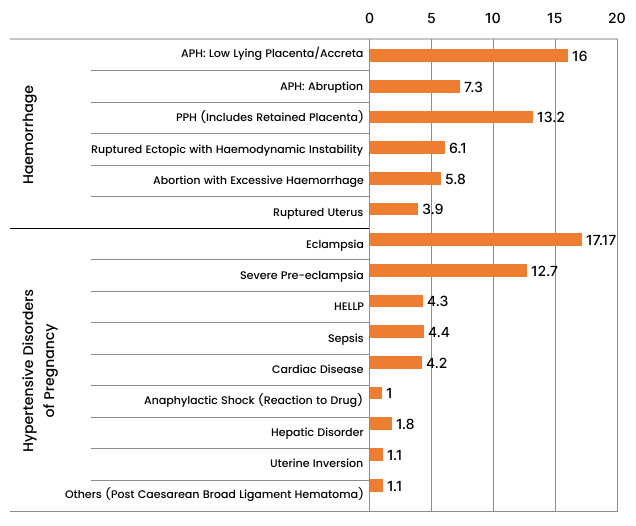
Results: The hospital witnessed 36,273 live births over the period of the study, of which 821 involved a near-miss. This equates to a MNM incidence ratio of 22.63 per 1000 live births. The mortality index in our study was 3.97%, and the near-miss to mortality ratio was 24.14:1. Haemorrhage was the leading cause of MNM (N=429 or 2.25%), followed by hypertensive disorders of pregnancy (N=280 or 34.10%). Anaemia was the most common associated factor and was present in 460 (56.03%)patients.
Conclusion: Early identification of risk factors for placenta accreta spectrum, hypertensive disorders of pregnancy, medical disorders complicating pregnancy, anaemia, previous Caesarean section, and multifoetal pregnancy, among others, and thereby prompt management of such conditions, plays a critical role in the optimal management of MNM.
Keywords: Maternal Near-Miss, Mortality, Pregnancy
Maternal mortality remains a significant chal- lenge in developing nations, and maternal near- miss (MNM), referring to cases in which a woman nearly dies but survives a severe compli- cation during pregnancy, childbirth, or within 42 days postpartum/ post-termination, serves as a crucial indicator of the quality of maternal healthcare [1]. The primary causes of MNM in- clude obstetric complications such as severe haemorrhage, hypertensive disorders such as pre- eclampsia and eclampsia, sepsis, obstructed la- bour, and pre-existing medical conditions such as heart disease, diabetes, and anaemia. Contrib- uting factors also include healthcare system defi- ciencies such as delayed access to care and inad- equate infrastructure [1]. The consequences of MNM are significant, ranging from immediate physical and psychological impacts on the mother to long-term health issues, social and eco- nomic burdens, and adverse neonatal outcomes. Prevention strategies focus on improving access to timely, skilled care, enhancing healthcare in- frastructure, raising community awareness, and implementing evidence-based guidelines [2]. Global statistics reveal disparities in MNM rates
between high- and low-income countries, under- scoring the need for targeted interventions. Cur- rent research highlights the importance of ongo- ing studies to address knowledge gaps and guide future policies aimed at reducing MNM and im- proving maternal health outcomes [2].
In 2009, the World Health Organization (WHO) defined maternal near miss as ‘a woman who nearly died but survived a complication during pregnancy, childbirth, or within 42 days of termi- nation of pregnancy’ [1]. The criteria for identi- fying MNM cases are categorised into clinical, laboratory, and management-based indicators that reflect the severity of complications during pregnancy, childbirth, or within 42 days postpar- tum. Clinically, MNM includes conditions such as severe pre-eclampsia with hypertension and organ dysfunction, eclampsia marked by convul- sions, severe postpartum haemorrhage with blood loss exceeding 1,000 ml, uterine rupture, and severe systemic infections such as sepsis. La- boratory-based criteria include severe acute anaemia with haemoglobin levels below 7 g/dl, coagulation disorders such as disseminated intra- vascular coagulation (DIC), and acidosis with a pH below 7.1. Management-based criteria in- clude the use of critical interventions such as blood transfusions, vasoactive drugs, hysterec- tomy, admission to an intensive care unit (ICU), prolonged hospitalisation due to severe compli- cations, mechanical ventilation for more than 12 hours, and dialysis for renal failure. These crite- ria help healthcare providers to effectively iden- tify and manage MNM cases, ultimately improv- ing maternal health outcomes.
India continues to grapple with alarmingly high maternal mortality rates, witnessing approxi- mately 120 maternal deaths per day [2]. A paper released by the WHO in 2015, titled ‘Trends in Maternal Mortality: 1990 to 2015’, draws esti- mates from various reputable sources such as the World Bank Group, United Nations Population Division, UNICEF, UNFPA, and WHO. Accord
ing to this publication, Nigeria and India collec- tively accounted for more than a third of global maternal deaths in 2015, with Nigeria recording approximately 58,000 deaths (19%) and India with 45,000 deaths (15%) [3]. Despite a decline in maternal mortality ratio (MMR), from 301 per 100,000 live births in 2001 to 167 per 100,000 in 2014, India failed to meet the target set by Millennium Development Goal (MDG)5 (MMR < 150/100,000 live births) [4,5]. The Sustainable Development Goals, particularly Goal 3 (target 3.1), aim to further reduce MMR to below 70/100,000 live births by 2030 [6]. Maternal near miss (MNM) remains a vital pub- lic health issue in India, with significant maternal mortality and morbidity rates, particularly in ru- ral and underserved areas. While the WHO’s cri- teria for MNM help identify life-threatening complications that women survive, the topic’s importance in India extends beyond these defini- tions. MNM highlights critical gaps in the healthcare system, such as delayed access to care, and reflects the challenges posed by poverty, gender inequality, and inadequate healthcare in- frastructure. Addressing MNM in India is essen- tial for improving maternal health outcomes, tar- geting interventions more effectively, and pro- moting broader socio-economic development by ensuring that every woman has access to the care she needs during pregnancy and childbirth. The majority of maternal deaths and disabilities are preventable, given the availability of established medical solutions. Sadly, 99% of maternal deaths occur in developing countries characterised by inadequate transport systems, limited access to skilled caregivers, and deficient emergency ob- stetric services [7].
This was an observational prospective study, conducted over a period of 18 months from Au- gust 2017 to February 2019. The study was con- ducted in the Department of Obstetrics and Gy- naecology at Lal Ded Hospital, Srinagar. Lalla
Ded is a 700-bed tertiary care maternity hospital associated with Govt. Medical College, Srinagar, and is known to cater to hundreds of thousands of patients annually. After obtaining proper in- formed consent, data were collected from those patients who experienced MNM events during their hospital stay or upon admission, using a proforma survey questionnaire. Characteristics including the patient’s age, parity, gestational age at the time of near-miss, type of admission, booking status, and interventions taken to save the life of the patient, were noted. Details of in- vestigations undertaken for anaemia, septicae- mia, organ system dysfunction/failure, etc., were collected from the patient’s case records. The mode of delivery and foetal outcome were also noted. Women who fulfilled any of the WHO cri- teria for MNM were considered eligible for this study as maternal near-miss cases.
The selection criteria included women aged 15- 49, who were currently pregnant, post-partum, or had been pregnant within the past 42 days, and who had experienced severe complications dur- ing any of the abovementioned stages. The study specifically targeted those who had survived se- vere complications such as haemorrhage, hyper- tensive disorders, sepsis, or other conditions that meet the World Health Organization’s maternal near-miss (MNM) criteria, including those re- quiring intensive care or specialised interven- tions. Conversely, the exclusion criteria elimi- nated women who were not pregnant and had not been pregnant within the past 42 days, those without recent pregnancy-related complications,
as well as cases that did not meet the MNM se- verity threshold. Also excluded were participants with incomplete records that failed to confirm their MNM status, as well as non-survivors, as the focus was solely on survivors.
Data Analysis
To correct any errors, the data were first entered into a Microsoft Excel spreadsheet and examined thoroughly. IBM Corporation’s SPSS Statistics for Windows (Version 27.0, released in 2020, Armonk, NY, USA) was used for statistical anal- ysis, and frequencies and percentages were used to represent categorical variables.
Ethics
The study was conducted according to the insti- tutional ethics committee guidelines, and proper ethical clearance was obtained from the Ethical Committee of Government Medical College Sri- nagar (IRBGMC/Gynae).
The total number of live births during the study period was 36,273, of which 821 involved near- miss cases. There were also 34 maternal deaths in the hospital during the same period. Our study revealed a maternal near-miss inci- dence ratio of 22.63 per 1000 live births, a ma- ternal mortality index of 3.97%, and a near-miss to mortality ratio of 24.14:1.The median age of near-miss patients was 29 years (18-37), with the majority of patients aged between 20-35 years. Most of the patients (N=427;52%) were parity 1- 2, and 319 (38.9%) were nullipara (Table 1).
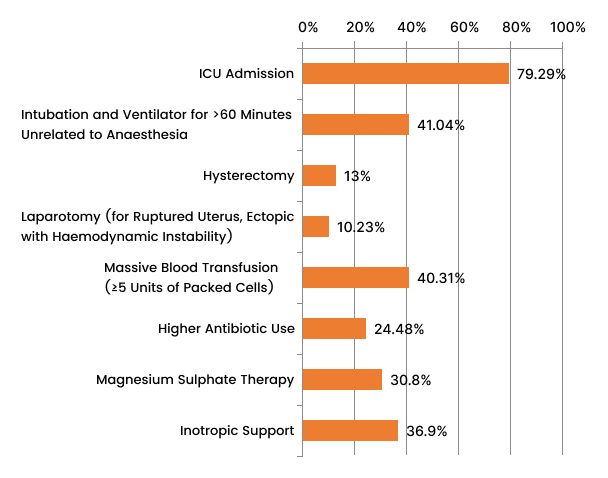
The majority of the patients were near-miss upon arrival at the hospital (N=468;57%), while al- most 337 (41.05%) were admitted with a disorder and became near-miss. Only 16 patients (1.95%) became near-miss having been admitted without any disorder. Most of the near-miss patients (N=651;79.29%)required admission to the hospi- tal’sIntensive Care Unit (ICU), while other near- misses were managed in the High Dependency Ward (HDW) or High-Risk Ward. The mean du- ration of hospital stay for near-miss patients was 14 days, and the majority of those requiring ICU
admission (N=537;65.4%) remained there for longer than 24 hours. Eighty-seven out of 821 near-miss patients did not seek antenatal care (ANC), the most common reason being the sud- den onset of disease such as ectopic pregnancy, or abortion. Other reasons were obstacles to healthcare access due to living in difficult areas, and lack of awareness or of an attendant (Table 2). However, the majority of near-miss patients (N=700;85.26%) did receive ANC from a medi- cal officer/ specialist.
hospitals. Healthcare personnel should be sensi- tised to obstetric emergencies and refer promptly when necessary. Funding: Not applicable (no funding received). Acknowledgements: None. Conflict of Interest: The authors have no con- flicts of interest to declare.
| Age (Years) | N | % |
|---|---|---|
| <20 | 58 | 7.06 |
| 20-35 | 623 | 75.88 |
| >35 | 140 | 17.05 |
| Parity | ||
| 0 (nullipara) | 319 | 38.9 |
| 1-2 | 427 | 52 |
| 3-4 | 45 | 5.5 |
| >5 | 30 | 3.7 |
| E-mail: fizamink@gmail.com | ||
| Gestational Age | ||
| <13 Weeks | 101 | 12.3 |
| 13-28 Weeks | 66 | 8.04 |
| >28 Weeks | 531 | 64.68 |
| Postpartum | 123 | 14.98 |
| Type of Admission | ||
| Self | 205 | 24.97 |
| Referred | 616 | 75.03 |
| Of Referred | ||
| Transport provided | 493 | 80.03 |
| Attended by staff | 147 | 23.86 |
| Severity | ||
| Needed ICU admission | 651 | 79.29 |
| Needed HDW/ High-risk | ward 170 | 20.71 |
| Hospital Stay | ||
| <10 Days | 156 | 19 |
| 10-20 Days | 608 | 74.06 |
| >20 Days | 57 | 6.94 |
| ICU Stay (of total near-misses) | ||
| >24 Hours | 537 | 65.4 |
| <24 Hours | 114 | 13.9 |
| Antenatal Care | ||
| Received antenatal care | 734 | 89.4 |
| Did not receive antenatal | care 87 | 10.59 |
| The third trimester poses the | highest risk for tions. About | 123 (14.98%) were post-partum at |
| pregnant women to experience | life-threatening the time | of near-miss. Haemorrhage (N=429; |
| situations, and most of our participants | (N=531; 52.25%), | followed by hypertensive disorders of |
| 64.68%) were indeed beyond | 28 weeks gestation pregnancy | (N=280; 34.10%), were the leading |
| when they suffered | near-miss condi causes of | MNM in our study (Figure 1). |
| ReasonANC not sought N | % of those not receiving ANC % of total near- |
|---|---|
| misses | |
| Lack of awareness 11 | 12.64 1.33 |
| Lack of attendant 3 | 3.45 0.36 |
| Obstacles to access 10 | 11.49 1.21 |
| (living on hilly terrain, difficult areas) | |
| Sudden onset of disease 63 | 72.41 7.67 |
| (ectopic, abortion) | |
| Total patients who did not receive ANC 87 | 100 10.59 |
| About 249 (30.33%) MNM patients were illit- | (41.04%) were intubated. Massive blood transfu- |
| erate. Anaemia (N=460; 56.03%) was found to | sion was required by 331 (40.31%) of the pa- |
| be the most common indirect factor associated | tients, while 303 (36.9%) needed inotropic sup- |
| with MNM, followed by previous Caesarean sec- | port. A total of 253 patients (30.8%) required |
| tion (N=331; 40.32%). A total of 651 (79.29%) | magnesium sulfate therapy for hypertension |
| MNM patients were admitted to ICU, and 337 | (Figure 2). |
| Figure 2. Distribution of patients | according to management. |
| E-mail: fizamink@gmail.com | |
| Our study found that haematology/coagulation | quality of care. Conversely, a lower index indi- |
| was the most affected system in MNM patients | cates fewer deaths among women with life- |
| (N=207; 25.21%). Most near-miss patients deliv- | threatening conditions, suggesting better quality |
| ered by Caesarean section 497 (60.53%), and | of care. In our study, the mortality index was cal- |
| most had live births 590 (71,86%). | culated as 3.97%, indicating a better quality of |
| care compared with studies conducted by Taher | |
| IV. DISCUSSION | et al. in Egypt (MI = 8.6%) [15], El-Agwany et |
| This study presents an examination of cases of | al. in Egypt (MI = 7.5%) [16], and Roopa et al. |
| maternal near-miss based on prospective data | in Karnataka, India (MI = 14.9%) [17]. |
| from a tertiary care facility in Srinagar, Jammu | Our study identified obstetric haemorrhage as the |
| and Kashmir. Near-miss cases were identified ac- | leading cause of potentially life-threatening con- |
| cording to the MNM criteria provided by the | ditions and near-miss cases, accounting for |
| WHO (2009). The MNM incidence ratio calcu- | 52.25% of cases, followed by hypertensive disor- |
| lated in our study was 22.63 per 1000 live births; | ders of pregnancy at 34.10%. Similar trends have |
| this aligns with findings from other studies in de- | been observed in various other studies. Norhayati |
| veloping countries, which range from 15 to 40 | et al. reported comparable results in their study |
| per 1000 live births [8]. Kamal et al. reported a | conducted in Malaysia [18], and a study by |
| similar near-miss incidence ratio of 24 per 1000 | El‑Agwany et al.in Egypt yielded similar find- |
| live births in their study conducted at a tertiary | ings [16]. Numerous studies in India have also |
| care medical college in Jharkhand, India [8]. | demonstrated consistent results [19, 20]. |
| Similarly, Naderi et al. found a comparable inci- | In contrast, a study conducted in Syria identified |
| dence ratio of 25.2 per 1000 live births in their | hypertensive disorders of pregnancy as the pri- |
| study in Iran [9]. | mary cause of near-miss cases (52%), followed |
| The near-miss to mortality ratio in our study was | by obstetric haemorrhage. Another study in Ethi- |
| 24.14:1, indicating that for every 24 to 25 occur- | opia highlighted obstructed labour (45%) as the |
| rences of a life-threatening condition, one mater- | predominant cause, followed by haemorrhage |
| nal death occurred. Studies conducted in Nepal | [13, 21]. |
| and southern India reported ratios of 7.2:1 and | Indirect causes, often overlooked, also play a sig- |
| 5.34:1 respectively, while a study in Maharash- | nificant role in MNM cases. In our study, anae- |
| tra, India, reported a ratio of 14.2:1. Higher ratios | mia was identified as the most common indirect |
| are indicative of better care; thus, our ratio is su- | cause, affecting nearly 460 women (56.03%). |
| perior to those reported in the aforementioned | Similar findings were reported by Tallapureddy |
| studies. Conversely, a Syrian study showed a bet- | et al. [11] and Sarma et al. [22] in their respective |
| ter ratio than ours, of 60:1. However, these fig- | studies. Additionally, the majority of our patients |
| ures all pale in comparison to those reported in | (52%) had parity between 1 and 2, aligning with |
| Western Europe, where ratios between 117– | findings from a study conducted in Jharkhand, |
| 223:1 have been observed, possibly due to better | India [23]. |
| available health care [10–14]. | In our study, a majority of near-miss patients |
| The maternal mortality index (MI) serves as a re- | were multiparous (61.2%), while 38.9% were |
| liable indicator of healthcare quality within an in- | nulliparous. Similar results were reported by Ku- |
| stitution [MI = MD / (MNM + MD)]. A higher | rugodiyavar et al. in their study in Karnataka, In- |
| index suggests more deaths among women with | dia, and by Ranatunga et al. from Sri Lanka |
| life-threatening conditions, indicating lower | [24,25]. |
| The third trimester of pregnancy poses the high- | similar percentage of patients being near-miss |
| est risk for potentially life-threatening situations | cases upon arrival at their hospital [8]. |
| in pregnant women. In our study, 64.68% of near | A multidisciplinary approach to ICU manage- |
| misses occurred after 28 weeks of gestation, fol- | ment, involving obstetricians, intensivists, and |
| lowed by the postpartum period at 14.98%. Sim- | anaesthesiologists, is crucial for saving maternal |
| ilar findings were reported in a study by Gazala | lives. In our study, 79.29% of MNM patients re- |
| et al. [26]. | quired ICU care, a finding echoed in many other |
| A significant majority of MNM cases (60.53%) | studies [8, 26]. |
| underwent delivery by Caesarean section, likely | Social factors, such as a lack of financial re- |
| due to the severity of their obstetric conditions | sources, lack of awareness, and, occasionally, |
| necessitating urgent intervention. This finding | lack of attendants, were found to influence near- |
| aligns with those of Umadevi et al. [27]. How- | miss incidents in our study. At the administrative |
| ever, internationally, studies have noted an asso- | level, issues such as inadequate transport, short- |
| ciation between the increasing incidence of pla- | ages of blood and blood products, and lack of sur- |
| centa previa and accreta with rising Caesarean | geons and operating rooms at referral centres ad- |
| delivery rates and previous Caesarean sections, | versely affected near-miss occurrences. Address- |
| potentially leading to complications such as near- | ing these challenges promptly is essential to the |
| miss incidents [28, 29]. Therefore, while Caesar- | development of an effective maternal healthcare |
| ean section may save patients in near-miss situa- | system. |
| tions, it also presents risks such as accreta, which | The strengths of this study include the use of |
| can lead to near-miss incidents in future pregnan- | standardised WHO criteria andthe inclusion of |
| cies, making Caesarean section a double-edged | diverse participants, while its limitations involve |
| sword. | potential selection bias, incomplete data, varia- |
| In our study, the haematological system was the | bility in healthcare quality, and challenges asso- |
| most commonly affected (25.21%), followed by | ciated with prospective analysis. |
| the renal (17.78%) and respiratory (12.79%) sys- | V. CONCLUSION |
| tems. A study by Ismail et al.in Egypt [15] also | |
| showed haematology as the most commonly af- | Effective management of MNM is a robust indi- |
| fected system in near-miss cases, consistent with | cator of the quality of a state’s healthcare system. |
| our findings. | Haemorrhage and hypertensive disorders were |
| A substantial portion of near-miss patients | the leading causes of MNM events in our study |
| (75.03%) were referred to our hospital from sur- | population. Only prompt and appropriate inter- |
| rounding areas, similar to findings in other stud- | vention can avert the catastrophe of death in such |
| ies [26, 30]. Additionally, 65.7% of near-miss pa- | patients; hence, an ICU with appropriate bed |
| tients in our study were unbooked, a trend seen | strength, as recommended by MCI, is essential in |
| in studies conducted by Bindal et al. [20] and | every obstetrics and gynaecology hospital. More- |
| Kamal et al. [8]in India. | over, the fact that the majority of near-miss cas- |
| Upon arrival at our hospital, 57% of patients | esin our study occurred before the patients’ arri- |
| were near-miss cases while almost 337 (41.05%) | val at the hospital, underscores the importance of |
| were admitted with a disorder and became near- | eliminating pre-hospital barriers. This can be |
| miss. Only 16 patients (1.95%) became near- | achieved by improving the overall healthcare |
| miss having been admitted without any disorder. | system, from the level of primary health centre, |
| In line with our findings, Kamal et al. reported a | through sub-district hospitals, and up to district |