Full text rendered from the published PDF. The PDF is the version of record; if the two differ, the PDF governs.
Background : Prostitutes are at high risk of unintended pregnancy, and induced abortions are widely practised among this cohort. Aims : This study examined the effects of prostitution bans on the prevalence of induced abortions. We focused particularly on the bans on juvenile prostitution, which were introduced by 32 states of Japan between 1975 and 1998. Methods : This was a cross-sectional study employing event-study analyses and a difference-in-difference-in-differences methodology. We compared the changes in numbers of induced abortions before and after the bans were introduced, among women under 20 years of age and among those aged 20―24 years, over states. Results : The number of induced abortions among women under 20 years of age increased after the juvenile prostitution bans were implemented. In the fifth year of implementation, the number increased by 56.79 percentage points (p < 0.001) compared with the previous year. Conclusion : The number of induced abortions among adolescents increased after juvenile prostitution was banned. As to its mechanism, the outcomes of our additional identification suggest that former juvenile prostitutes who retired due to the bans contributed to the increase.
Keywords: Induced Abortion, Juvenile Prostitutes, Prostitution
Prostitutes are at high risk of unintended pregnancy, and induced abortions are widely practised among this population [1-4]. Pregnant prostitutes are usu- ally forced to obtain induced abortions, which, in the event of unsafe abortions, can result in negative out- comes or even death [5]. According to WHO, Takahide Kobayashi (t.kobayashi.io@juntendo.ac.jp) and Hiroyuki Kobayashi (koba@juntendo.ac.jp) are with the Grad- uate School of Medicine, Juntendo University, Tokyo, Japan. DOI: 10.52609/jmlph.v5i2.167
between 13,685 and 38,940 lives are lost annually due to failure to provide safe abortions, with more individuals experiencing serious morbidities [6]. To protect the reproductive health of prostitutes, governments can reduce unintended pregnancy among them by implementing prostitution bans. Given that these bans should reduce the frequency of sexual intercourse between prostitutes and their clients, unintended pregnancies, as well as the re- sulting induced abortions, would become less prev- alent in this group. However, it remains uncertain whether prostitution bans do effectively reduce the frequency of paid sex between prostitutes and their clients. It might be the case that such bans do not reduce prostitution, but only make it less visible. When Sweden criminalised the purchase of sex in 1999, although the number of female sex workers working visibly on the streets decreased, it was sug- gested that both female sex workers and their cus- tomers had simply chosen less visible ways of mak- ing contact [7]. This study identifies the effects of prostitution bans on the prevalence of induced abortions. It is gener- ally difficult to conduct such identification, largely for three reasons. First, research into prostitution fre- quently faces a scarcity of empirical evidence be- cause of the discrete nature of the business [8]. As to the Swedish case, researchers found little empirical evidence suggesting that prostitution really went un- derground [9]. Second, women are known to under- report abortions in surveys [10]. Prostitutes may do this particularly in an interview situation because in- duced abortion is a traumatic experience for them [11]. Third, we have only a small number of exam- ples of prostitution bans at the country level. To the best of our knowledge, there are only seven coun- tries that have introduced such bans in the last 30 years (Sweden, South Korea, Norway, Iceland, Can- ada, France, and Ireland) [12-14]. These countries are not the best examples for comparative analyses,
because they differ in factors associated with the prevalence of induced abortions, such as race, cul- ture, and legal regulations. To overcome these difficulties, we use objective data to examine the effects of state-level interventions. First, to secure an adequate sample size, we focus on Japan's juvenile prostitution bans at the state level. All of the country’s 47 states (prefectures) enacted, at a different point in time, an ordinance criminalising the purchase of sex from any person under 18 years of age (a ‘juvenile’). The first state introduced the ban in 1952, and the last state in 2016. We thus have a relatively large sample size com- pared with those at the country level. In addition, we use objective data to estimate the effects of the crim- inalisation on the prevalence of induced abortions. This approach enables us to address the scarcity of empirical evidence related to prostitution and the suspicions over reliability of information about abortions obtained through interviews. In particular, we use data from Japan's official statistics on in- duced abortions. These are based on information that doctors are required, by law, to submit to a state gov- ernor.
Difference-in-difference-in-differences methodology To estimate the effects of the juvenile prostitution bans, we employ the difference-in-difference-in-dif- ferences (‘triple-difference’) methodology. Our tri- ple-difference analysis compares changes in the number of induced abortions among people under 20 years of age (‘minors’) and among those between 20 and 24 years of age, over states. Our identification is based on the common-trend assumption that the numbers of induced abortions in the absence of a ban would all follow the same trend. This assumption can be violated when unobserved heterogeneity ex- ists between states in trends of induced abortions. In this regard, we use triple-differences analysis to con- trol for state-specific trends. The two adjacent age-groups have a number of sim- ilarities; this allows us to assume the same trends in prevalence of induced abortions in the absence of any intervention affecting either group.
In this regard, our specification can effectively ac- count for different dynamics of outcomes across states. Event-study analysis We use an event-study analysis to identify the dynamic effects of the bans. Our event-study equa- tion is as follows:
T
ln(Y a,i,t ) = α Minor i,t + ∑ β t
Time i,t
t=−P
+ ∑ γ t (Minor i,t ∗ Time i,t ) T
(1)
t=−P + vZ + FE t + μ a,i,t
where ln(Y a,i,t ) is the logarithm of the number of in- duced abortions performed to age-group a (under 20 or 20-24 years of age) in state i in year t (per 1,000 population); Minor i,t is a dummy variable equal to one if the number is of induced abortions performed to minors; Time i,t is a dummy variable identifying the distance of year t from the year in which the ban was implemented in state i (The estimation window is from the year -5 to the year 5, and the year -1 is the baseline omitted period.). Z is a vector of control variables. We use year-fixed effects FE t to control for time-invariant shocks, whereas state fixed effects are not included due to collinearity. Standard errors are clustered at the year level. The parameter of interest is γ t . The coefficients { γ 1 ,. . . , γ 5 } identify dynamic effects of the ban on changes in the number of induced abortions among minors relative to the number among people be- tween 20 and 24 years of age, compared with states which have not yet introduced it. Target period The study focuses on induced abortions performed between 1975 and 1998, for the following reasons. First, the statistical data are not available for our control variables prior to 1975. Second, Japan im- plemented the juvenile prostitution ban at the coun- try level in 1999. We therefore need to omit data from 1999 and later to exclude the impact of the na- tional ban from our estimation. Out of Japan’s 47 states, 32 introduced the juvenile prostitution ban within the target period. Dependent variables Data on induced abortions were obtained from
the ‘Report on Maternal Health’, a statistical report covering induced abortions and sterilisation. This re- port has been published annually by the Japan’s Ministry of Health, Labour and Welfare since 1970. Specifically, we use the annual numbers of induced abortions by state and by age-group. The report in- cludes data for eight age-groups: under 20, 20-24, 25-29, 30-34, 35-39, 40-44, 45-49, and over 50 years of age. We abstracted the data of two age-groups, under 20 and 20-24 years of age, and created a da- taset covering each of the 32 states. Independent variables Municipal data were obtained from the state govern- ments. We asked all 32 state governments, by email, for the dates of implementation of their bans, and all of them provided the requested information. Control variables We include six variables which extant research
commonly suggests influence women's decisions to obtain an induced abortion: poverty, educational sta- tus of women, relationship problems, maternal and foetal health, and accessibility to abortion facilities [15-21]. Data on these variables were obtained from the Regional Statistics Database, which has been up- dated annually by Japan’s Ministry of Internal Af- fairs and Communications since 1975. Summary statistics Table 1 provides a summary of statistics and descrip- tion of variables. Panel A presents the dependent variables, the numbers of induced abortions per- formed in the two age-groups (per 1,000 population) and their logarithm. Panel B shows the year of crim- inalisation at state level, used as independent varia- bles in our specification. Lastly, Panel C presents the six control variables included in our estimation.
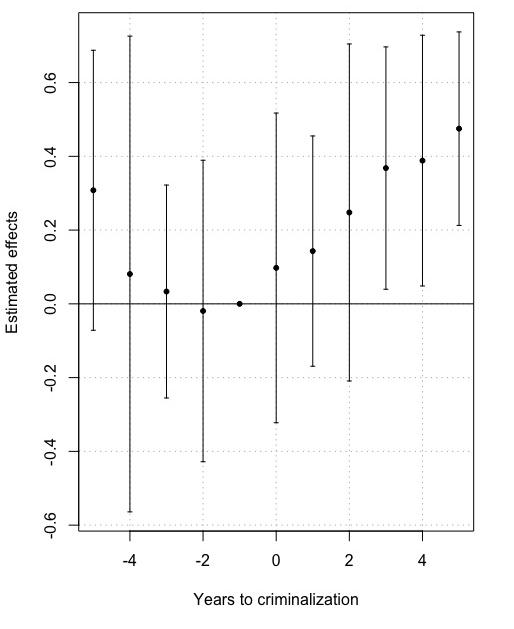
5, the number of induced abortions among minors relative to women aged 20-24 increased by 56.79 percentage points (p < 0.001), compared with year 1. Furthermore, Figure 1 shows the absence of pre- trends in changes to the number of induced abortions among minors. The coefficients prior to criminalisa- tion (excluding year -1) { γ −5 , . . . , γ −2 } are distrib- uted over both positive and negative and are not sta- tistically significant. The result suggests that the tim- ing of criminalisation is exogenous to changes in the number of induced abortions among minors.
use are consistently lower with emotional (non-pay- ing) partners than with paying clients [23]. Thus, it might be the case that juvenile prostitutes who quit prostitution following the bans had more frequent unprotected sex with emotional partners, resulting in a greater prevalence of unintended pregnancy and therefore abortions in this group after the bans were implemented. Methods and data To examine the potential mechanism, we conducted additional identification. More specifically, we esti- mated the effects of the bans on changes in the number of deliveries by minors. If more retired ju- venile prostitutes became pregnant through unpro- tected sex with emotional partners, it follows that the number of deliveries would increase alongside the number of induced abortions. That is because some would choose to terminate their pregnancies while others would choose to have a child with their emo- tional partner. On the other hand, if more active prostitutes fell pregnant due to unprotected sex with paying clients, the number of deliveries would not change because they are usually forced to obtain an induced abortion [5].
We conducted an event-study analysis to identify the dynamic effects, using the following equation:
T
ln(Y a,i,t ) = δ Minor i,t + ∑ ε t
Time i,t
t=−P
+ ∑ ζ t (Minor i,t ∗ Time i,t ) T
(2)
t=−P + vZ + FE t + μ a,i,t
where ln(Y a,i,t ) is the logarithm of the number of de- liveries in age-group a (under 20 or 20-24 years of age) in state i in year t (per 1,000 population). Year fixed effects FE t are included, whereas state fixed effects are not, due to collinearity. The parameters of interest are { ζ t } . Standard errors are clustered at the year level. Table 2 provides a summary of statistics and descrip- tion of variables. Panel A presents the dependent variables, and Panel B the control variables. Our control variables are population density, age, mar- riage and divorce rates, age at first marriage for women, poverty, educational status of women, la- bour force participation of women, and infant and child mortality [24-28]. All data were obtained from the Regional Statistics Database.
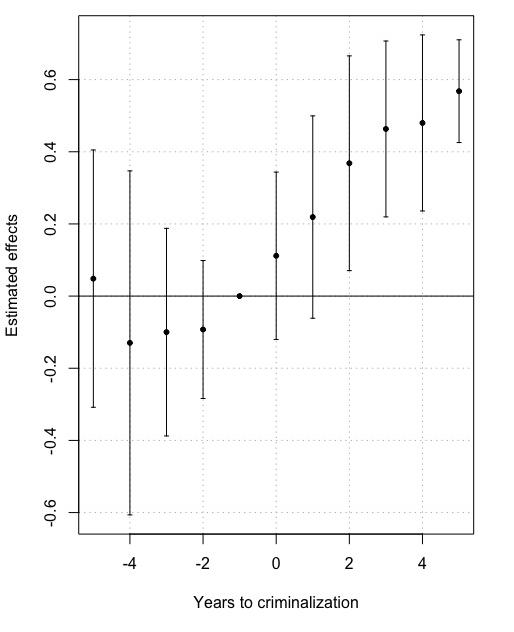
the first two { ζ 1 , ζ 2 } are not. In year 5, the number of deliveries among minors relative to people aged 20-24 increased by 47.50 percentage points (p < 0.01), compared with year -1.
Moreover, the coefficients in the pre-event periods, except for year -1, { ζ −5 , . . . , ζ −2 } are distributed over both positive and negative, and statistically insignif- icant. They show that no pre-trends exist.
This study focuses on the impacts of Japan's state- level bans on juvenile prostitution on the prevalence of induced abortions. The outcomes of our baseline specification show that the number of induced abor- tions among minors relative to people aged 20-24 years significantly increased after the bans were im- plemented. As to the mechanism, the results of our additional event-study analysis show that the num- ber of deliveries by minors relative to people aged 20-24 also significantly increased in the post-event periods. These findings suggest that active juvenile prostitutes would not have contributed to the in- crease; had unintended pregnancy become more prevalent among this group, the number of deliver- ies would not have increased concurrently, because such pregnancies usually result in forced termina- tion [5]. It is suggested that former juvenile prosti- tutes, who quit prostitution due to the bans, contrib- uted to the increase in induced abortions. After leav- ing the industry, they would no longer participate in paid sex with clients, and instead have unprotected sex with their emotional partners more frequently [see 23]. Unintended pregnancy and the resulting in- duced abortions would consequently become more prevalent among this group. To the best of our knowledge, this is the first study that empirically estimates the effects of prostitution bans on the prevalence of induced abortions. The re- sults of our baseline specification reveal a signifi- cant increase in induced abortions after the bans were implemented. Moreover, given the suggested mechanism, our findings could be evidence that the criminalisation of paid sex does effectively reduce prostitution. Although it has been argued whether such bans deter prostitution, there has been no evi- dence to support the argument either way [7, 29]. However, assuming the mechanism, it could be said that, due to the bans, some active juvenile prostitutes ceased their engagement in prostitution. In this re- gard, the bans could be a solution for prostitution as a social problem, even if they might contribute to the increase in induced abortions. As a policy implication, prostitution bans should be accompanied by appropriate support for retiring
prostitutes. The study suggests that retired prosti- tutes have a higher probability of unintended preg- nancy and therefore abortions, due to unprotected sex with emotional partners. It is important for their reproductive health that the authorities that ban pros- titution adequately provide them with the necessary instruction or guidance regarding contraceptive use. Our approach has three advantages. First, we se- cured an adequate sample size for identification by focusing on state-level interventions. We have 32 examples of prostitution bans at state level, while there are fewer than 10 such bans at country level. Second, Japan's states have plenty of similarities in factors affecting abortion rates. For example, Japan has a population that is relatively homogeneous in terms of race and culture. Sex education is nationally mandatory in primary schooling. Moreover, induced abortions are available under the same regulations in all the states. These similarities allow us to control for unobserved heterogeneity. Third, the reliability of our selected statistical data is secured by laws. The national acts of Japan require doctors who per- form induced abortions to submit relevant infor- mation to a state governor; those who violate the ob- ligation or submit false information are subject to criminal and administrative sanctions. Furthermore, these data cover almost all induced abortions per- formed in Japan, because most abortions are safe there [30]. Although these data are relatively old, their use can be justified to examine past events [31]. Limitations This study has several limitations. First, we treated data solely from Japan. It is thus uncertain whether our findings could be applicable to other countries. Second, the study focused on juvenile prostitution, and it might be the case that prostitutes in other age- groups react differently to such interventions. Third, as data on induced abortions specifically among juveniles (under 18 years) in Japan are una- vailable, we used data on minors (under 20 years) instead. Furthermore, we have little information re- garding the characteristics of Japanese juvenile pros- titutes in our target period. If available, they could enable more detailed analysis. In these regards, fur- ther research is needed to advance the understanding
of the relationship between prostitution and induced abortions. Particularly, it should be a priority to esti- mate the effects of prostitution bans on the preva- lence of induced abortions in other countries.
The prevalence of induced abortions increased among minors after juvenile prostitution was banned in Japan. In addition, the number of deliveries by mi- nors increased simultaneously. These outcomes sug- gest that juvenile prostitutes who had recently left the industry due to the bans contributed the increase in induced abortions. Funding: No funding was received for this research. Conflict of Interest: The authors declare no conflict of interest. Ethical approval: This article does not include any studies by any of the authors involving human par- ticipants or animals.
| A: Dependent variables | ||||||
|---|---|---|---|---|---|---|
| Number of induced abortions per- | ||||||
| Induced abortions | 1032 | 0.2068 | 0.1009 | 0.0238 | 0.6391 | formed in people under 20 years |
| among minors | of age (per 1,000 population) | |||||
| (logarithm) | 1032 | - | 0.4518 | - | 0.8024 | |
| 0.4131 | 2.6165 | |||||
| Induced abortions | Number of induced abortions per- | |||||
| among people aged | 1032 | 0.7285 | 0.3198 | 0.0731 | 2.2310 | formed in people aged between |
| between 20 and 24 | 20 and 24 years (per 1,000 popu- | |||||
| years | lation) | |||||
| (logarithm) | 1032 | - | 0.5587 | - | - | |
| 1.7127 | 3.7387 | 0.4477 | ||||
| B: Independent variables | ||||||
| Year of effectuation of state ordi- | ||||||
| Year of criminalisation | 32 | 1979 | 2.5963 | 1976 | 1986 | nance criminalising paid sex with |
| a juvenile | ||||||
| C: Control variables | ||||||
| Poverty | 1032 | 0.0168 | 0.0095 | 0.0047 | 0.0608 | Rate of family units receiving |
| public assistance | ||||||
| Educational status of | Rate of female graduates of local | |||||
| women | 1032 | 0.3711 | 0.0949 | 0.1734 | 0.6075 | high schools newly enrolled at a |
| university | ||||||
| Number of divorces (per 1,000 | ||||||
| Relationship problems | 1032 | 0.0131 | 0.0034 | 0.0063 | 0.0273 | population) |
| Number of maternal deaths (per | ||||||
| Maternal health | 1032 | 0.0001 | 0.0001 | 0 | 0.0006 | pregnancy) |
| Foetal health | 1032 | 0.0430 | 0.0112 | 0.0234 | 0.0850 | Number of foetal deaths (per |
| pregnancy) | ||||||
| Number of abortion facilities (per | ||||||
| Access to facilities | 1032 | 0.0111 | 0.0176 | 0.0011 | 0.1141 | square kilometre) |
| The variables are from the | states of Japan | which | provided us | with the | requested information | (see Section 2.5). The |
| variables cover the target period | of this | study (1975 | to 1998). | |||
| III. RESULTS | 5, the | number | of induced | abortions among minors | ||
| relative | to women | aged | 20-24 increased by 56.79 | |||
| results | ||||||
| percentage | points | (p < | 0.001), compared with year 1. |
| Count | Mean | SD | Min | Max | Descriptions | |
|---|---|---|---|---|---|---|
| A: Dependent variables | ||||||
| Deliveries by mi- | Number of deliveries by people | |||||
| nors | 1032 | 0.1376 | 0.0660 | 0.0298 | 0.8542 | under 20 years of age (per 1,000 |
| population) | ||||||
| (logarithm) | 1032 | -2.0565 | 0.3665 | - | -0.1575 | |
| 3.5149 | ||||||
| Deliveries by | Number of deliveries by people | |||||
| people aged be- | ||||||
| tween 20 and 24 | 1032 | 2.2784 | 0.8987 | 0.8303 | 6.1620 | aged between 20 and 24 years |
| (per 1,000 population) | ||||||
| years | ||||||
| (logarithm) | 1032 | 0.7568 | 0.3544 | - | 1.8184 | |
| 0.1860 | ||||||
| B: Control variables | ||||||
| Population den- | ||||||
| sity | 1032 | 0.6570 | 1.1098 | 0.1021 | 5.6744 | Population per square kilometre |
| Age | 1032 | 0.1023 | 0.0108 | 0.0765 | 0.1370 | Rate of women aged between 15 |
| and 30 years in population | ||||||
| Number of marriages (per 1,000 | ||||||
| Marriage rate | 1032 | 6.0812 | 0.8296 | 4.3796 | 9.5233 | population) |
| Number of divorces (per 1,000 | ||||||
| Divorce rate | 1032 | 1.3074 | 0.3396 | 0.6258 | 2.7339 | population) |
| Age at first mar- | 1032 | 25.4889 | 0.6613 | 23.7 | 27.7 | Mean age at first marriage for |
| riage for women | women | |||||
| Rate of family units receiving | ||||||
| Poverty | 1032 | 0.0168 | 0.0095 | 0.0047 | 0.0608 | public assistance |
| Educational status | Rate of female graduates of lo- | |||||
| of women | 1032 | 0.3711 | 0.0949 | 0.1734 | 0.6075 | cal high schools newly enrolled |
| at a university | ||||||
| Labour force par- | Number of newly employed | |||||
| ticipation of | 1032 | 4.7338 | 2.3473 | 1.2267 | 18.6034 | women (per 1,000 population) |
| women | ||||||
| Number of deaths of children | ||||||
| Infant mortality and child | 1032 | 0.1055 | 0.0572 | 0.0291 | 0.3461 | under 5 years of age (per 1,000 |
| population) | ||||||
| The variables are from | the states | of Japan | which provided | us with | the requested | information (see Section 2.5). |
| The variables cover the | target | period of this | study (1975 | to 1998). |