Full text rendered from the published PDF. The PDF is the version of record; if the two differ, the PDF governs.
Effective risk communication is essential for coordinated disaster response, particularly among Emergency Operation Center (EOC) leaders managing crises. This study assesses the perceptions of EOC leaders in Saudi Arabia regarding key risk communication challenges, focusing on clarity, transparency, and consistency. Using a purposive sample of 95 EOC leaders, the study employed a structured survey to gather data on various aspects of disaster communication. Results indicated high ratings for the clarity and accessibility of information, though transparency and consistency scored lower, revealing gaps in cross-agency communication. Notable correlations between trust, reliability, and transparency suggest that strengthening one element may reinforce others, promoting cohesive disaster response.
Qualitative responses highlighted the need for standardized protocols, real-time updates, and culturally adaptive messaging suited to the regional context. The findings emphasize practical steps, including centralized communication channels, designated spokespersons, and training programs tailored to EOC leaders’ unique needs. These measures, emphasizing clarity, consistency, and trust, can improve inter-agency coordination and strengthen disaster resilience. This study contributes to the literature on disaster management by providing insights into the Saudi Arabian context, with implications for policy and practice in risk communication.
Keywords: Disaster Management, Emergency Operation Centres, Risk Communication, Information Dissemination
Effective risk communication is a cornerstone of disaster management, ensuring that timely and accu- rate information reaches all stakeholders to facilitate informed decision-making and appropriate action [1]. In Saudi Arabia, the need for robust disaster management strategies has grown due to the increas- ing frequency and impact of natural and human- made disasters [2]. For leaders within emergency operation centres (EOCs), effective communication strategies are crucial not only for dissemination of public information, but also for internal coordina- tion. These strategies significantly enhance prepar- edness, response, and recovery efforts by providing clear, consistent information to the public and to emergency responders. Previous studies have recognised the critical role of EOC leaders in disaster response, highlighting their need for clear communication strategies to coordi- nate effectively during crises. Research on EOC op- erations in Saudi Arabia has emphasised the im- portance of leadership in managing response efforts under challenging conditions [3]. Internationally, recent studies have examined the unique challenges of risk communication in emer- gency management, stressing that reliable, transpar- ent communication is essential for successful disas- ter preparedness and public safety [4]. In the Middle East, emerging research underscores that, while ad- vances are being made in disaster management, there remains a need for focused efforts to enhance
communication protocols in order to address soci- ocultural and logistical complexities unique to the region [5]. However, there is limited research spe- cifically examining how EOC leaders perceive and address risk communication challenges, an area that is crucial for the success of disaster response and re- covery. This study addresses a gap in understanding how EOC leaders perceive and manage risk communica- tion challenges in disaster management. By as- sessing the perspectives of EOC leaders across Saudi Arabia, we aim to identify specific areas for improvement and offer evidence-based recommen- dations for enhancing communication strategies. These insights contribute to the literature on disaster management by advancing a more comprehensive understanding of the preparedness and communica- tion needs of EOC leaders, ultimately supporting more resilient and effective disaster response frame- works.
Study Design and Population This descriptive survey study aimed to assess the perceptions of EOC leaders regarding risk commu- nication challenges in disaster management across Saudi Arabia. The target population included 110 EOC leaders, with 90 from various health regions and 20 from the National Health EOC. A purposive non-probability sampling approach was employed to focus on key decision-makers in disaster response, though this approach limits the generalisability of findings. This sampling method was selected to en- sure that individuals with the most relevant experi- ence in disaster response were included, maximizing the study’s practical insights despite potential sam- pling limitations. Development of Survey Instrument The survey instrument was developed following a comprehensive review of literature on risk commu- nication in disaster management, drawing on key sources (6,7). The questionnaire was designed to capture a range of risk communication factors criti- cal to effective disaster response, including clarity, trustworthiness, transparency, consistency, and per-
ceived effectiveness. It was divided into two sec- tions: demographic data (e.g., age, years of experi- ence in emergency management) and targeted ques- tions addressing the aforementioned aspects of risk communication as they pertain to disaster scenarios. The survey instrument, translated into English for clarity, is included in Appendix A for reference. To ensure content relevance and clarity, the ques- tionnaire underwent a validation process that in- cluded review by two disaster management experts, who provided feedback on item phrasing, cultural applicability, and completeness. This process also aimed to identify and minimise potential biases, such as culturally inappropriate language or ambig- uous phrasing, which could hinder the accurate cap- ture of leaders' perceptions. Based on this feedback, minor adjustments were made to improve the ques- tions’ clarity and contextual relevance, ensuring that the instrument effectively captured the perspectives of EOC leaders in Saudi Arabia.
Data Collection and Analysis
Data collection was conducted electronically to fa- cilitate ease of participation and to reach a broad sample of EOC leaders. The survey link was distrib- uted via the WhatsApp network, which helped to achieve the high response rate of 86.4%. Quantita- tive data from the survey responses were analysed using descriptive statistics, summarising the demo- graphic characteristics of respondents and their re- sponses to questions on various aspects of risk com- munication. In addition to the descriptive analysis, Pearson’s cor- relation was used to examine relationships among core variables, such as the trustworthiness of infor- mation sources, frequency of updates, clarity, and perceived effectiveness of communication. This analysis aimed to identify any significant associa- tions between key aspects of risk communication, providing insight into factors that might impact the effectiveness of communication strategies in disas- ter management. For qualitative insights, open-ended responses were reviewed manually to identify recurring themes re- lated to disaster risk communication challenges.
Using an iterative reading process, responses were categorised into key themes such as standardised protocols, real-time updates, and cultural adaptation. This systematic approach ensured that the analysis captured meaningful insights into the perceptions of EOC leaders. The resulting themes were synthesised into a thematic table to provide a clear and structured presentation of the qualitative findings. Ethical Considerations Participants provided informed consent, and confi- dentiality was maintained throughout the study. Ap- proval was obtained from the Institutional Review Board prior to commencement of the study via IRB log No: 24-55 M, Dated 29-5-2024.
Participant Demographics Out of 110 leaders contacted, 95 responded, yielding a response rate of 86.4%. Most respondents were male, aged 24 to 44 years, representing a range of experience levels in emergency management, from less than 5 years to over 20 years. Leaders with over 15 years’ experience formed a smaller subgroup, of- fering perspectives on long-term operational chal- lenges.
Quantitative Findings
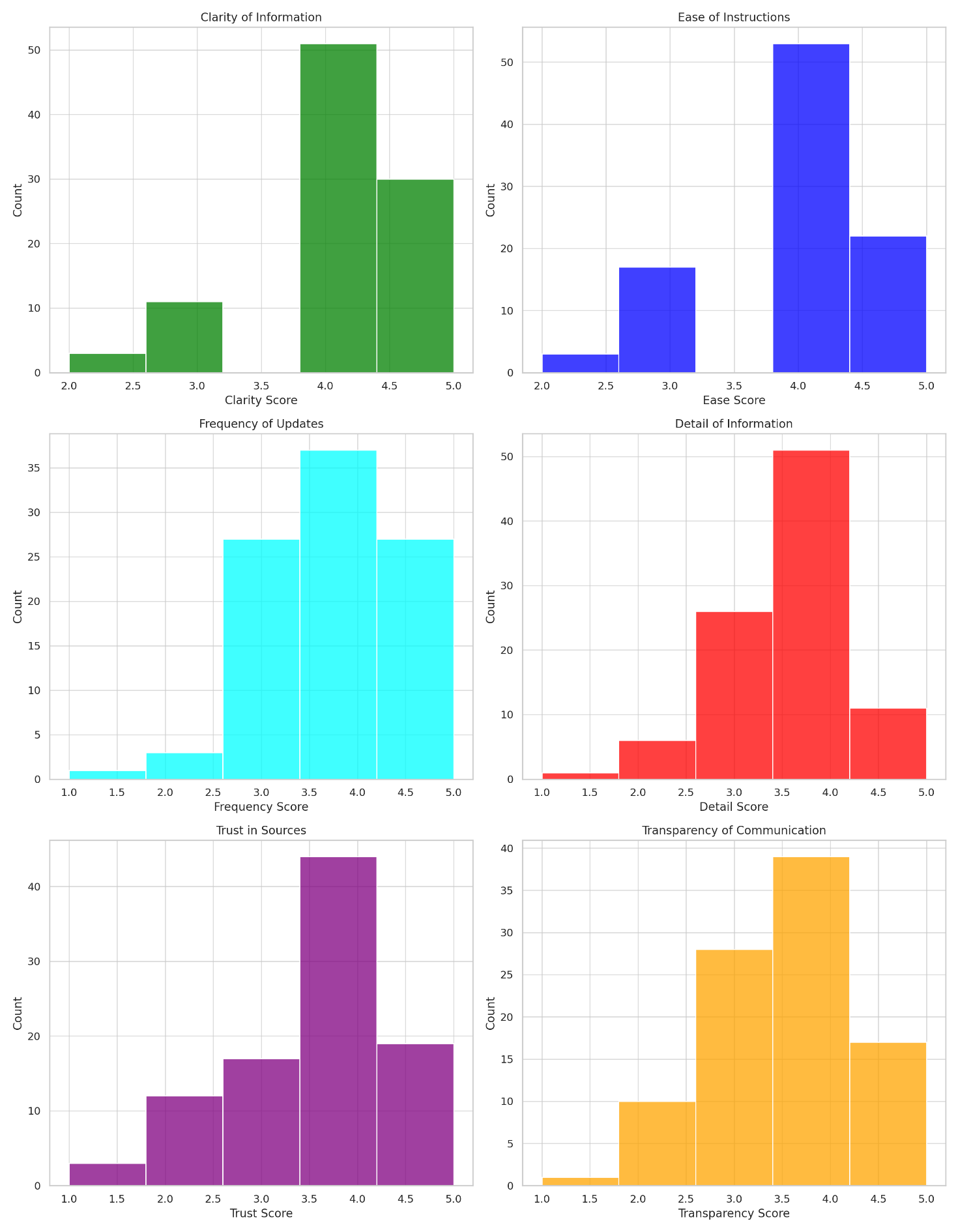
• Clarity and Ease of Information: Clarity of disaster risk information was rated relatively high (mean = 4.14, SD = 0.74). Instructions were also generally easy to understand (mean = 3.99, SD = 0.74). Leaders with over 15 years’ experience rated clarity slightly higher, though differences were not statistically significant (Figure 1a). Gender analysis showed consistent ratings across groups.
• Detail and Frequency of Information: The detail of information received scored moderately (mean = 3.68, SD = 0.80), while update frequency was rated higher (mean = 3.91, SD = 0.89). Younger leaders (24-34 years) reported greater satisfaction with update frequency, suggesting generational dif- ferences in expectations for real-time information (Figure 1b).
• Trust, Reliability, and Transparency: Trust in information sources was rated at 3.67 (SD = 1.04), with reliability slightly higher at 3.73 (SD = 0.99). Transparency scored lower (mean = 3.64, SD =
0.93), with younger leaders rating it lower than their older counterparts (Figure 1c).
Consistency of Information: Consistency across sources scored 3.42 (SD = 0.91), highlighting room for improvement, particularly in cross-agency communication. Leaders with over 10 years’ experi- ence and female leaders identified this as a critical area for improvement.
• Understanding and Usefulness of Infor- mation: Participants rated understanding of risks high (mean = 4.28, SD = 0.69). Information was deemed useful for decision-making (mean = 4.02, SD = 0.76) and effective for action-taking (mean = 4.31, SD = 0.77). These aspects were rated higher by those in management roles than by field-based lead- ers.
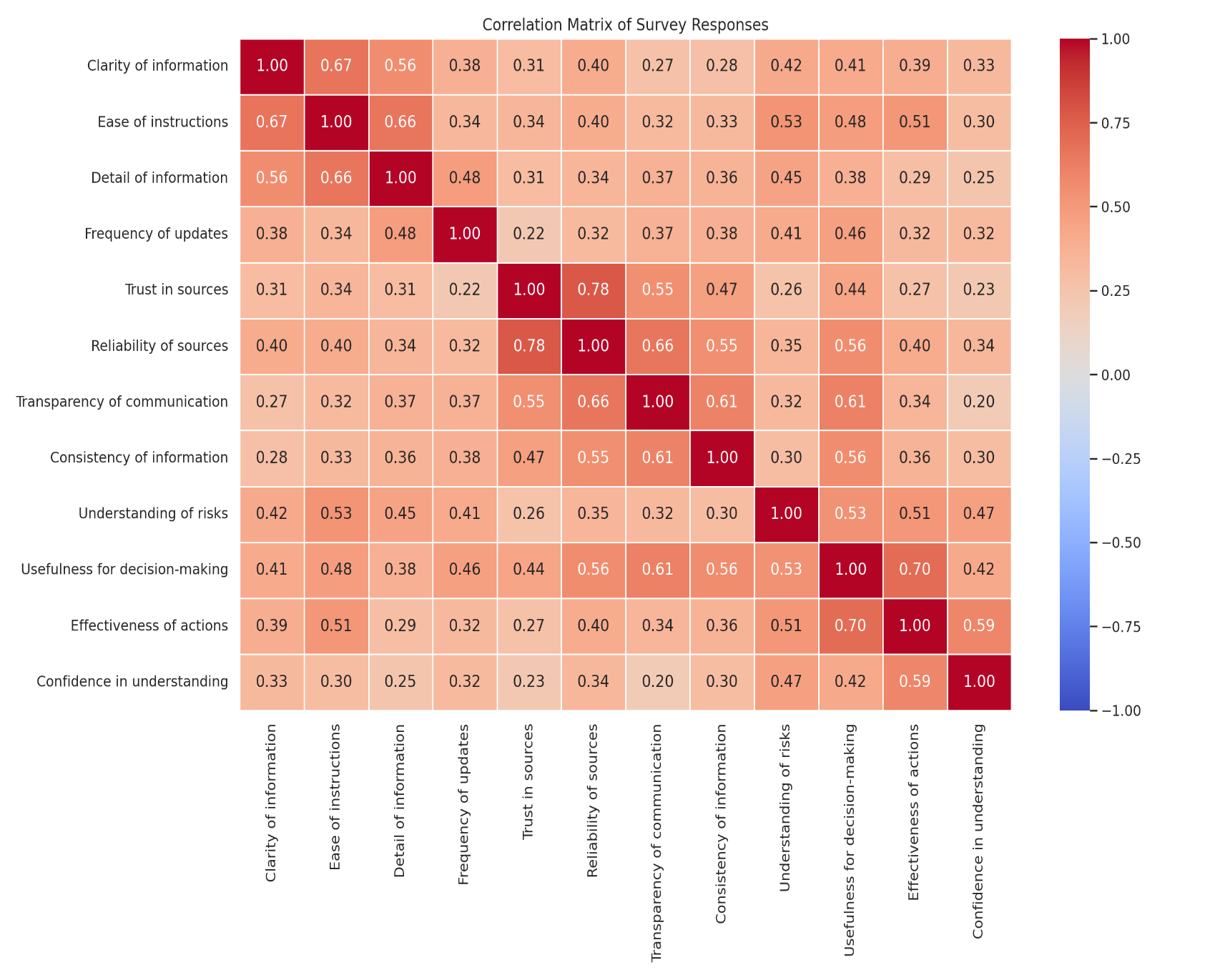
• Confidence and Training Needs: Confi- dence in understanding communicated risks was high (mean = 4.26, SD = 0.69). However, newer leaders (<5 years) expressed a need for additional training, indicating a perceived skills gap. Correlation Analysis Pearson’s correlation revealed significant relation- ships between key variables. Trust strongly corre- lated with reliability (r = 0.87, p < 0.01) and trans- parency (r = 0.76, p < 0.01). Consistency correlated positively with understanding of risks (r = 0.58, p < 0.05). The usefulness of information for decision- making correlated strongly with its effectiveness for action-taking (r = 0.75, p < 0.01), and frequency of updates was moderately correlated with clarity of in- formation (r = 0.51, p < 0.05) (Figure 2). Qualitative Insights Open-ended responses highlighted themes such as the need for standardised communication protocols, real-time updates, and additional training in commu- nication tools. A recurring theme was the im- portance of comprehensive guidelines to ensure con- sistency across scenarios. Respondents emphasised cultural sensitivity, with locally tailored messages increasing message acceptance. Female leaders em- phasised this need more strongly, underscoring the importance of adapting communication to regional contexts. Thematic analysis also revealed a prefer- ence for concise, action-oriented messaging over ex-
tensive background information. Limited commu- nity awareness and engagement were highlighted as significant barriers to effective disaster manage- ment. Table 1 provides a summary of these themes,
ease of instructions, frequency of updates, detail of information, trust in sources, and transparency of communica-
including recommendations to address identified challenges.
tion
aspects of disaster communication.
This study examined the perceptions of EOC leaders in Saudi Arabia regarding risk communication chal- lenges in disaster management. High ratings for clar- ity and understanding of risk information indicate that leaders generally perceive disaster communica- tions as accessible. However, moderate ratings for transparency and consistency highlight areas for im- provement. Correlations among trust, reliability, and transparency reveal the interconnected nature of ef- fective communication, emphasising that trust- building through reliable and transparent infor- mation enhances decision-making during emergen- cies. Leaders in management roles rated the useful- ness of information higher, reflecting the practical value of effective communication for strategic deci- sion-making.
These findings align with previous studies empha- sising clarity and trustworthiness in risk communi- cation [6, 8]. International research highlights the importance of clear instructions and frequent up- dates in disaster communication [7, 9]. While much of the global literature focuses on public communi- cation needs, this study uniquely addresses the spe- cialised communication requirements of EOC lead- ers. Consistent with Kapucu [10], clarity and con- sistency are essential components of effective disas- ter communication. The emphasis on inter-organisa- tional trust and transparency observed here provides a nuanced understanding of internal communication dynamics within EOCs, rarely addressed in public- focused studies. This study also supports Alshehri et al. [2], who highlighted the importance of culturally adaptive communication tailored to Middle Eastern contexts.
EOC leaders expressed a preference for region-spe- cific approaches, emphasising that effective com- munication must account for local contexts and cul- tural sensitivities. This aligns with Al Kurdi [11], who advocated for frameworks incorporating cul- tural dynamics. Additionally, while previous studies often focus on public trust in disaster communica- tion [12], this study shifts the focus to inter-organi- sational trust. Transparency within EOCs emerged as a foundational element for cohesive operations, reflecting the organisational need for effective cross- agency collaboration in Saudi Arabia. These find- ings support the IDEA model, which emphasises clear, consistent, and actionable communication strategies [13]. Building trust among organisations can further en- hance effective communication. Veil et al. [14] highlight the potential of social media and dynamic platforms to foster transparency and reliability. Sim- ilarly, Wukich [15] emphasises the value of integrat- ing leadership-focused models with advanced tools to improve preparedness and response. Combining modern communication technologies with tradi- tional leadership practices can promote cohesive disaster response strategies. Several practical recommendations emerge from these findings. First, implementing standardised communication protocols is essential to address in- consistencies across sources. Establishing clear in- ter-agency communication guidelines can reduce messaging discrepancies and foster cohesion. En- hanced transparency, achieved through regular up- dates and better information access, could further improve collaboration. Standardised practices can also reinforce trust, with centralised communication channels and designated spokespersons reducing discrepancies and promoting faster, more cohesive responses during emergencies. Training programs tailored to risk communication, particularly for newer leaders, could address skill gaps in transpar- ency and consistency. Scenario-based training and mentorship programs would provide practical tools to enhance leaders’ preparedness. Trust-building should remain a primary focus, with simulation ex- ercises fostering communication strategies in con- trolled environments.
Finally, these findings align with global research emphasising the importance of tailored communica- tion strategies. A systematic review highlighted the effectiveness of two-way communication channels in improving public understanding and response during emergencies [4]. Similarly, the World Disas- ters Report underscored the importance of trust and inter-agency collaboration in enhancing prepared- ness, particularly in regions with complex sociocul- tural dynamics [12]. By connecting these insights to global best practices, this study reinforces the uni- versal need for clarity, consistency, and trust in dis- aster risk communication. This study has several limitations. The use of pur- posive sampling may restrict the generalisability of the findings to all EOC leaders in Saudi Arabia, as regional differences in experiences and practices may exist. Additionally, the reliance on self-re- ported data introduces the potential for bias, as par- ticipants may have overestimated their familiarity and satisfaction with current communication tools. By focusing primarily on the perspectives of leaders, the study may not fully capture the experiences of frontline staff, who engage more directly with these tools during disaster scenarios. Lastly, the rapid pace of technological advancements means that findings related to current tools may lose relevance over time, highlighting the importance of ongoing evaluations and research.
This study underscores the critical role of effective risk communication among EOC leaders in Saudi Arabia. Findings highlight the importance of clarity, transparency, and trust as central pillars of success- ful communication. While leaders generally rated disaster communication as accessible and clear, moderate scores for transparency and consistency indicate areas for improvement to ensure cohesive response efforts. The strong correlations between trust, reliability, and transparency suggest that en- hancing one element can positively reinforce others. Practically, the study emphasises the need for stand- ardised communication protocols across agencies, supported by regular updates to enhance con-
sistency. Training programs focusing on transpar- ency, consistency, and trust-building are particularly critical for newer leaders, ensuring their prepared- ness for unified and effective disaster management. By implementing these recommendations, EOC leaders can strengthen inter-agency coordination and enhance overall resilience in disaster response.
None Conflict of Interest: The author declares that there are no conflicts of interest regarding the publication of this article. Funding: None Consent for participation: Participation in the survey was voluntary, and informed consent was obtained from all participants before their participa- tion.
| based on qualitative | analysis. | ||
|---|---|---|---|
| Suggestion | Details | Recommendations | |
| Intensive training and | Lack of adequate disaster | | Conduct intensive training courses and continuous drills |
| continuous education | communication skills, includ- | involving all levels of leadership and external entities. | |
| ing active listening and crisis | | Focus on disaster communication skills, including active | |
| management. | listening, negotiation, and crisis management. | ||
| | Provide continuous training on communication tools and | ||
| techniques. | |||
| Enhanced communi- | Inconsistent communication | | Create a 24/7 communication platform. |
| cation mechanisms | platforms and delayed updates | | Develop mobile applications with disaster notifications |
| during emergencies. | and immediate meeting capabilities. | ||
| | Ensure transparency and provide regular updates on dis- | ||
| aster developments. | |||
| E-mail: jameel.abualenain@kau.edu.sa | |||
| | Set clear algorithms for communication mechanisms. | ||
| Collaborative net- | Poor collaboration and trust | | Build support networks among government entities, |
| works | among agencies and stake- | NGOs, media, and other stakeholders. | |
| holders. | | Share experiences and strategies with neighbouring coun- | |
| tries. | |||
| | Conduct regular meetings and workshops with risk own- | ||
| ers and stakeholders. | |||
| Technological inte- | Limited use of modern tools | | Use modern technology and risk analysis models. |
| gration | for effective communication. | | Ensure high-quality wireless networks for reliable com- |
| munication. | |||
| | Develop visual communication systems linking crisis | ||
| management centres and affiliated facilities. | |||
| | Utilise the latest technologies and intensify drills for vari- | ||
| ous disaster scenarios. | |||
| Strategic planning | Lack of standardised commu- | | Analyse past crises to derive lessons for improving future |
| and evaluation | nication protocols and frame- | strategies. | |
| works. | | Regularly evaluate and improve communication strategies | |
| after each disaster. | |||
| | Prepare risk lists with confrontation strategies and share | ||
| them with relevant entities. | |||
| Effective information | Messages not tailored to re- | | Provide accurate, reliable, and transparent information us- |
| dissemination | gional sociocultural contexts. | ing simple and clear language. | |
| | Ensure rapid communication at the onset of a disaster | ||
| with clear, confirmed information about the risk. | |||
| Community aware- | Limited public engagement in | | Raise awareness of risk concepts and the importance of |
| ness and involvement | disaster preparedness and | disaster communication. | |
| communication. | | Engage in social media awareness campaigns. | |
| | Conduct workshops on the importance and sensitivity of | ||
| disaster work to educate the community and encourage | |||
| active involvement. |