Full text rendered from the published PDF. The PDF is the version of record; if the two differ, the PDF governs.
Abstract—Introduction: Eye care in children is of critical importance, as numerous pathologies can arise during childhood with the risk of serious consequences, including blindness. Parents' knowledge, attitudes, and practices in this regard are therefore crucial, as they significantly influence their children's eye health. This study aimed to assess the knowledge, attitudes, and practices (KAP) of parents regarding children's eye care in the Jazan region of southwestern Saudi Arabia.
Materials and Methods: A cross-sectional study was conducted using a validated questionnaire comprising 29 questions, divided into four sections: sociodemographic data, parents' practices regarding their children's eye care, parents' knowledge of eye problems, and parents' attitudes towards their children's eye examinations.
Results: The study included 782 participants, most of whom were aged between 36 and 45 years (41.8%). The majority were Saudi nationals (95.9%) and married (94.2%). Regarding children's eye care, 61.1% of parents reported taking their child for an eye examination primarily in response to an eye illness. Awareness of specific eye conditions varied, with 57% aware of refractive errors, 71% of amblyopia, and 85% of cataracts. Logistic regression analysis identified participants’ area of residence and educational level as significant predictors of good knowledge and positive attitudes towards child eye care, while factors such as age and nationality had variable effects.
Conclusion: The findings indicate that the majority of parents in Jazan are well-informed about children's eye care and recognise the importance of early eye examinations. However, there remains a need for targeted educational campaigns addressing the importance of regular eye checks, concerns regarding the psychological and educational impact of eyeglasses, and increased awareness of the preventability and treatability of childhood eye conditions.
Keywords: Attitude, Child, Eye Diseases, Health Knowledge, Parents, Practice, Vision Screening
Eye pathology in children is a significant cause of medical consultations [1]. It is estimated that 19 million children worldwide are visually impaired [2]. In Saudi Arabia, regional studies have reported varying prevalence of eye pathologies among chil- dren; one conducted in the Dammam region found that 9.1% of children suffer from amblyopia [3], while another study from the Jazan region identi- fied strabismus and refractive errors as the most common ocular pathologies, affecting 36.9% and 26.5% of children, respectively [4]. It is estimated that 80% of childhood vision problems are treatable if detected at an early stage. Delayed treatment can adversely affect children's development, learning, communication, health, performance, and overall quality of life; thus, early detection and interven- tion are essential [5]. Many factors influence the prevalence and causes of childhood visual impairment, including the de- gree of socioeconomic development, accessibility and availability of ophthalmic care facilities, and societal norms regarding health-seeking behaviour. The estimated global prevalence of childhood blindness is 0.75 per 1,000 children, with the high- est rates observed in low-income countries (0.9 per 1,000), followed by middle-income (0.7 per 1,000)
and high-income countries (0.4 per 1,000) [6]. In the Eastern Mediterranean region, a study by Al- rasheed et al. reported a pooled prevalence of un- corrected visual impairment among children of 11.57%. Furthermore, refractive errors (51.89%), amblyopia (11.15%), retinal disorders (3.90%), corneal opacity (3.0%), and cataract (1.88%) were identified as the most common paediatric eye pa- thologies [7]. Among the Gulf countries, a study by Kandi et al. involving schoolchildren from the Hatta region of the United Arab Emirates found that 20.9% of pupils suffered from refractive errors [8]. In Saudi Arabia, the prevalence of amblyopia and refractive errors has been estimated at 2.3% and 17.5%, respectively [9,10]. Early management is essential to preserve good eyesight [11]. The World Health Organization (WHO) has introduced the "Integrated People-Cen- tred Eye Care (IPEC)" initiative, which aims to eradicate and control juvenile blindness. The WHO estimates that therapeutic and preventive ap- proaches can avert 75% of cases of blindness, re- gardless of age [12,13]. Various vision-threatening eye conditions in children, such as amblyopia, cat- aracts, and refractive errors, are treatable if de- tected early; parents must be well-informed about these conditions, as a lack of awareness can con- tribute to visual impairment. Multiple factors can impede early eye care in children, including finan- cial constraints, time limitations, limited access to healthcare services, lack of trust in general practi- tioners and paediatricians, and the availability of traditional medicine as a less expensive alternative. All of these factors are directly related to parents' practices and attitudes, and should be promptly identified and addressed [6]. The risk factors associated with parents' inadequate knowledge, attitudes, and practices regarding this crucial issue, as well as the relationship between these factors and specific parental characteristics, have not yet been investigated in the Jazan region. Therefore, the aim of this study was to assess the knowledge, attitudes, and practices (KAP) of par- ents regarding children's eye care in the Jazan re- gion of Saudi Arabia. By addressing the question, "What is the level of knowledge, attitudes, and practices regarding children's eye care among par- ents in Jazan?", the findings of this study will help guide educational campaigns to focus on areas of deficiency and support policymakers in developing appropriate protocols to address this issue.
Study Design and Target Population This cross-sectional descriptive study assessed the knowledge, attitudes, and practices related to chil- dren's eye care among the population of the Jazan region. Jazan, situated on the Red Sea coast, is one of the fastest-growing cities in Saudi Arabia. Ac- cording to the 2017 Census, the city has a popula- tion of 1,567,547 and covers an area of 11,671 km2. The target participants were Saudi and non-Saudi parents, aged 18 years and above, who spoke Ara- bic and resided in the Jazan region. Participants from other regions were included for comparative purposes. Adults without children and those who declined to participate were excluded from the study. Convenience (non-random) sampling was utilised in this study. The sample size was determined using the Raosoft software, with calculations based on a 95% confidence level, an assumed 50% response rate, and a margin of error of ±5%. The minimum required sample size was initially set at 385, but this was adjusted to 424 to accommodate a 10% al- lowance for non-responses. The final target sample size was increased to 782 participants to enhance precision and improve the reliability of the results.
Data Collection Tool Data were collected using a straightforward, vali- dated questionnaire in the Arabic language, which was distributed conveniently to residents of the Jazan region. The questionnaire was previously adopted and validated by another study, with the permission of the original authors [14]. A pre- tested, online version of the questionnaire ensured participants' anonymity. The questionnaire was di- vided into four sections: The first consisted of nine items related to social and demographic data, such as participants’ age, level of education, occupation, marital status, and number of children. The second section comprised four questions about parental practices concerning their children's eye care, in- cluding whether their children had undergone an eye examination, as well as the indications for, and reasons for refusing, such examination. The third section contained ten questions addressing parents' knowledge of eye problems; this included their un- derstanding of refractive errors, their prevention and complications, and their knowledge of ambly- opia and cataracts. Finally, the fourth section as- sessed parents' attitudes towards their children's eye
examinations through six items. These covered per- ceptions of their child wearing glasses, whether glasses were regarded as an educational oppor- tunity, and concerns regarding the potential deteri- oration of visual acuity or negative psychological effects. Data were collected via social media platforms in- cluding WhatsApp, Telegram, X (formerly Twit- ter), and Snapchat. The researchers and data collec- tors distributed the online questionnaire through group chats and personal networks, and also en- couraged participants to share the survey further on a voluntary basis. Upon completion of data collec- tion, responses were manually verified and then coded using Microsoft Excel.
Scoring System To evaluate knowledge levels regarding eye prob- lems and screening, a scoring system was applied to ten knowledge-related items, all of which were simple-choice (yes or no) questions. Correct an- swers received a score of 1, while incorrect answers or "I do not know" responses were scored as 0, re- sulting in a total knowledge score ranging from 0 to 10. Knowledge levels were categorised as fol- lows: poor (0–4), fair (5–7), and good (8–10). A similar approach was used for the attitude-related items (six questions), with scores ranging from 0 to 6, categorised as poor (0–2), fair (3–4), and good (5–6). Knowledge and attitude scores above 75% were considered indicative of good knowledge and positive attitudes, respectively. Scores between 50– 75% indicated fair knowledge and neutral attitudes, while scores below 50% represented poor knowledge and negative attitudes towards chil- dren's eye care.
Statistical Analysis Data were analysed using IBM SPSS Statistics for Windows, Version 26.0. Qualitative variables were expressed as numbers and percentages, and the Chi-squared test (χ2) was employed to assess rela- tionships. Quantitative data were presented as means and standard deviations (mean ± SD), and multivariate logistic regression analysis was used to identify significant predictors of knowledge and attitudes. Odds ratios (OR) with 95% confidence intervals (CI) were reported. A p-value lower than 0.05 was considered statistically significant. Ethical Approval This study received approval from the institutional review board (HAPO-10-z-001) at Jazan Univer- sity. All participants were informed that the study
would maintain complete privacy and confidential- ity; they were also advised of their right to with- draw from participation at any time. The survey did not include any identifying questions or personal information, and only the study investigators had access to the collected data.
Sociodemographic Characteristics A total of 782 parents from the Jazan region partic- ipated in this study. The majority were in the 36– 45-year age group (41.8%; n = 327), while those aged over 60 years constituted the smallest propor- tion (0.4%; n = 3). Most participants were female (54.0%; n = 422) and Saudi nationals (95.9%; n = 750). The majority were married (94.2%; n = 737), with 4.2% (n = 33) divorced and 1.5% (n = 12) wid- owed. Nearly two-thirds were employed (63.4%; n = 496), and most held a diploma or bachelor's de- gree (69.8%; n = 546). Further sociodemographic data are presented in Table 1.
Knowledge of Child Eye Care and Sociodemo-
graphic Characteristics The study also explored the relationship between participants' knowledge of child eye care and their demographic characteristics. Among the 782 par- ticipants, age showed a trend towards significance (p = 0.076), with the 36–45-year age group demon- strating the highest proportion of good knowledge (46.8%). Gender was not significantly associated with knowledge levels (p = 0.506). Nationality also showed no significant relationship, with Saudis predominant across all knowledge categories (p = 0.176). Marital status was not significant, with married participants comprising the majority in each group (p = 0.737). The participants’ area of residence was significantly associated with knowledge; those from Jazan and its governorates exhibited higher knowledge levels compared with those from outside the region (p < 0.0001). Occu- pational status was also significant (p = 0.033), with employees having a higher proportion of good knowledge (71.3%) compared with other groups. Educational level was significant (p = 0.001); par- ticipants with a diploma or bachelor's degree had the highest proportion of good knowledge (77.1%), while those with secondary education or less had the highest proportion of poor knowledge (30.5%). These findings are further detailed in Table 2.
Attitudes Towards Child Eye Care and Sociodem-
ographic Characteristics
The relationship between the participants’ demo- graphic characteristics and their attitudes towards children's eye care is presented in Table 3. Age was found to be significantly related to attitude (p = 0.038), with the 36–45-year age group displaying the highest proportion of positive attitudes (51.0%). Gender did not significantly influence at- titudes (p = 0.759), but nationality was significant (p = 0.003), with Saudi nationals more likely than non-Saudis to exhibit a positive attitude (91.5%), in univariate analysis. Marital status was not signifi- cant, with married participants forming the major- ity across all attitude categories (p = 0.401). Area of residence was likewise not statistically signifi- cant (p = 0.086). While occupational status was not significantly associated with attitude (p = 0.166), employees exhibited the highest proportion of pos- itive attitudes (73.2%). Educational level also did not have a significant effect on attitudes (p = 0.638), with most participants across all categories holding a diploma or bachelor's degree.
Sociodemographic Factors Associated with a
Good Knowledge Level As shown in Table 4, a multivariate logistic regres- sion analysis identified residence in Jazan (adjusted odds ratio [aOR] = 2.298, p = 0.003), employment status (aOR = 1.810, p = 0.036), and educational level (aOR = 0.446, p = 0.050) as significant factors associated with good knowledge of child eye care.
Sociodemographic Factors Associated with
Positive Attitudes The multivariate logistic regression analysis re- vealed that nationality and area of residence signif- icantly influenced attitudes towards child eye care (Table 5). Both Saudi nationals (aOR = 0.166, p = 0.007), and residents of Jazan and its governorates (aOR = 0.420, p = 0.018) were less likely than other groups to hold positive attitudes, after adjusting for other variables.
Parental Attitudes Towards Child Eye Care
The distribution of parental attitudes towards child eye care is illustrated in Figure 1. The results show that 52.6% of participants held a neutral attitude, neither strongly supporting nor opposing child eye care practices. In contrast, 27.9% displayed a posi- tive attitude, endorsing the importance of eye care for children, while 19.6% held a negative attitude, indicating disapproval or a lack of support for child eye care initiatives.
Parents' Knowledge and Understanding of Child
Eye Care
Influence of Parental Knowledge on Attitudes To-
wards Child Eye Care
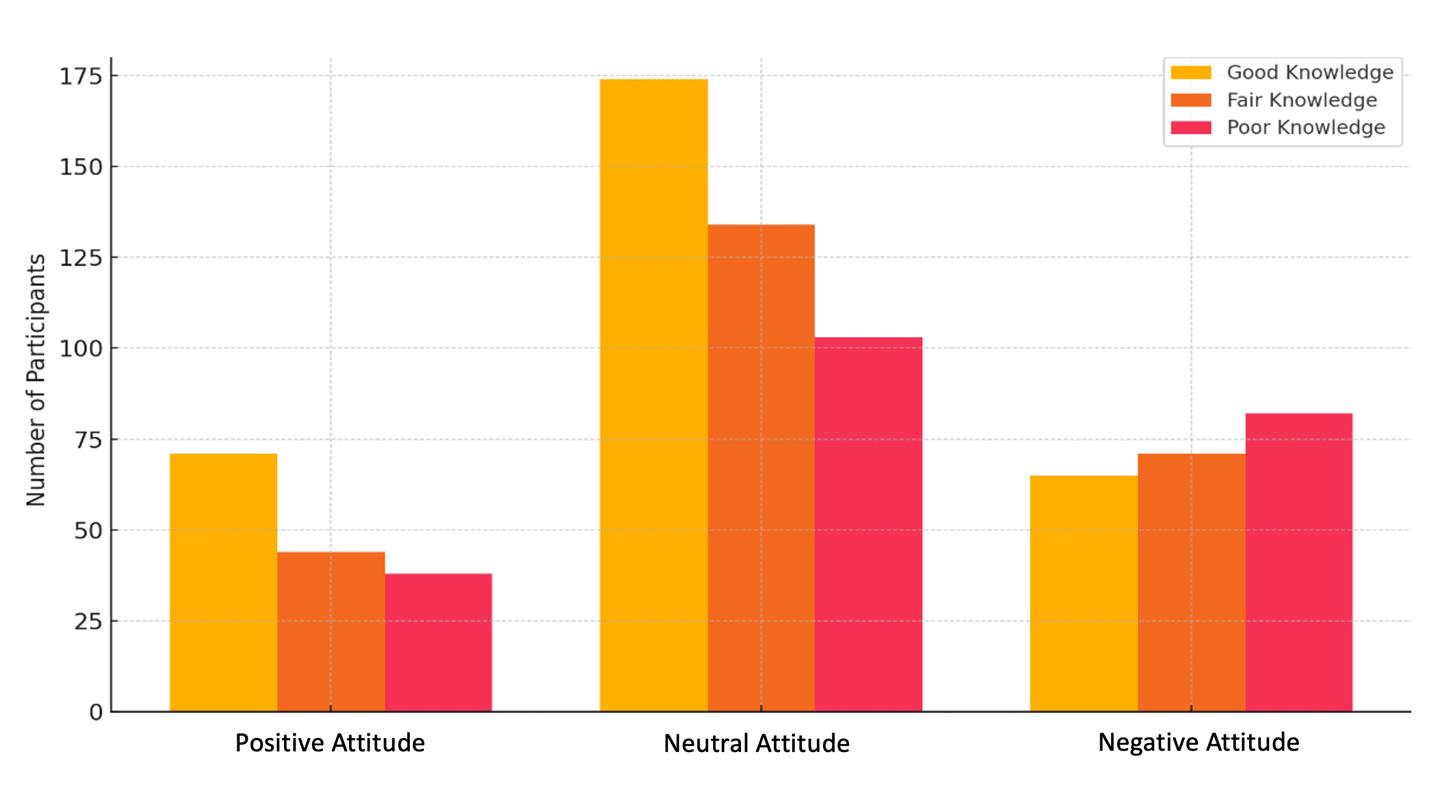
Figure 3 explores the association between partici- pants' attitudes towards child eye care and their knowledge levels, revealing a statistically signifi- cant correlation (p = 0.002). Among those with a positive attitude, 71 participants had good knowledge, 44 had fair knowledge, and 38 had poor knowledge. Of those with a neutral attitude, 174 had good knowledge, 134 fair, and 103 poor. Among participants with a negative attitude, 65 had good knowledge, 71 fair, and 82 poor. These find- ings suggest that higher levels of knowledge about child eye care are associated with more positive or neutral attitudes, whereas lower levels of knowledge are linked to more negative attitudes.
This cross-sectional study aimed to evaluate par- ents' knowledge, attitudes, and practices regarding children's eye care in the Jazan region, Saudi Ara- bia. In the present study, 57% of participants re- ported having heard about refractive errors. By comparison, a study conducted in Riyadh in 2021 found that only 26.2% of parents were aware of re- fractive errors [11]. Similarly, parental knowledge of amblyopia in our study was 71%, whereas a 2022 study in Madinah reported a knowledge level of 58.5% [15]. This variation in knowledge could be attributed to differences in participants' back- grounds and educational level, both of which sub- stantially influence parental understanding of such conditions. The most commonly recognised eye disease among parents was cataracts, with an awareness level of 85%. It is believed that this high
percentage is due to the early and noticeable mani- festation of symptoms, such as white pupils, which alert parents, as well as the fact that cataracts are highly prevalent and frequently discussed within the community. In the current study, 39.6% of participants demon- strated good knowledge of child eye care, whereas 28.5% exhibited poor knowledge. A 2019 study in Arar reported that 56.7% of respondents had ade- quate knowledge of common eye diseases, with re- fractive errors being the most recognised [16]. In contrast, a 2021 study conducted in Jeddah found low knowledge levels, with just 25.9% of partici- pants scoring adequately on the amblyopia knowledge scale and only 20% self-reporting suf- ficient knowledge [17]. In Al-Qunfudah in 2023, only 16.6% of participants demonstrated good knowledge, while 60% had low knowledge levels [14]. Research indicates that variations in public health strategies and the utilisation of different as- sessment tools can significantly impact reported outcomes. These discrepancies underscore the need for a comprehensive national study undertaken by an official body. Under-utilisation of preventive care has significant consequences. Proper prenatal care, the use of cor- rective eyewear, and timely treatment can prevent up to half of childhood blindness cases, while many paediatric eye conditions could be detected and managed early through appropriate care and educa- tion [18]. In this study, 45.3% of parents recognised refractive errors as both preventable and treatable, 51.4% agreed that amblyopia is treatable and pre- ventable, and 71.6% were aware that cataracts can be treated and prevented. By contrast, the 2023 study in Al-Qunfudah reported that only 32.5% of parents were aware that cataracts are manageable, and 39.2% recognised the treatability of refractive errors [14]. These findings suggest a higher level of awareness among parents in Jazan compared with those in Al-Qunfudah; however, significant gaps remain in both regions, particularly concerning re- fractive errors and amblyopia, highlighting the need for enhanced public health campaigns. Our findings showed that parents with a bachelor's degree or diploma demonstrated greater awareness of the importance of caring for their children's eyes than those with lower levels of education. Higher educational attainment provides access to reliable information and improves understanding of the po- tential risks and consequences associated with ne- glecting eye health. Moreover, higher education is
linked to better financial opportunities and a greater understanding of public health, both of which can increase access to healthcare services. In addition, a more educated social and academic environment fosters the exchange of health-related information and deepens appreciation for the significance of paediatric eye care. In contrast to our findings, however, a study conducted in Benin found that un- educated and poorly educated individuals pos- sessed more information about child eye care than parents with higher education [19]. Our results also indicate a significant association between employ- ment status and knowledge levels, with employed parents demonstrating greater awareness, as ob- served in another study [14]. Those with higher lev- els of education were also more likely to be well- informed about eye health issues and to hold fa- vourable views regarding children wearing glasses. Local factors, such as health programmes, educa- tion, and cultural attitudes in Jazan, may further en- hance parents' understanding of child eye care. In- terestingly, our study found that Saudi parents ex- hibited a more negative attitude specifically to- wards vision correction options, compared to non- Saudi parents, a finding that may be attributable to cultural norms and traditional beliefs. In contrast to other participants, parents aged be- tween 36 and 45 years demonstrated better knowledge and attitudes regarding their children's eye care. These findings are consistent with a local study conducted in Al-Qunfudah [14]. However, a different study, carried out in Medina, revealed a variation in knowledge and attitudes across age cat- egories, with parents aged 50 years and above ex- hibiting the highest levels of knowledge and posi- tive attitudes among all the age groups [15]. One possible explanation for the disparity in knowledge and attitudes between the southern and western re- gions of the Kingdom is the age of marriage; recent statistics indicate that residents of the southern re- gion tend to marry at a younger age than those in the western region. This earlier age of marriage in- creases the likelihood that parents will encounter eye problems in their children earlier in life, thereby raising awareness and fostering more posi- tive attitudes towards child eye care [20]. In the present study, 80.3% of participants reported no objection to their children wearing glasses. This finding is in line with a 2023 local study, where 85.1% of parents reported a willingness for their children to wear glasses [14]. By contrast, a 2013
study conducted in China found that 49% of par- ents expressed concerns about their child's need for vision correction [21]. These differences suggest that parental perceptions of eyewear are strongly influenced by societal and cultural beliefs, with stigma and aesthetic considerations potentially playing a significant role in regions where ac- ceptance is lower. With regard to parents' practices towards children's eye examinations, our study found that over half of parents (61.1%) had taken their children for an eye examination. Among those who had not, the most common reason cited was the absence of any signs or symptoms prompting a visit to the eye doctor (63.8%). This finding is comparable to a 2022 study conducted in the Aseer region of Saudi Ara- bia, which found that 48.5% of participants had taken their children for an eye examination; the variation observed could be attributed to differing levels of regional awareness [22]. Our study also aligns with the results of the 2023 study in Al-Qun- fudah, where the main reason cited by parents for not seeking an eye examination was the absence of symptoms warranting a doctor's visit [14]. Interna- tionally, our results are considerably higher than those of a 2015 cross-sectional study involving 514 participants from Ghana, Honduras, and India, where the vast majority (67%) had never taken their children for an eye examination. This differ- ence may be due to the low socioeconomic status and economic barriers—such as high medical costs and limited availability of services—shared by these countries [18]. A notable strength of our study is the use of a well- structured, validated questionnaire to assess par- ents' knowledge, attitudes, and practices regarding children's eye care. This approach ensures that the data collected are both relevant and reliable. With a sample size of 782 participants, the study benefits from a robust dataset, enhancing the generalisabil- ity of the findings within the Jazan region and im- proving the statistical power of the analysis. The research provides a comprehensive analysis of de- mographic factors and their association with knowledge and attitudes towards eye care, thus identifying specific areas where educational and public health interventions may be required. Im- portantly, our questionnaire was pre-tested and val- idated, further ensuring the accuracy and reliability of the results.
However, the study’s cross-sectional design cap- tures data at a single point in time, limiting the abil- ity to assess changes in knowledge, attitudes, and practices over time. Longitudinal studies would provide valuable insights into how these factors evolve and the impact of educational interventions. Additionally, data collection via social media plat- forms may have introduced selection bias, as not all demographic groups are equally represented online. The study also relies on self-reported data, which may be subject to recall bias or social desir- ability bias; participants might under- or over-re- port their knowledge and practices based on per- ceived social expectations. Furthermore, while the findings are applicable to the Jazan region, they may not be generalisable to other regions of Saudi Arabia or to countries with different cultural or so- cioeconomic contexts.
A considerable majority of parents in Jazan are aware of childhood eye diseases; however, there re- mains a notable gap in knowledge regarding the preventability and treatability of these conditions. In terms of attitudes, the study found that most par- ents hold positive views towards their children's eye care, with 80.3% (628 participants) expressing no concerns about their children wearing eye- glasses. Nevertheless, some parents continue to harbour concerns about the psychological and edu- cational implications of wearing eyeglasses. This suggests that, while general acceptance is high, tar- geted educational initiatives are still required to ad- dress residual concerns. The primary reasons cited for not seeking eye ex- aminations were the absence of visible symptoms and the belief that the child was too young—find- ings consistent with studies from other regions. This underscores the need for further educational programmes that emphasise the importance of rou- tine eye examinations, even in the absence of obvi- ous symptoms. In conclusion, we recommend the implementation of comprehensive public health programmes aimed at increasing parental knowledge and improving practices around chil- dren's eye care.
SOURCES This study received no specific funding from out- side sources. All authors volunteered their time and resources.
VII. CONFLICT OF INTEREST The authors declare no conflicts of interest.
VIII. AVAILABILITY OF DATA The datasets generated and/or analysed during this study are available from the corresponding author upon reasonable request.
The authors would like to thank all of the partici- pants in this study.
X. REFERENCES 1. World Health Organization. Universal eye health: a global action plan 2014-2019 [Inter- net]. Geneva: World Health Organization; 2013 [cited 2025 Apr 4]. Available from: https://iris.who.int/handle/10665/105937 2. Pascolini D, Mariotti SP. Global estimates of visual impairment: 2010. Br J Ophthalmol . 2012 May;96(5):614-8. 3. Al-Tamimi E, Shakeel A, Yassin S, Ali S, Khan U. A clinic-based study of refractive er- rors, strabismus, and amblyopia in pediatric age-group. J Fam Community Med . 2015;22(3):158. 4. Darraj A, Barakat W, Kenani M, Shajry R, Khawaji A, Bakri S, et al. Common eye dis- eases in children in Saudi Arabia (Jazan). Ophthalmol Eye Dis . 2016 Jan;8:OED.S39055. 5. Brown MM, Brown GC, Sharma S, Busbee B. Quality of life associated with visual loss. Ophthalmology. 2003 Jun;110(6):1076-81. 6. World Health Organization, Blindness and Deafness Unit, International Agency for the Prevention of Blindness. Preventing blind- ness in children: report of a WHO/IAPB sci- entific meeting, Hyderabad, India, 13-17 April 1999. Geneva: World Health Organiza- tion; 2000. (WHO/PBL/00.77). Available from: https://iris.who.int/han- dle/10665/66663 7. Alrasheed S. Systematic review and meta- analysis of childhood visual impairment in the Eastern Mediterranean region. East Med- iterr Health J . 2023 Jun 27;29(6):482-90.
8. Kandi SC, Khan HA. Epidemiological find- ings of refractive errors and amblyopia among the schoolchildren in Hatta Region of the United Arab Emirates. Dubai Med J . 2021 Jan 12;4(1):3-9. 9. Challa NK. Prevalence of amblyopia among the children of Saudi Arabia: a systematic re- view, 1990-2020. Afr Vis Eye Health [Inter- net]. 2022 Sep 26 [cited 2024 Sep 27];81(1). Available from: https://avehjournal.org/in- dex.php/aveh/article/view/752 10. Alghamdi W. Prevalence of refractive errors among children in Saudi Arabia: a systemic review. TOOPHTJ . 2021 May 24;15(1):89- 95. 11. Al Mazrou A, Alsobaie NA, Abdulrahman AKB, AlObaidan O. Do Saudi parents have sufficient awareness of pediatric eye diseases in Riyadh? Saudi J Ophthalmol. 2020 Jul;34(3):171-6. 12. Yekta A, Hooshmand E, Saatchi M, Ostadi- moghaddam H, Asharlous A, Taheri A, Khabazkhoob M. Global prevalence and causes of visual impairment and blindness in children: A systematic review and meta-anal- ysis. J Curr Ophthalmol . 2022 Apr 16;34(1):1-15. doi: 10.4103/joco.joco_135_21. PMID: 35620376; PMCID: PMC9128433. 13. World Health Organization. Eye care in health systems: guide for action. 1st ed. Ge- neva: World Health Organization; 2022. 1 p. 14. Alkalash SH, Alsayed HY, Alamshani TK, Almarhabi BA, Alsayed KN, Alsayed GM, et al. Knowledge, attitude, and practice of par- ents regarding children's eye care in Al-Qun- fudah Governorate, Saudi Arabia. Cureus [Internet]. 2023 Oct 31 [cited 2024 Sep 27]; Available from: https://www.cureus.com/ar- ticles/194319-knowledge-attitude-and-prac- tice-of-parents-regarding-childrens-eye- care-in-al-qunfudah-governorate-saudi-ara- bia 15. Surrati AM, Almuwarraee SM, Mohammad RA, Almatrafi SA, Murshid SA, Khayat LI,
et al. Parents' awareness and perception of children's eye diseases in Madinah, Saudi Arabia: a cross-sectional study. Cureus [In- ternet]. 2022 Feb 25 [cited 2025 Apr 5]; Available from: https://www.cureus.com/ar- ticles/84061-parents-awareness-and-percep- tion-of-childrens-eye-diseases-in-madinah- saudi-arabia-a-cross-sectional-study 16. Rehman Parrey MU. Parents' awareness and perception of children's eye diseases in Arar City. Ann Clin Anal Med [Internet]. 2019 [cited 2025 Apr 5];10(06). Available from: https://archive.org/download/parents-aware- ness-and-perception-of-childrens-eye-dis- eases-in-arar-city/10.4328ACAM.6133.pdf 17. Basheikh A, Alhibshi N, Bamakrid M, Baqais R, Basendwah M, Howldar S. Knowledge and attitudes regarding amblyo- pia among parents in Jeddah, Saudi Arabia: a cross-sectional study. BMC Res Notes . 2021 Dec;14(1):60. 18. Ramai D, Elliott R, Goldin S, Pulisetty T. A cross-sectional study of pediatric eye care perceptions in Ghana, Honduras, and India. JEGH . 2014;5(2):133. 19. Amiebenomo O, Achugwo D, Abah I. Paren- tal knowledge and attitude to children's eye care services. Niger J Paed . 2016 Jul 1;43(3):215. 20. General Authority of Statistics. Marriage and Divorce Statistics 2020 [Internet]. Riyadh, Saudi Arabia: General Authority of Statis- tics; 2020 [cited 2025 Apr 5]. Available from: https://www.stats.gov.sa/docu- ments/20117/2435265/Marriage+and+Di- vorce+Statistics+2020.xlsx/bbb489d8-340f- d0da-4e11- 7f8e0943c377?t=1735073628697 21. Senthilkumar D, Balasubramaniam SM, Ku- maran SE, Ramani KK. Parents' awareness and perception of children's eye diseases in Chennai, India. Optom Vis Sci . 2013 Dec;90(12):1462-6. 22. Aldhabaan W, Alkhammash ZM, Al Zomia AS, Alshahrani Y, Asiri R, Alqhtani MM, et
al. Knowledge and practices of child eye healthcare among parents in Aseer Region, Saudi Arabia. Cureus [Internet]. 2022 Oct 17 [cited 2025 Apr 5]; Available from: https://www.cureus.com/articles/111096- knowledge-and-practices-of-child-eye- healthcare-among-parents-in-aseer-region- saudi-arab
Poor Knowledge
Fair Knowledge
28.5%
Good Knowledge
39.6%
31.8%
| Variables | n | % | |||
|---|---|---|---|---|---|
| Age group | 18-25 years | 52 | 6.6% | ||
| 26-35 years | 211 | 27.0% | |||
| 36-45 years | 327 | 41.8% | |||
| 46-60 years | 189 | 24.2% | |||
| >60 years | 3 | 0.4% | |||
| Gender | Male | 360 | 46.0% | ||
| Female | 422 | 54.0% | |||
| Nationality | Saudi | 750 | 95.9% | ||
| Non-Saudi | 32 | 4.1% | |||
| Marital status | Married | 737 | 94.2% | ||
| Divorced | 33 | 4.2% | |||
| Widowed | 12 | 1.5% | |||
| Area of residence | Jazan and its governorates | 693 | 88.6% | ||
| Outside Jazan | 89 | 11.4% | |||
| Occupational status | Student | 36 | 4.6% | ||
| Employee | 496 | 63.4% | |||
| Retired | 42 | 5.4% | |||
| Self-employed | 53 | 6.8% | |||
| Unemployed | 155 | 19.8% | |||
| Educational level | Secondary school or lower | 180 | 23.0% | ||
| Diploma | or bachelor's degree | 546 | 69.8% | ||
| Master's or PhD | 56 | 7.2% | |||
| Table 2. Relationship between | demographic | characteristics and | knowledge | of child | eye care (n = 782). |
| Knowledge | level | ||||
| Variables | Good knowledge | Fair knowledge | Poor | knowledge p-value | |
| n | % n | % | n | % | |
| 18-25 years | 16 | 5.2% 20 | 8.0% | 16 | 7.2% |
| 26-35 years | 66 | 21.3% 71 | 28.5% | 74 | 33.2% |
| 36-45 years | 145 | 46.8% 95 | 38.2% | 87 | 39.0% 0.076 |
| 46-60 years | 82 | 26.5% 62 | 24.9% | 45 | 20.2% |
| >60 years | 1 | 0.3% 1 | 0.4% | 1 | 0.4% |
| Male | 139 | 44.8% 111 | 44.6% | 110 | 49.3% 0.506 |
| Female | 171 | 55.2% 138 | 55.4% | 113 | 50.7% |
| Saudi | 293 | 94.5% 239 | 96.0% | 218 | 97.8% 0.176 |
| Non-Saudi | 17 | 5.5% 10 | 4.0% | 5 | 2.2% |
| Married | 294 | 94.8% 231 | 92.8% | 212 | 95.1% |
| Divorced | 11 | 3.5% 13 | 5.2% | 9 | 4.0% 0.737 |
| Widowed | 5 | 1.6% 5 | 2.0% | 2 | 0.9% |
| of Medicine, Law & Public | Health | Vol 5, No 4. 2025 | p715 | ||
| Jazan and its gov- | 285 | 91.9% 226 | 90.8% | 182 | 81.6% |
| ernorates | <0.0001 | ||||
| Outside Jazan | 25 | 8.1% 23 | 9.2% | 41 | 18.4% |
| status Student | 14 | 4.5% 10 | 4.0% | 12 | 5.4% |
| Employee | 221 | 71.3% 150 | 60.2% | 125 | 56.1% |
| Retired | 13 | 4.2% 16 | 6.4% | 13 | 5.8% 0.033 |
| Self-employed | 18 | 5.8% 18 | 7.2% | 17 | 7.6% |
| Unemployed | 44 | 14.2% 55 | 22.1% | 56 | 25.1% |
| level Secondary school | 48 | 15.5% 64 | 25.7% | 68 | 30.5% |
| or lower | |||||
| Diploma or bache- | 239 | 77.1% 166 | 66.7% | 141 | 63.2% |
| lor's degree | 0.001 | ||||
| Master's or PhD | 23 | 7.4% 19 | 7.6% | 14 | 6.3% |
| Knowledge | level | |||||||
|---|---|---|---|---|---|---|---|---|
| Variables | Good knowledge | Fair knowledge | Poor knowledge | p-value | ||||
| n | % | n | % | n | % | |||
| Age group | 18-25 years | 16 | 5.2% | 20 | 8.0% | 16 | 7.2% | |
| 26-35 years | 66 | 21.3% | 71 | 28.5% | 74 | 33.2% | ||
| 36-45 years | 145 | 46.8% | 95 | 38.2% | 87 | 39.0% | 0.076 | |
| 46-60 years | 82 | 26.5% | 62 | 24.9% | 45 | 20.2% | ||
| >60 years | 1 | 0.3% | 1 | 0.4% | 1 | 0.4% | ||
| Gender | Male | 139 | 44.8% | 111 | 44.6% | 110 | 49.3% | 0.506 |
| Female | 171 | 55.2% | 138 | 55.4% | 113 | 50.7% | ||
| Nationality | Saudi | 293 | 94.5% | 239 | 96.0% | 218 | 97.8% | 0.176 |
| Non-Saudi | 17 | 5.5% | 10 | 4.0% | 5 | 2.2% | ||
| Marital status | Married | 294 | 94.8% | 231 | 92.8% | 212 | 95.1% | |
| Divorced | 11 | 3.5% | 13 | 5.2% | 9 | 4.0% | 0.737 | |
| Widowed | 5 | 1.6% | 5 | 2.0% | 2 | 0.9% | ||
| The Journal of | Medicine, Law & Public | Health | Vol 5, No 4. 2025 | p715 | ||||
| of residence | Jazan and its gov- | 285 | 91.9% | 226 | 90.8% | 182 | 81.6% | |
| ernorates | <0.0001 | |||||||
| Outside Jazan | 25 | 8.1% | 23 | 9.2% | 41 | 18.4% | ||
| status | Student | 14 | 4.5% | 10 | 4.0% | 12 | 5.4% | |
| Employee | 221 | 71.3% | 150 | 60.2% | 125 | 56.1% | ||
| Retired | 13 | 4.2% | 16 | 6.4% | 13 | 5.8% | 0.033 | |
| Self-employed | 18 | 5.8% | 18 | 7.2% | 17 | 7.6% | ||
| Unemployed | 44 | 14.2% | 55 | 22.1% | 56 | 25.1% | ||
| level | Secondary school | 48 | 15.5% | 64 | 25.7% | 68 | 30.5% | |
| or lower | ||||||||
| Diploma or bache- | 239 | 77.1% | 166 | 66.7% | 141 | 63.2% | ||
| lor's degree | 0.001 | |||||||
| Master's or PhD | 23 | 7.4% | 19 | 7.6% | 14 | 6.3% |
| = | 782). | |||||||
|---|---|---|---|---|---|---|---|---|
| Attitude | level | p-value | ||||||
| Variables | Positive | attitude | Neutral | attitude | Negative | attitude | ||
| n | % | n | % | n | % | |||
| Age group | 18-25 years | 6 | 3.9% | 27 | 6.6% | 19 | 8.7% | |
| 26-35 years | 32 | 20.9% | 105 | 25.5% | 74 | 33.9% | ||
| 36-45 years | 78 | 51.0% | 172 | 41.8% | 77 | 35.3% | 0.038 | |
| 46-60 years | 36 | 23.5% | 106 | 25.8% | 47 | 21.6% | ||
| >60 years | 1 | 0.7% | 1 | 0.2% | 1 | 0.5% | ||
| Gender | Male | 69 | 45.1% | 186 | 45.3% | 105 | 48.2% | 0.759 |
| Female | 84 | 54.9% | 225 | 54.7% | 113 | 51.8% | ||
| Nationality | Saudi | 140 | 91.5% | 395 | 96.1% | 215 | 98.6% | 0.003 |
| Non-Saudi | 13 | 8.5% | 16 | 3.9% | 3 | 1.4% | ||
| Marital status | Married | 143 | 93.5% | 391 | 95.1% | 203 | 93.1% | |
| Divorced | 6 | 3.9% | 14 | 3.4% | 13 | 6.0% | 0.401 | |
| Widow | 4 | 2.6% | 6 | 1.5% | 2 | 0.9% | ||
| of residence | Jazan and its gover- | 133 | 86.9% | 358 | 87.1% | 202 | 92.7% | |
| norates | 0.086 | |||||||
| Outside Jazan | 20 | 13.1% | 53 | 12.9% | 16 | 7.3% | ||
| status | Student | 3 | 2.0% | 22 | 5.4% | 11 | 5.0% | |
| Employee | 112 | 73.2% | 256 | 62.3% | 128 | 58.7% | ||
| Retired | 4 | 2.6% | 24 | 5.8% | 14 | 6.4% | 0.166 | |
| Self-employed | 11 | 7.2% | 26 | 6.3% | 16 | 7.3% | ||
| Unemployed | 23 | 15.0% | 83 | 20.2% | 49 | 22.5% | ||
| The Journal of | Medicine, Law & Public | Health | Vol 5, No 4. 2025 | p716 | ||||
| level | Secondary school or | 28 | 18.3% | 98 | 23.8% | 54 | 24.8% | |
| lower | ||||||||
| Diploma or bache- | 114 | 74.5% | 284 | 69.1% | 148 | 67.9% | ||
| lor's degree | 0.638 | |||||||
| Master's or PhD | 11 | 7.2% | 29 | 7.1% | 16 | 7.3% |
| eye care. | ||||
|---|---|---|---|---|
| Knowledge level | p-value | Exp(B) 95% | confidence interval | for Exp(B) |
| Lower bound | Upper bound | |||
| Intercept | 0.507 | |||
| 18-25 years | 0.650 | 0.499 | 0.025 | 10.000 |
| 26-35 years | 0.623 | 0.484 | 0.027 | 8.701 |
| 36-45 years | 0.924 | 0.869 | 0.049 | 15.540 |
| 46-60 years | 0.954 | 0.919 | 0.052 | 16.252 |
| >60 years | 0 | 0 | 0 | 0 |
| Male | 0.068 | 0.681 | 0.450 | 1.029 |
| Female | 0 | 0 | 0 | 0 |
| Saudi | 0.088 | 0.397 | 0.137 | 1.148 |
| Non-Saudi | 0 | 0 | 0 | 0 |
| Married | 0.593 | 0.624 | 0.111 | 3.516 |
| Divorced | 0.501 | 0.513 | 0.074 | 3.579 |
| Widowed | 0 | 0 | 0 | 0 |
| Jazan and its governorates | 0.003 | 2.298 | 1.325 | 3.985 |
| Outside Jazan | 0 | 0 | 0 | 0 |
| Student | 0.215 | 1.877 | 0.693 | 5.085 |
| Employee | 0.036 | 1.810 | 1.041 | 3.148 |
| Retired | 0.684 | 1.224 | 0.461 | 3.249 |
| Self-employed | 0.369 | 1.460 | 0.639 | 3.333 |
| Unemployed | 0 | 0 | 0 | 0 |
| Secondary school or lower | 0.050 | 0.446 | 0.198 | 1.001 |
| Diploma or bachelor's degree | 0.908 | 0.958 | 0.467 | 1.967 |
| Master's or PhD | 0 | 0 | 0 | 0 |
| care. | ||||
|---|---|---|---|---|
| Attitude level | p-value | Exp(B) 95% | confidence | Interval for Exp(B) |
| Lower bound | Upper bound | |||
| Intercept | 0.029 | |||
| 18-25 years | 0.231 | 0.149 | 0.007 | 3.367 |
| 26-35 years | 0.192 | 0.140 | 0.007 | 2.693 |
| 36-45 years | 0.446 | 0.318 | 0.017 | 6.062 |
| Medicine, Law & Public Health Vol | 5, No 4. 2025 | p717 | ||
| 46-60 years | 0.387 | 0.273 | 0.014 | 5.151 |
| >60 years | 0 | 0 | 0 | 0 |
| Male | 0.267 | 0.759 | 0.466 | 1.235 |
| Female | 0 | 0 | 0 | 0 |
| Saudi | 0.007 | 0.166 | 0.045 | 0.613 |
| Non-Saudi | 0 | 0 | 0 | 0 |
| Married | 0.254 | 0.347 | 0.057 | 2.133 |
| Divorced | 0.096 | 0.176 | 0.023 | 1.361 |
| Widow | 0 | 0 | 0 | 0 |
| Jazan and its governorates | 0.018 | 0.420 | 0.205 | 0.861 |
| Outside Jazan | 0 | 0 | 0 | 0 |
| Student | 0.744 | 0.779 | 0.173 | 3.502 |
| Employee | 0.103 | 1.756 | 0.892 | 3.455 |
| Retired | 0.366 | 0.540 | 0.142 | 2.056 |
| Self-employed | 0.728 | 1.192 | 0.444 | 3.204 |
| Unemployed | 0 | 0 | 0 | 0 |
| Secondary school or lower | 0.828 | 0.899 | 0.344 | 2.351 |
| Diploma or bachelor's degree | 0.676 | 1.195 | 0.519 | 2.753 |
| Master's or PhD | 0 | 0 | 0 | 0 |
| 60.00% | ||||
| 52.60% | ||||
| 50.00% | ||||
| 40.00% | ||||
| 27.90% | 30.00% | |||
| 19.60% | ||||
| 20.00% | ||||
| 10.00% | ||||
| 0.00% | ||||
| Positive Attitude | Neutral Attitude | Negative | Attitude |