Full text rendered from the published PDF. The PDF is the version of record; if the two differ, the PDF governs.
Drug overdose is a common presentation in emergency departments, and overdose of cardioselective agents warrants special attention, given its association with high mortality and morbidity. This study reports a case of cardioselective overdose with suicidal intent. We shed light on the accessibility in Saudi Arabia of these life-threatening drugs, and explore the nature of public health intervention to reduce to reduce the risk of misuse.
Keywords: Cardioselective Drugs Over The Counter, Suicide By Medication
With the remarkable advances in the pharmaceutical indus- try, medications are available today which, when used appro- priately, can dramatically improve the quality of a patient’s life. Nevertheless, inappropriate use of drugs is a public health concern, given the impact thereof on patients, the healthcare system and economic productivity. Inquiry into intentional drug overdose, in particular, is imperative – this being the most common method of suicide attempt in Saudi Arabia, Korea, Australia and India [1-4] [1]. An investigation is required into the medications used for suicide and how these medications are accessed.
Overdose of cardioselective medications is associated with high mortality and morbidity [5,6], with beta-blocker and calcium channel blocker overdoses accounting for approxi- mately half of all cardioselective drug overdoses, according to the American Association of Poison Center [7]. Because the literature focuses on acute management rather than prevention, the latter requires further examination.
Beta-blockers, calcium channel blockers and digoxin require a prescription for dispensing in several countries [8-11]. In Saudi Arabia, however, lack of legislation enables the over-the- counter sale of these medications [12]. Investigation into the inappropriate use of these drugs revealed that self-prescription of beta-blockers was not uncommon in the community [13]. This calls for further analysis of the use and misuse of this class of drugs.
Here, we report a case of an adult female who attempted suicide by overdosing on cardioselective medication purchased without prescription. We also explore the dispensing attitude
Joud Enabi is with Alfaisal University, e-mail: Jenabi@alfaisal.edu (Corre- sponding author).
Abdulmohsen Alhumayn, Hisham Alomari, Yousef Alawad, Sharafaldeen Bin Nafisah are with Emergency Department, King Fahad Medical City, Saudi Arabia., e-mail: mohsen.alhumayn@gmail.com, e-mail: Dr-Hisham-alomari@hotmail.com, e-mail: yalawad@kfmc.med.sa, e-mail: Dr.Sharafaldeen@yahoo.com
of pharmacists, particularly with regard to cardioselective medications.
CASE PRESENTATION A 40-year-old female was brought to the emergency depart- ment complaining of shortness of breath, chest discomfort, lethargy, nausea and vomiting, after attempting suicide. The patient reported that she had used an online search engine to find ‘the easiest way to kill herself’, and ‘digoxin’ had appeared in the search results. She went to a local pharmacy and requested some bottles of digoxin; she bought them and ingested 100 tablets of 0.25 mg each.
After two hours she developed nausea and vomiting, fol- lowed by dizziness and lethargy. Some time later, she also experienced shortness of breath and chest discomfort.
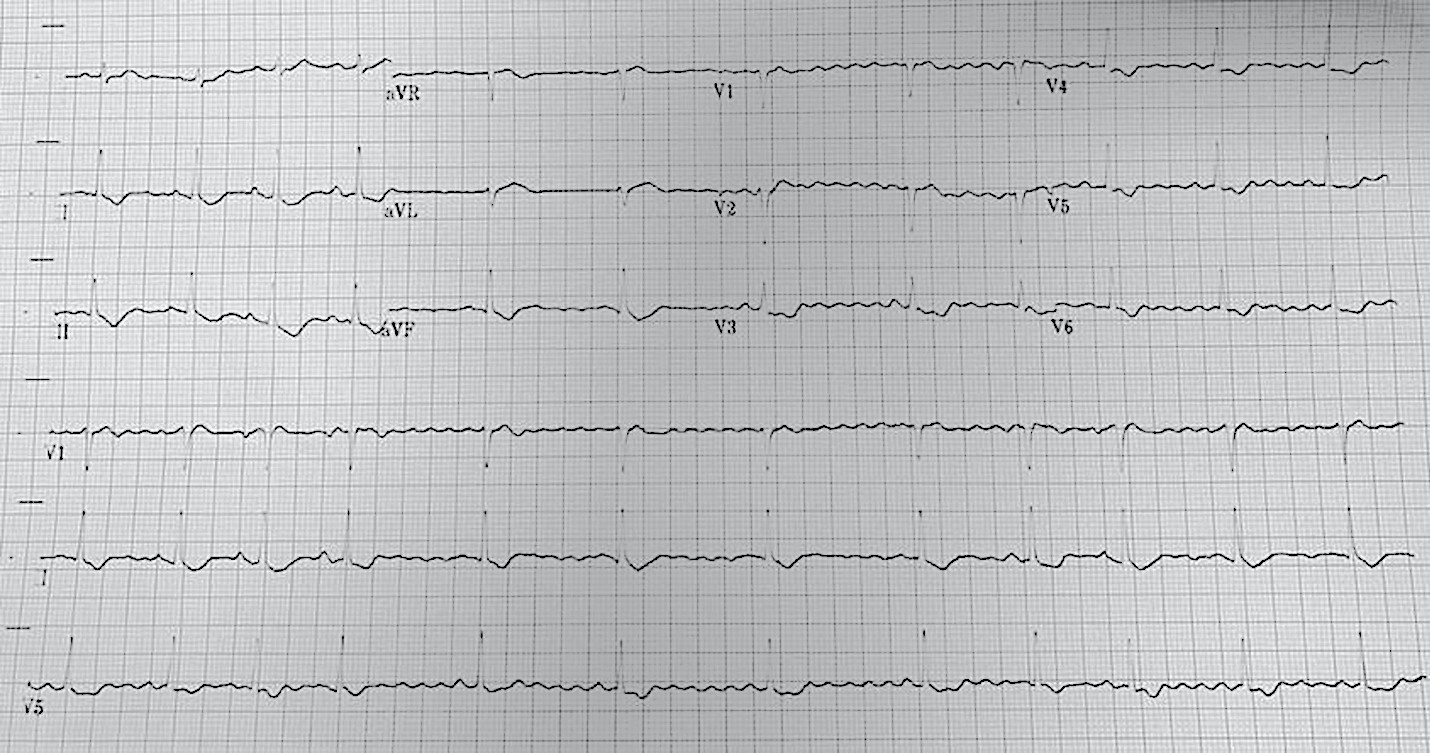
Her vital signs were within normal range (temperature: 36.1◦C, BP: 135/75 mmHg, HR: 76 bpm, RR: 18/min, SpO2: 97%, blood glucose: 5 mmol). The initial ECG revealed a digoxin effect, evolving into sinus arrhythmia, atrial flutter and atrial tachycardia, as illustrated in Figure 1. Upon arrival, the patient’s VBG values revealed metabolic acidosis, with pH: 7.27, PCO2: 46.2 mmHg, lactate: 3.4 mmol/L, HCO3:18 mEq/ L, and a slight increase in potassium: 4.8 mEq/L. The VBG parameters improved after six hours of resuscitation. Her renal profile revealed a normal creatinine level: 55 umol/L; urea: 1.8 mmol/L; the rest of the laboratory work was within normal range, including liver function test and coagulation profile. The digoxin level was 5.2 ng/mL, subsequently decreasing to 2.4 ng/mL. Other medication levels were within normal limits. After two of days of monitoring, the patient was discharged in good health.
Thereafter, the researchers visited four different pharmacies, using a proxy of similar character to the abovementioned patient: an adult female requesting cardioselective medications without prescription. The demographic character is based on the reported age group that showed the highest rate of suicide of the Saudi population [14]. The requested medications were amlodipine, verapamil, diltiazem and digoxin (packs available on the Saudi market are: amlodipine - 30 tablets/5 mg; verapamil - 20 tablets/240 mg; diltiazem - 30 tablets/90 mg; and digoxin - 100 tablets/0.125 mg). These medications were selected for their toxicity based on the number and dose of tablets within each pack [15-17]. The pharmacists’ response to the request for any of these cardioselective medications was recorded using five criteria: 1) Did the pharmacist ask about the indication for use of any of these medications? 2) Did the pharmacist ask about the appropriate dose? 3) Did the pharmacist ask for a prescription? 4) Was there any hesitancy in dispensing any of the medications? 5) Outcome (dis-
pensed/not). All four pharmacies dispensed the medications without hesitancy, and without asking about the indication, prescription, or dosage.
Cardioselective medication overdose requires public health attention. The abovementioned unfortunate case reveals the need for proactive policy reform. There is an urgent need to formulate a policy banning the dispensing of this group of drugs without prescription, and to monitor its implementation. It may be prudent to apply the same public policy initiative implemented in Saudi Arabia in 2018, regarding the sale of antibiotics without prescription, which was successful [18]. We believe the success of such policy is attributed to the multi-level approach applied in launching a public campaign enforced by fines and the threat of proceedings and license revocation. A similar process could be implemented here.
The attitude of the various pharmacists requires further examination. Those pharmacies’ websites indicate that the medications in question are not dispensed without prescription; however, their dispensing attitude could not be judged in the absence of legislation.
We believe this case should trigger further investigation into drugs used for suicide, especially as self-prescription appears a common practice in the community [19, 20]. Although the prevalence of suicide in the community is not high, the impact of suicide using such medications is extreme [21]. We therefore believe this issue should receive equal attention to that given to antibiotic misuse.
REFERENCES [1] Bakhaidar M, Jan S, Farahat F, Attar A, Alsaywid B, Abuznadah W. Pattern of drug overdose and chemical poison-
ing among patients attending an emergency department, west- ern Saudi Arabia . J Community Health. 2015 Feb;40(1):57-61. doi: 10.1007/s10900-014-9895-x. PMID: 24927975.
[2] Lim M, Lee SU, Park JI. Difference in suicide methods used between suicide attempters and suicide completers. Int J Ment Health Syst. 2014 Dec 15;8(1):54. doi: 10.1186/1752- 4458-8-54. PMID: 25584067; PMCID: PMC4290454. [3] Taylor R, Page A, Wodak A, Dudley M, Munot S, Morrell S. Confluence of suicide and drug overdose epidemics in young Australian males: common causality? BMC Pub- lic Health. 2018 Aug 3;18(1):965. doi: 10.1186/s12889-018- 5875-x. PMID: 30075719; PMCID: PMC6090755. [4] Rane A, Nadkarni A. Suicide in India: a system- atic review. Shanghai Arch Psychiatry. 2014 Apr;26(2):69-80. doi: 10.3969/j.issn.1002-0829.2014.02.003. PMID: 25092952; PMCID: PMC4120287.
[5] Ghosh, S., & Sircar, M. (2008). Calcium channel blocker overdose: experience with amlodipine. Indian journal of critical care medicine : peer-reviewed, official publication of Indian Society of Critical Care Medicine, 12(4), 190–193. https://doi.org/10.4103/0972-5229.45080
[6] Chakraborty RK, Hamilton RJ. Calcium Channel Blocker Toxicity. [Updated 2021 Mar 1]. In: StatPearls [Inter- net]. Treasure Island (FL): StatPearls Publishing; 2021 Jan-. Available from: https://www.ncbi.nlm.nih.gov/books/NBK537 147/ [7] DeWitt CR, Waksman JC. Pharmacology, pathophys- iology and management of calcium channel blocker and beta- blocker toxicity. Toxicol Rev. 2004;23(4):223-38. doi: 10.2165/00139709-200423040-00003. PMID: 15898828. [8] Beta blockers [Internet]. nhs.uk. 2017 [cited 2021 Jun 16]. Available from: https://www.nhs.uk/conditions/beta-block
[9] Digoxin: a medicine used to treat irregular heartbeats (Arrhythmias) and atrial fibrillation [Internet]. nhs.uk. 2020 [cited 2021 Jun 16]. Available from: https://www.nhs.uk/med icines/digoxin/ [10] amlodipine: medicine to treat high blood pressure [Internet]. nhs.uk. 2018 [cited 2021 Jun 16]. Available from: https://www.nhs.uk/medicines/amlodipine/
[11] Research C for DE and Over-the-counter (OTC) drugs branch. FDA [Internet]. 2020 Jun 2 [cited 2021 Jun 16]; Available from: https://www.fda.gov/drugs/enforcement-activ ities-fda/over-counter-otc-drugs-branch
[12] Ministry of Health. Ions Health Practicing of Law Dated), 59/M. (No Decree Royal The By Issued H 1426/11/04 Thereof Regulations Implementing The And .No Resolution Ministerial The By Issued 1439h/01/02 Dated) 4080489( [Internet]. 2017 [cited 2021 Jun 1]. Available from: https://www.moh.gov.sa/en/Ministry/Rules/Documents/ Executive-Regulations-of-Health-Practice-Law-Ar.pdf
[13] Abukhalaf A, Alomar A, Alsalame N, Sumaya O, Alessa O, Alasbali M, et al. Inappropriate use of beta-blockers among medical and dental students at King Saud University, Riyadh. J Family Med Prim Care. 2020;9(8):4391.
[14] Elfawal MA. Cultural influence on the incidence and choice of method of suicide in Saudi Arabia. Am J Forensic Med Pathol. 1999 Jun;20(2):163-8. doi: 10.1097/00000433- 199906000-00012. PMID: 10414658. [15] Stephen VS, Pluymers NA, Gauton SJ. Emergency management of calcium channel blocker overdose. S Afr Med J. 2019 Aug 28;109(9):635.
[16] Howarth DM, Dawson AH, Smith AJ, Buckley N, Whyte IM. Calcium channel blocking drug overdose: an Australian series. Hum Exp Toxicol. 1994 Mar;13(3):161-6. doi: 10.1177/096032719401300304. PMID: 7909677.
[17] Pincus M. Management of digoxin toxicity. Aust Pre- scr. 2016 Feb;39(1):18-20. doi: 10.18773/austprescr.2016.006. Epub 2016 Feb 1. PMID: 27041802; PMCID: PMC4816869.
[18] Alrasheedy AA, Alsalloum MA, Almuqbil FA, Al- muzaini MA, Aba Alkhayl BS, Albishri AS, Alharbi FF, Alharbi SR, Alodhayb AK, Alfadl AA, Godman B, Hill R, Anaam MS. The impact of law enforcement on dispensing antibiotics without prescription: a multi-methods study from Saudi Arabia. Expert Rev Anti Infect Ther. 2020 Jan;18(1):87- 97. doi: 10.1080/14787210.2020.1705156. Epub 2019 Dec 23. PMID: 31834825.
[19] Alshahrani SM, Alavudeen SS, Alakhali KM, Al- Worafi YM, Bahamdan AK, Vigneshwaran E. Self-Medication Among King Khalid University Students, Saudi Arabia. Risk Manag Healthc Policy. 2019 Nov 14;12:243-249. doi: 10.2147/RMHP.S230257. PMID: 31814786; PMCID: PMC6861838.
[20] Al-Ghamdi S, Alfauri TM, Alharbi MA, Alsaihati MM, Alshaykh MM, Alharbi AA, Aljaizani NS, Allehiby IA, Alzahrani MA, Alharbi AS. Current self-medication practices in the Kingdom of Saudi Arabia: an observa- tional study. Pan Afr Med J. 2020 Sep 14;37:51. doi: 10.11604/pamj.2020.37.51.24098. PMID: 33209178; PMCID: PMC7648480.
[21] Saudi Arabia suicide rate 2000-2021 [Internet]. [cited 2021 Jun 16]. Available from: https://www.macrotrends.net/c ountries/SAU/saudi-arabia/suicide-rate