Full text rendered from the published PDF. The PDF is the version of record; if the two differ, the PDF governs.
Background: Injury interpretation, a core component of forensic practice, has the potential to alter the course of an investigation and guide it in the correct direction. Here, we discuss four cases in which the identification, analysis, and interpretation of injuries led the investigating agency to revise their understanding of the cause of death.
Aim: This case series aims to highlight the importance of injury interpretation in forensic practice.
Methodology: We reviewed the results of all medicolegal autopsies conducted in the Whitefield area of Bengaluru city, India, over the seven-year period from 2015 to 2021, to identify those in which a discrepancy existed between the history submitted by the investigating officer and the autopsy findings.
Results: Of 781 postmortem reports, only the current four cases showed a significant difference between the history documented by the investigating officers and the observations of the autopsy surgeons. In one case, the cause of death was reported to be a road traffic accident, but was found by autopsy to be homicide. The second case, found deceased approximately 1.5 km from the main road, was presented as a homicide but found at autopsy to be a road traffic accident. In the third case, there were fatal injuries to the head, a stab wound to the brachial artery in the arm, and injuries to the external genitalia, but the investigating officer had suspected dog mauling as the cause of death. The fourth case involved the mutilated remains of a body discovered on a road, suggestive of multiple runovers. Upon meticulous examination, however, a stab wound was identified on the chest region, causing the investigating authorities to alter the investigation from that of a road traffic accident to that of homicide with concealment of evidence.
Conclusion: Accurate and timely injury interpretation plays a significant role in criminal investigations, with the potential to reveal concealed injuries and facilitate justice.
Keywords: Accidents, Forensic Pathology, Homicide, Postmortem Changes, Traffic, Wounds and Injuries
In India, according to Section 174 of the Criminal Procedure Code (CrPC), inquiry into the cause of death is conducted by a police inquest or a magis- trate’s inquest; this is followed by the postmortem examination by a forensic medicine expert [1]. This process differs from the medical examiner system or the coroner system of investigation, the former of which has largely replaced the latter [2]. The advantage of the medical examiner system is the presence of a forensic pathologist from the out- set of the investigation. Conversely, in India, a qualified forensic specialist will be formally in- volved in a case only upon the official request of the investigating officer (I.O.) to conduct a post- mortem examination at the time the body is moved to the mortuary. By such time, the investigation is largely over and, because the I.O. generally lacks sufficient knowledge of injury interpretation, they may not have followed the correct line of inquiry. The forensic examiner should also remain mindful that, in rare cases, the cause of death may be ma- nipulated. Here, we discuss four cases in which fo- rensic injury interpretation corrected the line of in- vestigation and thereby the course of justice. These cases highlight the importance of injury interpreta- tion in the context of criminal investigations.
For this study, we searched the reports of all autop- sies conducted between 2015 and 2021 in the Whitefield area of Bengaluru city, India, including only those in which the discrepancy between the I.O.’s report and the autopsy findings was suffi- cient to result in the revision of the cause of death. All other cases were excluded from the study.
Out of 781 postmortem examinations conducted during this period, four cases met the inclusion cri- teria for our study. In these cases, the significant difference between the I.O.’s recorded observa- tions and those of the autopsy surgeons led to the
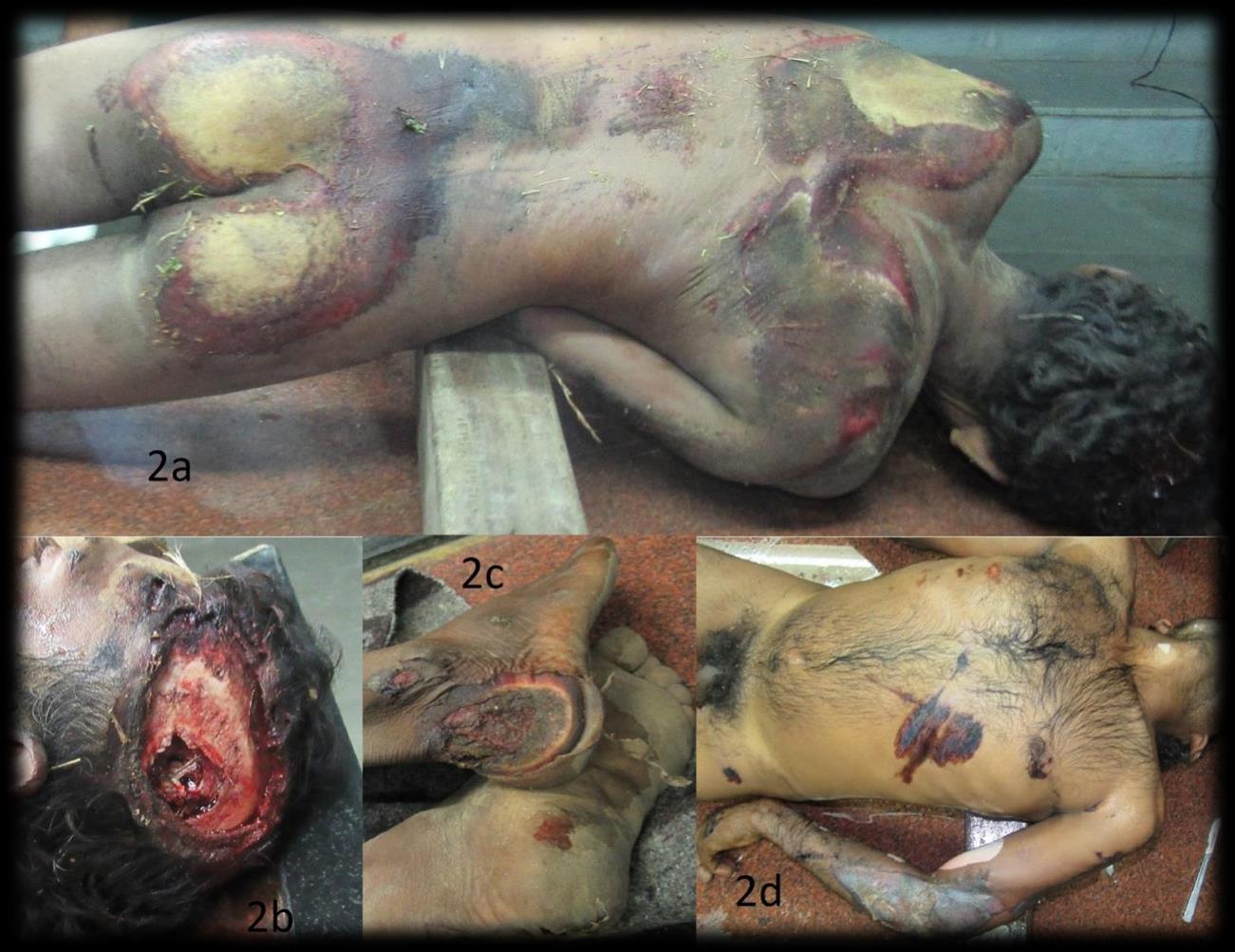
initially recorded cause of death, as presumed by the I.O., to be revised by the autopsy surgeons. Case 1: Homicide presented as hit-and-run road traffic accident The deceased, a moderately-built male in his mid- 50s, was brought for autopsy with an alleged his- tory of a road traffic accident (RTA). The case was registered under sections 279 and 304-A of the In- dian Penal Code (IPC), which penalise rash driving and causing death by a rash or negligent act, respec- tively [1]. On the autopsy table, grouped injuries were found on the head; meticulous examination (Figure 1) revealed a typical narrow, wedge-shaped pattern with nearly clean-cut margins (Figure 1a). The underlying bone of the cranial vault also dis- played a fracture consistent with impact from a weapon (Figure 1b). There were two incision wounds in different planes over the palmar aspect of the left hand (Figure 1c). The presence of scalp hematoma corresponded to the injuries seen in Fig- ure 1a. The brain was covered with subdural and subarachnoid haemorrhages (the absolute volume of blood could not be determined under the circum- stances). No other injuries were observed, and a toxicology analysis was negative for ethyl alcohol. These injuries were presumed to be caused by a RTA simply because the body had been found on the roadside; however, upon the homicidal nature of the injuries being explained to the I.O.s, the course of the investigation was altered. Based on the autopsy report, the I.O. found that the deceased had been killed by his wife and her lover, using a sickle. Subsequent examination of the weapon found it to be consistent with the type of injury sus- tained by the victim. Case 2: Road traffic accident presented as homi- cide The body of a male in his 40s was presented with an alleged history of death due to homicide. The case was booked under Section 302 of the IPC, which penalises murder (Indian Criminal Manual [1]). On the autopsy table, a moderately built male body displayed typical grazing injuries, symmetri- cally distributed over the prominences of the back (Figure 2a). There were further abrasive injuries over the front of the body, involving the trunk (Fig- ure 2d). Postmortem grazes (there were no vital re- actions) were observed over the back, scalp, parie- tal region of the skull, and the heels of both feet (Figures 2b & 2c). Internally, there were multiple rib fractures.
These injuries were incorrectly interpreted by the I.O. as homicidal in nature, based only on the fact that the body had been found in an abandoned area. However, on the basis of the autopsy findings, the cause of death was found to be RTA: the driver and assistant of a public transport vehicle, upon discov- ering the body after dragging it for 1.5 km, had dis- posed of it, fearing punishment. Case 3: Uncertain cause of death with animal scav- enging marks The body of a male in his 30s was found in an un- dressed state in an abandoned area. The body dis- played multiple scratches in various planes, rang- ing in size from 1 x 0.25 cm to 9 x 0.30 cm, some involving only the epidermis, while others involved also the dermis (Figure 3a). These scratch injuries were accompanied by superficial as well as deep- seated contusions in places. There was a perforat- ing injury over the right arm region, with clean-cut margins (Figure 3b), as well as a lacerated wound in the pubic region which exposed the testes (Fig- ure 3e). Similar lacerations were also observed on the scalp and the left scapular region (Figures 3c & 3d). A section of the scalp, including a tuft of hair, was found grasped in the right hand. Histopatho- logical examination of the testes revealed signs of antemortem trauma. All antemortem injuries ap- peared non-accidental, substantiated by their ap- pearance and anatomical distribution. This case was booked under Section 174(3)(iv) of the Crimi- nal Procedure Code (CrPC), which provides for cases where there is doubt regarding the cause of death (Indian Criminal Manual), owing to the dif- ficulty of amending a case once it has been regis- tered as a homicide. Any I.O. who is unsure of the cause of death will register such cases under Sec- tion 174(3); this can later be adjusted to homicide or unnatural death before charge sheeting. The I.O. had suspected death by dog mauling in this case, but instead, the injuries leading to death were an injury to the head, a stab wound to the brachial artery of the right arm, and injury to the external genitalia. This led to the investigation changing from animal-induced death to a case of homicide. After the autopsy, the police found that the de- ceased had belonged to a nomadic community that relocated frequently according to work opportuni- ties. The police hypothesized that the death could be related to an illicit relationship, but reported that they could not locate any members of the group as they had no details of their whereabouts.
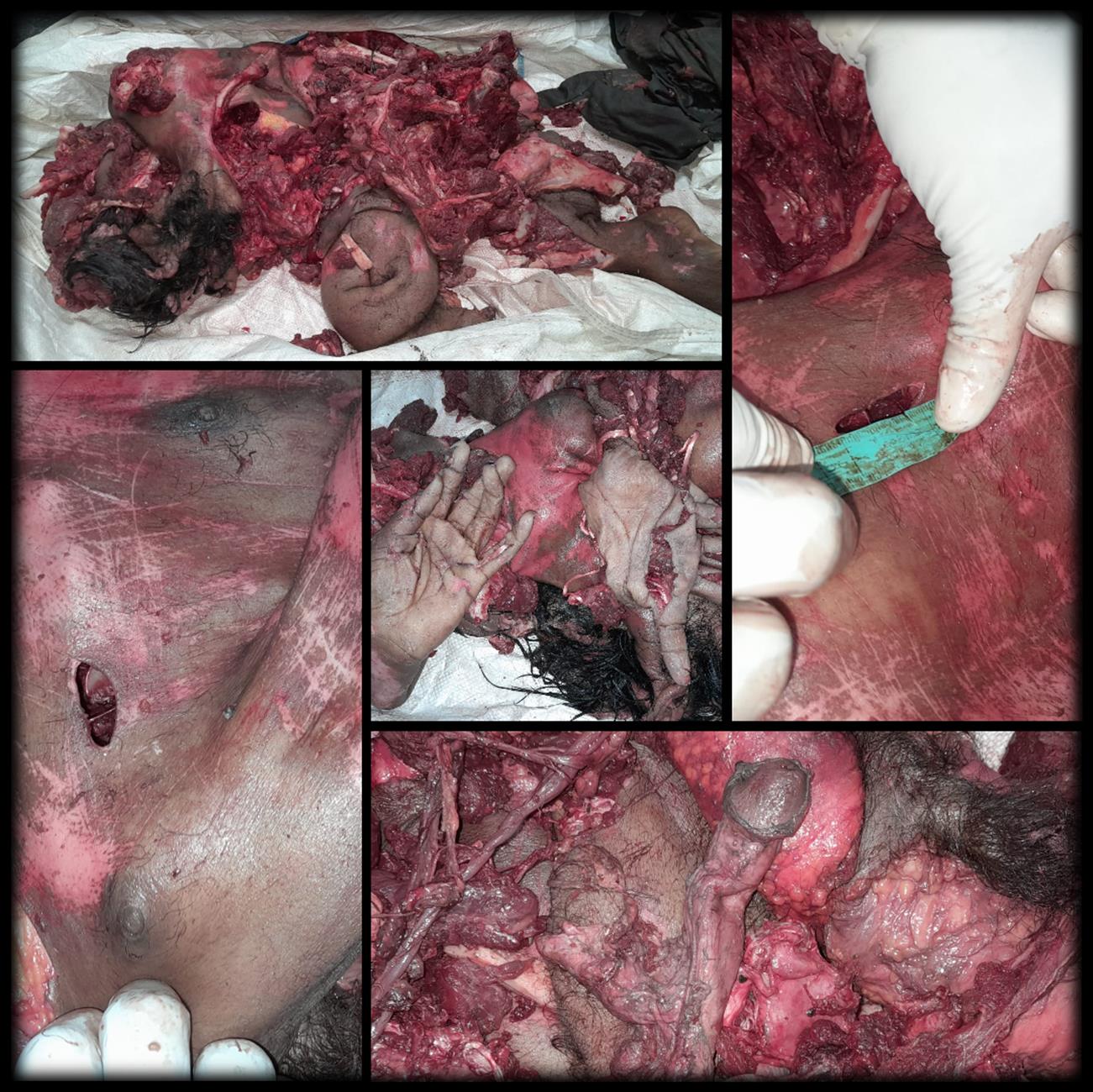
Case 4: Homicide presented as a run-over road traffic accident The deceased presented with disfigured body parts and an alleged history of multiple run-over events occurring overnight (Figure 4). Examination re- vealed a degloved penile shaft, confirming male gender. All body parts, including the organs, were irregularly crushed. A stab wound was noted be- tween the nipples, in the middle region of the chest. Some of the injuries were postmortem in nature, in- dicated by the absence of vital reactions in places. There were multiple linear crush injuries over both palmar aspects, raising suspicion of defence wounds. Toxicology analysis was negative for ethyl alcohol. The possible causes of such injuries were explained to the I.O.; this altered their outlook on the case, raising suspicion of homicide concealed as RTA, rather than RTA alone. Upon receiving the injury interpretation, the police changed the course of their investigation from that of a road traffic acci- dent to that of a homicide with concealment of ev- idence.
Accurate injury interpretation aids investigating agencies in ensuring justice. While police investi- gation of road traffic accidents (RTAs) is generally cursory [3], cases 1 and 4, discussed here, illustrate how mutilations caused by RTAs can be used by perpetrators to conceal homicidal injuries. These reports represent two instances where clear-cut homicides were misidentified as RTAs and pre- sented as such to the autopsy surgeon. It is the lat- ter’s interpretation of the injuries that led the I.O. to correct the course of investigation. Injuries that are unfamiliar to investigators, or are not typically encountered in their regular investiga- tive work, may be brought to an autopsy surgeon for assistance and guidance. Case 2 discusses a death initially presumed by the I.O. to be a homi- cide. The autopsy surgeons, however, found the pattern of injuries and their distribution to be sug- gestive of dragging/grinding injuries consistent with RTA. Similar RTA injuries have been re- ported by other authors in the past [4]. In such cases, death would have occurred on initial impact, with bone abrasions and other postmortem injuries caused by dragging over a significant distance when the body became trapped under the vehicle,
or clothing was caught on a vehicle part [5,6]. Sim- ilar bone abrasions observed in two other cases were also caused by dragging force [7]. The unusual injuries in Case 3 led the I.O. to sus- pect dog mauling as the primary cause of death. However, upon autopsy, it was found that the bite wounds were postmortem in nature (evidenced by the absence of vital reactions at the bite sites), and that the fatal injuries were those to the head, bra- chial artery, and the external genitalia. The dog bite injuries, rather than being the cause of death, may have been entirely coincidental to the circum- stances [8]. This prompted the I.O. to change their course of investigation to one of homicide.
A review of the literature review revealed only a small percentage of cases in which the autopsy findings differed sufficiently from the cause of death reported by the I.O. Moreover, instances of injury interpretation influencing the course of in- vestigation are scarcely reported in the locality where this study was conducted. Nevertheless, it must be concluded that meticulous autopsy and in- jury interpretation is essential, requiring a scientific approach rather than reliance on the history fur- nished by investigators, in order to ensure justice.
Ethics approval and consent to participate: Not ap- plicable Consent for publication: Not applicable Funding: Not applicable
VII. REFERENCES 1. Government of India. Indian Criminal Manual [Internet]. 1974. https://legisla- tive.gov.in/sites/default/files/A1974- 02.pdf. Accessed 22 July 2024. 2. Payne-James J, Byard RW. United States death investigation systems. In: Encyclope- dia of Forensic and Legal Medicine . Else- vier. Ed., 2005. 3. Patra AP, Rayamane AP, Shaha KK. Hom- icide disguised as road-traffic accident: a case-report. Forensic Res Criminol Int J . 2015; 1 (3):87-89. https://doi.org/10.15406/frcij.2015.01.000 15
4. Prahlow SP, Prahlow JA. Fatal dragging deaths with soft tissue and bone grinding in- juries. Acad Forensic Pathol . 2016; 6 (4):709-719. 5. Klintschar M, Darok M, Roll P. Fatal truck- bicycle accident involving dragging for 45 km. Int J Legal Med . 2003; 117: 226–228. https://doi.org/10.1007/s00414-003-0364- 9 6. Giorgetti A, Cecchetto G, Giraudo C, Quaia E, Viero A, Viel G, et al. Reconstruction of the dynamic in a fatal traffic accident with prolonged dragging of the victim. Legal Medicine . 2021; 53: 101963. https://doi.org/10.1016/j.le- galmed.2021.101963 7. Tumram, NK. Bone abrasions due to the dragging force of a moving vehicle: Two unusual case reports. Arch Med Sadowej Kryminol . 2020; 70 (4):251-256. https://doi.org/10.5114/amsik.2020.10458 3 8. Byard RW. Animals, autopsies and arte- facts. Forensic Science, Medicine, and Pa- thology . 2011; 7 (3):309–310. https://doi.org/10.1007/s12024-011-9269- y
Figure 1. Case of homicide presented as a hit-and-run road traffic accident (1a) Four incised wounds: 1, measuring 4 cm x 0.5 cm x bone deep, situated obliquely over the left side of the head, 6 cm above the top of left ear pinna; 2, measuring 3.5 cm x 0.3 cm x scalp deep, situated 2 cm behind the first injury; 3, measuring 3 cm x 0.3 cm x bone deep, behind injury number 2; and 4, measuring 8 cm x 0.5 cm x bone deep, situated 2 cm below injury number 3. (1b) Underlying clean-cut skull fractures corresponding to the incised wounds. (1c) Incised wounds over the palmar aspect of the left hand, measur- ing 7.5 cm x 0.25 cm and 4 cm x 0.25 cm.
Figure 3. Uncertain cause of death with animal scavenging injuries. (3a) Multiple scratch marks with no bleeding points, showing whitish base, likely caused by postmortem gnawing by an animal—probably dog/s. (3b) Stab wound, measuring 4 cm x 2.5 cm x muscle deep, over inner aspect of middle of right upper arm. (3c) Lacerated wound, measuring 11 cm x 10 cm x scalp deep, over the top of the frontal region of the head. (3d) Lacerated wound, measuring 13 cm x 11 cm x skin deep, over upper posterior aspect of left scapular region. (3e) Lacerated wound, measuring 8 cm x 7.5 cm x bone deep, over the pubic region; testis and spermatic cord are exposed.