Full text rendered from the published PDF. The PDF is the version of record; if the two differ, the PDF governs.
Background Clinical research is an integral part of medical and surgical residency programmes, as well as medical school.
Aim This study aimed to investigate attitudes toward, the experience of, and perceived barriers to, conducting clinical research in the medical and surgical fields in Saudi Arabia. We also aimed to explore attitudes toward article processing charges and submission fees.
Methods A cross-sectional study conducted in Saudi Arabia during the months of May-June 2021. The inclusion criteria were trainees in various medical and surgical specialities.
Results The majority of participants conducted at least one research project, representing 92.5% (n=185); of those, 77.3% (n=143) had already published their research. While 33.5% (n=67) of participants felt comfortable designing, leading and critically appraising articles, only 17.3% (n=34) were comfortable using statistical software. Barriers to clinical research include lack of personal interest, lack of interest on the part of programme directors/mentors, inadequate support from mentors/assistants, being overwhelmed with educational activities and examinations, lack of reward and/or motivation, and difficulties obtaining an appropriate sample.
Conclusion This article provides new insight into the knowledge of, and attitude toward, clinical research among Saudi Arabian trainees, and discusses the implications thereof and the future direction of clinical research in Saudi Arabia.
In recent years, research has become an essential component of several medical and surgical training specialities. With the overall aim of drawing appropriate scientific conclusions, research activities foster critical thinking and lifelong learning. Thus, health research training is an essential aspect of medical school, residency training programmes and fellowships.
As part of their training programmes, Saudi Arabian trainees have recently been mandated by the Saudi Commission for Health Specialties to conduct at least one research project before graduation; however, only 58% have complied with this mandatory requirement [1]. Although one study noted a favourable attitude toward research [2], several barriers emerged, including lack of research training/ curriculum, in- adequate facilities, insufficient time, work-related stress, and a lack of supervisors [3]. Two of those factors – the lack of su- pervisors and the lack of a research curriculum in the training programme – were emphasised [1]. Still, the literature lacks
Ziad Zekry, Mossa Khalifah, Albara Alsayed are with Emergency De- partment, King Fahd Medical City, e-mail: Mossa.r.k@hotmail.com, e-mail: Ziad.wz@hotmail.com, e-mail: asaalsayed@kfmc.med.sa
Joud Enabi, Hamza Enabi, Basel Alkhatib are with Alfaisal Uni- versity , e-mail: jenabi@alfaisal.edu, e-mail: henabi@alfaisal.edu, e-mail: Balkhatib@alfaisal.edu
exploration of the trainees’ competencies toward research – mainly whether trainees are competent to conduct studies and appraise articles.
The purpose of this study was to investigate attitudes to- ward, the experience of, and perceived barriers to, conducting clinical research in Saudi Arabian medical and surgical train- ing programmes. Moreover, we were unable to establish from the literature what constitutes “fair” article processing charges and submission fees from the trainees’ perspective. Therefore, we aimed to explore attitudes toward article processing charges and submission fees.
This is a cross-sectional study carried out in Saudi Arabia during the months of May-June 2021. The inclusion criteria were trainees in various medical and surgical specialities. The data were collected via a structured survey, using an online survey tool; the survey was developed by the authors and distributed via social media. The first part consists of questions about demographics; participation in research; and familiarity with the journal submission process, data analysis and statistical software such as SPSS or STATA. Part Two is concerned with barriers to conducting clinical research, while Part Three inquires about fees for article submission and what constitutes a fair amount to pay. We excluded those whose survey response was incomplete.
Demographic The total number of participants was 200; the participants’ demographics are illustrated in Table 1.
Design, submission and publishing The majority of the trainees conducted at least one research project, representing 92.5% (n=185); of those, 77.3% (n=143) had already published their research. Almost two thirds sub- mitted their research to the journal independently, representing 70.8% (n=131). However, the percentage of those who feel comfortable designing, leading or critically appraising articles was only 33.5% (n=67) of all participants, and only 17.3% (n=34) were capable of conducting data analysis using statis- tical software such as SPSS or STATA.
The majority of participants conducted cross-sectional stud- ies – 47% (n=94); followed by case reports – 15.5% (n=31); and cohort studies – 15.5% (n=31). Review articles were written by 9.5% (n=19), while case-control and clinical trials each comprised only 6% (n=12). Case series were reported by only one participant – 0.5% (n=1).
In this study, most participants conducted at least one research project. This percentage is higher than previously re- ported [1], indicating more research engagement. Interestingly,
descriptive studies were the leading research design, of which cross-sectional and case-report studies were the most common.
Furthermore, we noted that only one-third of participants were comfortable designing and leading studies. This raises the question as to whether other experimental designs were perceived as challenging from a knowledge deficiency point of view or due to lack of supportive infrastructure; those two factors were indeed reported as barriers to conducting research.
The predictors for uncomfortableness in designing, leading or critically appraising a study include variables related to the trainees themselves and those related to the training pro- grammes. The former include lack of personal interest, being
Our study also provides insight into what is perceived as fair with regard to article processing charges and publication fees in general. Charges vary significantly between journals and between countries. The average amount paid to journals was $2 732, with a range between $1 620 and $3 662 [10], [11]. This amount is considered unreasonable among our trainees; the majority believed $500 to be an acceptable upper limit.
Volunteer bias might have overestimated the result of this analysis. A further large-scale analysis is needed to confirm or refute our findings.
This article provides new insight into the knowledge of, and attitude toward, clinical research among Saudi Arabian trainees. We noted an improvement in the percentage of those conducting research, although the knowledge of study design, analysis and publishing is still far from acceptable. More effort should therefore be directed toward clinical research training during residency, with an emphasis on more experimental studies.
REFERENCES [1] Soubhanneyaz AA, Salem KA, Al-Dubai SAR. Perceptions, barriers, and practice of medical research of family medicine residents in Medina, Saudi Arabia . J Family Community Med. 2019 Sep-Dec;26(3):227-231. doi: 10.4103/jfcm.JFCM_38_19. PMID: 31572055; PMCID: PMC6755763.
[2] Al-Arifi MN. Attitudes of pharmacy students to- wards scientific research and academic career in Saudi Arabia. Saudi Pharm J. 2019 May;27(4):517-520. doi: 10.1016/j.jsps.2019.01.015. Epub 2019 Jan 17. PMID: 31061620; PMCID: PMC6488809.
[3] Saud AlEnazi A, Alamri AS, AlGhamdi AS, Alman- sour AH, Rubaian NFB, Al-Otaibi FK, Alreshaid FT, Saad Alaftan M, Esam Himdy Z, Makhdom RA, Alshahrani M. Perceptions, barriers, and attitudes toward research among in-training physicians in Saudi Arabia: A multicenter sur- vey . Sci Prog. 2021 Apr- Jun;104(2):368504211010604. doi: 10.1177/00368504211010604. PMID: 33970049.
[4] Ul Haq I, Ur Rehman S, Al-Kadri HM, Farooq RK. Research Productivity in the Health Sciences in Saudi Arabia: 2008-2017 . Ann Saudi Med. 2020 Mar-Apr;40(2):147-154. doi: 10.5144/0256- 4947.2020.147. Epub 2020 Apr 2. PMID: 32241169; PMCID: PMC7118236.
[5] Jahan S, Al-Saigul AM. Primary health care research in Saudi Arabia: A quantitative analysis. Int J Health Sci (Qassim). 2017 Apr-Jun;11(2):9-15. PMID: 28539857; PM- CID: PMC5426411.
[6] Mayo MJ, Rockey DC. Development of a success- ful scholarly activity and research program for subspecialty trainees . The American Journal of the Medical Sciences. 2015 Sep;350(3):222–7.
[7] Smith E, Haustein S, Mongeon P, Shu F, Ridde V, Larivière V. Knowledge sharing in global health research - the impact, uptake and cost of open access to scholarly literature . Health Res Policy Syst. 2017 Aug 29;15(1):73. doi: 10.1186/s12961-017-0235-3. PMID: 28851401; PMCID: PMC5576373.
[8] Al-Rawashdeh N, Damsees R, Al-Jeraisy M, Al Qasim E, Deeb AM. Knowledge of and attitudes toward clinical trials in Saudi Arabia: a cross-sectional study . BMJ Open. 2019 Oct 22;9(10):e031305. doi: 10.1136/bmjopen-2019-031305. PMID: 31641002; PMCID: PMC6830621. [9] Al-Jumah M, Abolfotouh MA, Alabdulkareem IB, Balkhy HH, Al-Jeraisy MI, Al-Swaid AF, Al-Musaaed EM, Al-Knawy B. Public attitude towards biomedical research at outpatient clinics of King Abdulaziz Medical City, Riyadh, Saudi Arabia . East Mediterr Health J. 2011 Jun;17(6):536-45. PMID: 21796973.
[10] Al-Hilali SM, Al-Kahtani E, Zaman B, Khandekar R, Al- Shahri A, Edward DP. Attitudes of Saudi Arabian Undergraduate Medical Students towards Health Research . Sultan Qaboos Univ Med J. 2016 Feb;16(1):e68-73. doi: 10.18295/squmj.2016.16.01.012. Epub 2016 Feb 2. PMID: 26909216; PMCID: PMC4746046.
[11] Morey CC. The Journal of Cognition after One Year: A Modern, Society-Backed, Fair Open-Access Option for Cognitive Psychology and Cognitive Neuroscience . J Cogn. 2019 Jan 24;2(1):1. doi: 10.5334/joc.54. PMID: 31517219; PMCID: PMC6634356.
| Variables | Percentage (n) |
|---|---|
| Age | |
| 18-24 years | 11 (22) |
| 25-27 years | 47.5 (95) |
| Older than 27 years | 41.5 (83) |
| Gender | |
| Male | 44.5 (89) |
| Female | 55.5 (111) |
| Educational level | |
| Intern | 18.3 (36) |
| Resident | 62.4 (123) |
| Registrar or specialist | 19.3 (38) |
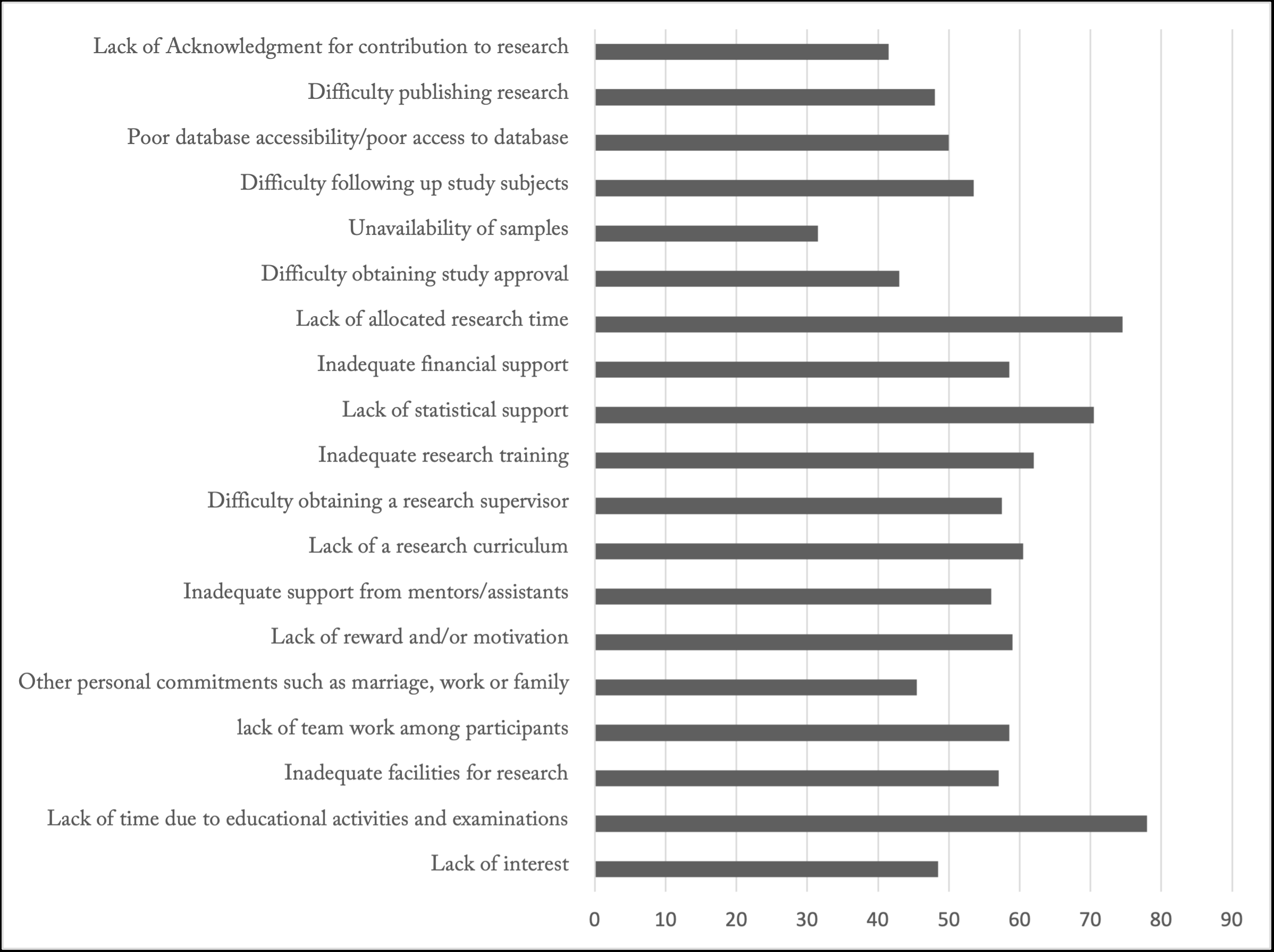
| Barriers to conducting research | overwhelmed with educational activities and examinations, |
| Upon exploring the barriers to conducting research, the par- | and lack of reward. The latter, meanwhile, include a lack |
| ticipants reported a lack of acknowledgement, difficulty getting | of interest in research in general, and a lack of support |
| their article published, difficulty accessing data and getting | from mentors. Therefore, emphasis should be placed on the |
| approval, lack of statistical or financial support, deficiencies | role of mentors and programme directors in motivating res- |
| in research proficiency and in the research curriculum, lack of | idents to become involved in research activity. This can be |
| interest from the supervisors themselves, and lack of interest | accomplished by allowing time for a research symposium, |
| and time constraints on the part of the trainees. Figure 1 | allocating time purely for research, and collaborating with |
| illustrates the percentage prevalence of these factors. | research scientists for teaching and guidance. |
| Furthermore, predictors for uncomfortableness in designing, | Residents and interns also reported the lack of a research |
| leading and critically appraising a study revealed five statisti- | curriculum, which emerged as a predictor for not designing |
| cally significant variables. These include a lack of personal | and leading research projects. We believe research knowledge |
| interest, inadequate support from mentors/assistants, being | among trainees requires attention. The large number of publi- |
| overwhelmed with educational activities and examinations, | cations should not be used as a surrogate marker for increasing |
| lack of reward and/or motivation, and difficulties obtaining an | quality of education, as was once suggested [4]. Perhaps |
| appropriate sample. Table 2 illustrates the inferential statistical | the reduced number of publications suggests the need for |
| tests and their p-value for each variable. | more research-oriented training programmes [5]; nonetheless, |
| monitoring of productivity should be centralised and reported | |
| Article processing charge and publication fee | annually by the Saudi Commission for Health Specialties. |
| Half the participants, 51.5% (n=103), had never paid an | Monitoring should include the study design, the sample size |
| article processing charge or publication fee directly to the | and the productivity based on the programme, institution and |
| journal. 27% (n=54) reported paying less than $500; 16% | province. A centralised monitoring body should also include |
| (n=32) paid less than $1000; whereas 5.5% (n=11) of par- | the medical schools and the Saudi trainees abroad. |
| ticipants reported paying an amount higher than $1000. When | |
| we inquired further as to what is considered a reasonable fee, | We propose having multiple research blocks with didactic |
| 76% (n=149) believed $100-$500 to be an acceptable rate, | lectures on statistics, as advocated by one study [6]. A |
| while 5.5% (n=11) believed publications should be free of | structured research curriculum is required in every training |
| charge. | programme, and the already-established curriculum should be |
| re-examined, particularly as medical students cited inadequate | |
| f l h t i i b i [7] F th th |
| Variables | t-test (df) | p-value |
|---|---|---|
| Lack of interest | 2.37 (198) | 0.019 |
| Lack of time due to the burden of educational activities, including examinations | 3.49 (99.6) | 0.001 |
| Inadequate facilities for research | 1.37 (198) | 0.173 |
| Lack of teamwork among participants | 1.34 (198) | 0.180 |
| Other personal commitments such as marriage, work or family | 1.95 (198) | 0.053 |
| Lack of reward and/or motivation | 2.39 (116) | 0.019 |
| Inadequate support from mentors/assistants | 2.24 (115) | 0.027 |
| Lack of a research curriculum | 1.49 (198) | 0.136 |
| Difficulty obtaining a research supervisor | 1.91 (116) | 0.059 |
| Inadequate research training during medical training or med school | 1.63 (198) | 0.104 |
| Lack of statistical support | -0.21 (198) | 0.837 |
| Inadequate financial support | -1.14 (198) | 0.256 |
| Lack of allocated research time | -0.49 (198) | 0.625 |
| Difficulty obtaining study approval | -0.13 (198) | 0.897 |
| Unavailability of samples (or patients) | 2.73 (198) | 0.007 |
| Difficulty following up study subject (or patients) | -0.71 (198) | 0.477 |
| Poor access to database | 0.29 (198) | 0.766 |
| Difficulty publishing research | 0.11 (198) | 0.910 |
| Lack of acknowledgement for contribution to research | 1.77 (198) | 0.078 |