Full text rendered from the published PDF. The PDF is the version of record; if the two differ, the PDF governs.
Background : Health literacy refers to the skills that enable individuals to make informed decisions to maintain their health.
Aim : This study aimed to determine the association between sociodemographic factors and health literacy in hypertensive patients.
Method : This was a cross-sectional survey conducted in the Cardiology Unit of Abidjan’s National Institute of Public Health, from June to September 2024. Health literacy was assessed using the Health Literacy Questionnaire covering nine dimensions, the first five on a 4-point scale and the last four on a 5-point scale. Mean scores were calculated for each dimension, and the patients’ sociodemographic characteristics were studied.
Results : A total of 431 participants were included, with a mean age of 55.83 ± 11 years. The lowest scores were for ‘Social support for health’ and ‘Navigating the healthcare system’. In contrast, ‘Appraisal of health information’ and ‘Understanding health information’ scored highest. Among the first five dimensions of health literacy, an association was found between dimension 1 and gender, while among the last four dimensions, marital status was associated with dimension 7. Moreover, educational level was associated with all nine dimensions.
Conclusion : Strengthening social support and health system navigation skills could improve the health literacy of hypertensive patients, while educational level is the sociodemographic factor that most strongly influences health literacyamong this cohort.
Keywords: Age Factors, Health Literacy, Hypertension, Patients, West Africa
Health literacy is a complex concept that has evolved over the years since its inception in the 1970s, and has become an important topic in public health. Initially, health literacy focused mainly on health services and therefore only concerned the ability to understand difficult words and master arithmetic calculations in a medical context. However, the concept has broadened over time to include more complex and interconnected skills such as understanding health information, communicating one's needs to health professionals, and understanding health instructions [1]. Health literacy is recognised as a key determinant of public health, and improving literacy levels is therefore a major health policy issue, affecting the public’s ability to better oversee their own health [1]. To achieve health literacy, individuals must be able to understand and critically utilise health information, as well as acquire the skills necessary to improve their health [2]. Promoting health literacy therefore goes beyond simply conveying information on the assumption that people will be able to act on it [3]. A low level of health literacy is a major obstacle to educating patients with chronic diseases, hindering their mastery of the skills required to self-manage their disease and monitor their treatment [4]. Among such chronic diseases is hypertension, defined as a persistent elevation of systolic blood pressure ≥ 140 mmHg and/or diastolic blood pressure ≥ 90 mmHg [5], which is a major public health challenge and a significant risk factor for mortality and excessive morbidity globally [6]. In Africa, the prevalence of hypertension varies considerably from one country to another, ranging from 37% to 75% [7]. Over the past four decades, the highest blood pressure levels in the world have been recorded in low-income countries in South Asia and sub- Saharan Africa. This observation is linked to the
epidemiological transition, which is accompanied by rapid urbanisation and Westernisation of lifestyles [8]. In Côte d'Ivoire, during the International Society of Hypertension's May Measurement Month initiative in 2017, the prevalence of hypertension was estimated at 20.4%, with poor blood pressure control in 54.4% of subjects over the age of 18 [9]. With regard to health literacy among hypertensive patients in Africa, particularly in Côte d'Ivoire, the data is scarce. To improve health literacy, countries must first address health inequalities by analysing the various socio-demographic factors that characterise their populations. Such analysis is essential to highlight the strengths and weaknesses of the health system in relation to the problems encountered, in order to implement the measures necessary to improve health literacy at the national level [10]. It is with this in mind that we undertook this study, the objective of which was to determine the association between sociodemographic factors and health literacy among hypertensive patients at a health centre in Côte d'Ivoire.
Study setting, type, and duration The study was conducted at the Cardiology Unit of the National Institute of Public Health in Abidjan, the economic capital of Côte d'Ivoire, a country in West Africa. It was a cross-sectional analytical survey carried out from 6 June to 20 September 2024. Study population The target population included all hypertensive patients seen in consultation during the study period. All patients aged 18 years and older who consented to participate in the survey were included. Individuals with mental disorders were excluded. Sample size calculation The minimum sample size was determined using Schwartz’s formula. The assumed prevalence was
50%, with a precision of 5% and a 5% α risk, which resulted in a sample size of 384 subjects. Data collection tools
Data were collected using a structured questionnaire consisting of two sections: (i) sociodemographic variables (age, gender, educational level, marital status); and (ii) the Health Literacy Questionnaire (HLQ) [11–14]. The HLQ assesses nine dimensions of health literacy, the first five on a 4-point scale ranging from ‘strongly disagree’ to ‘strongly agree’, and the last four on a 5-point scale ranging from ‘always difficult’ to ‘always easy’. The score for each dimension was calculated as the average of the corresponding items. Data were collected through face-to-face interviews in the waiting room, after presenting the survey and obtaining informed consent. Data entry, processing, and analysis Data were entered using Microsoft Excel 2021 software and processed using SPSS version 25 and R software. Quantitative variables were expressed as averages with standard deviations and extreme values. Qualitative variables were described in terms of numbers and percentages for each variable category. The statistical significance threshold was p < 0.05 [15]. ANOVA was performed to assess for differences between the mean values of each variable according to each dimension of the HLQ. A student’s t-test was performed for variables with two values. In addition, when the conditions for ANOVA were not all met, we performed a Kruskal-Wallis test. The Wilcoxon-Mann Whitney test was also performed for variables with two modalities. Multivariate analysis was performed using the non-parametric PERMANOVA test to analyse data involving several variables simultaneously. This approach made it possible to understand the overall effect of each explanatory variable on the nine dimensions of health literacy simultaneously.
Ethical considerations Participants were informed of the objectives of the
survey, and their free and informed consent was obtained before the survey began. Data confidentiality was ensured throughout the study, and participants were free to withdraw at any time without prejudice. Data collection and entry were carried out in accordance with anonymity and confidentiality requirements.
Socio-demographic characteristics of patients A total of 431 patients were interviewed at the Cardiology Unit of Abidjan’s National Institute of Public Health. All the patients to whom we explained the study agreed to take part in the survey, giving a 100% participation rate. Women predominated, with a sex ratio (M/F) of 0.83. The average age was 55.83 ± 11 years, with a preponderance of the 55‒65 age group, representing 31.79% of the study population. The average age by gender was 54.58 ± 10.71 years for women and 57.33 ± 11.41 years for men. Nearly one-third of patients had a primary school education, and married patients constituted nearly two-thirds of the study population.
The distribution of patients according to gender, age, educational level, and marital status is presented in Table 1. Average health literacy profile of patients In the first part of the HLQ, questions 1 to 5, the score range is 1‒4, with higher scores indicating greater agreement. In the second part, for questions 6 to 9, the score range is 1‒5, with higher scores indicating less difficulty. The overall average score for the 9 dimensions was 2.83. The average score for the first part of the questionnaire (the first five dimensions) was 2.62. The lowest score in this section was for ‘Social support for health’ (2.58), while ‘Appraisal of health information’ scored highest (2.65). The average score for the second part of the questionnaire (the last four dimensions) was 3.10. The lowest score was for ‘Navigating the healthcare system’ (3.06), while the highest was
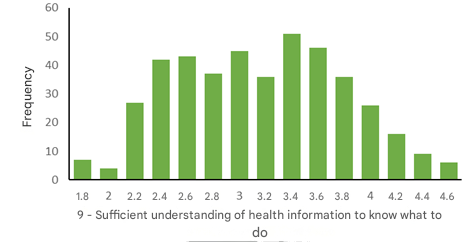
for ‘Understanding health information well enough to know what to do’ (3.16). Table 2 summarises the participants’ average health literacy profile. The overall distribution of scores across all 431 patients centred around intermediate values for all nine dimensions of the HLQ. For most domains, the frequency distribution peaked between 2.2 and 2.8 on the measurement scale, reflecting a concentration of patients around average levels of health literacy. No dimension showed significant accumulation at the extremes, indicating limited variability between individuals. Some dimensions, notably ‘Ability to actively engage with healthcare professionals’, ‘Navigating the healthcare system’. and ‘Understanding health information well enough to know what to do’, showed a slight shift towards higher scores, while ‘Social support for health’ and ‘Appraisal of health information’ remained more strongly concentrated around intermediate values. Overall, the score distribution reflects a relatively homogeneous health literacy profile within the study population. Figure 1 (Appendix) shows the distribution of patients’ health literacy scores. Association between health literacy dimensions and sociodemographic characteristics Table 3 shows the relationship between the first five health literacy dimensions and patients’ gender, age, educational level, and marital status. Among these first five dimensions, a relationship was found between dimension 1 and gender, with male patients feeling more understood and supported by healthcare professionals (p=0.039). Educational level, meanwhile, was associated with all of the first five dimensions; patients with higher levels of education felt understood and supported by healthcare professionals, reported having sufficient information to manage their health, actively managed their health, reporting having social support for health, and knew how to evaluate health information.
No relationship was found between age or marital status and any of the first five dimensions. Table 4 shows the relationship between the last four dimensions of health literacy and gender, age, educational level and marital status. A relationship was found between educational level and all four of the latter dimensions; patients with higher levels of education were able to engage actively with healthcare professionals, knew how to navigate the healthcare system, were able to find good-quality health information, and understood health information well enough to know what to do. Furthermore, unmarried patients were better able to navigate the healthcare system than their married counterparts. No relationship was found between gender or age and any of the last four dimensions.
This study evaluated the relationship between sociodemographic factors and health literacy among hypertensive patients attending the Cardiology Unit at the National Institute of Public Health in Abidjan. The overall average health literacy score for patients in our study was 2.83, indicating that this patient group generally had a moderate level of health literacy. The average age of our study population was 55.83 ± 11 years. This is similar to studies conducted in Lomé, France, and the United Kingdom, in which the authors reported average ages of 55.1 years [16]; 56 years [17], and 55.4 years [18], respectively. In our investigation, females predominated with a sex ratio of 0.83; these results are consistent with those of Said et al., where women accounted for 53.6% of their cohort study in the United Kingdom [19]. This observation could be attributed to the fact that women pay closer attention to their health; however, this trend may vary depending on cultural and regional contexts. Concerning health literacy, dimension 4, ‘Social support for health’, scored the lowest among the
first five dimensions. This indicates that patients did not receive sufficient support from their families with regard to their health—a surprising observation, as African families are known for their mutual support and assistance. In this regard, Olagbemide et al. observed that family support improved medication adherence and blood glucose control [20]. Likewise, Ayodapo et al. noted that, in West Africa, the family plays a very important role in society, its structure being generally robust [21]. The low level of social support observed in our study could be the result of society becoming increasingly individualistic, with people tending to focus on their own interests, not to mention the increasing cost of living which may hinder expressions of goodwill. Added to this is the very high cost of treatment, which tends to discourage even those relatives who would previously have provided support. Social support for health can be a valuable resource, helping patients to better adapt to the demands imposed by illness. The highest score in the first five dimensions was for dimension 5, ‘Appraisal of health information’. This means that patients take the time to verify the reliability of information they receive before making a decision. In contrast to this finding, Beauchamp et al . found that ‘Appraisal of health information’ to obtain the lowest score [22]. One reason for the high score in our study could be that regular appointments with healthcare professionals have developed patients’ critical thinking skills, enabling them to better analyse the information they receive. It is therefore essential that healthcare providers emphasise health education for cardiovascular patients [23]. With regard to the second part of the health literacy questionnaire, the lowest score was for dimension 7, ‘Navigating the healthcare system’. This result is consistent with that of Beauchamp et al. , who noted that the relatively low score observed for this dimension may be attributed to patients feeling overwhelmed by the complexity of information and the number of service providers involved in
their care [22]. Other reasons could also explain this observation, such as long waiting times before being seen by a healthcare professional [24,25]. The dimension that scored highest among the last four dimensions was dimension 9, ‘Understanding health information well enough to know what to do.’ This finding indicates that patients had no difficulty understanding written health information or treatment instructions [26]. These results are confirmed by a study in Australia, in which the same dimension had the highest score [27]. However, Beauchamp et al., also in Australia, noted dimension 6, ‘Ability to actively engage with healthcare professionals’, as the highest scoring dimension in this section [22]. These observations demonstrate that levels of health literacy can vary from one dimension to another, even in populations of a similar culture. Our results showed an association between gender and dimension 1 of the HLQ, ‘Feeling understood and supported by healthcare professionals’, indicating that male patients felt understood and supported by healthcare professionals. However, findings concerning the association between gender and health literacy are mixed. One systematic review showed that health literacy level was not associated with gender [28]. Conversely, in line with our findings, Amoah et al. found higher health literacy levels among men. This observed difference could be attributed to the dominant role of men in the studied populations [29]. In contrast to the above, Lee et al. in South Korea argued that women had higher health literacy than men in terms of understanding medical forms, instructions on medicine bottles, and written information provided by healthcare providers [30]. According to these authors, this gap may be associated with women’s greater ease in navigating the healthcare system when dealing with health issues. Another explanation may be related to women’s traditional role of caring for sick family members and children. This traditional gender expectation may provide women with more interactions with the healthcare system,
allowing them more opportunities to enrich their knowledge, thus resulting in higher levels of health literacy than men [30]. In our survey, educational level was strongly associated with all nine dimensions of health literacy, with our results showing better health literacy in patients with higher educational levels. This finding is consistent with previous studies that highlight an association between higher educational levels and better health literacy [26,31]. Those authors have demonstrated that an individual’s health literacy level is linked to their education and that years of schooling can be predictors of different health literacy levels, thus confirming the results observed in the present study. It should be noted that a high level of education may also be associated with population health, particularly with regard to understanding disease and promoting health. Concerning marital status, we found an association only with one dimension of health literacy, namely dimension 7, ‘Navigating the healthcare system’. According to our results, unmarried patients were better in this regard. This finding is surprising; we had expected to find married patients to be better able to navigate the health system, thanks to the support of their partners. In a similar vein, Hu et al., in China, emphasised in their research that marriage is generally beneficial to health because it provides social support and security, and that weakened social ties and persistent social isolation were associated with an increased risk of mortality. They found that health literacy levels were significantly lower among unmarried patients and that married patients reported the highest levels of social support [32]. The finding of our survey could be explained by greater autonomy and a need to seek information independently among people who are not in a relationship. Indeed, the absence of a partner may encourage greater individual responsibility in managing health by developing personal strategies for interpreting medical information, resulting in a greater ability
to seek available services in order to meet needs and better utilise the health system. Furthermore, greater independence, often characteristic of people not in a relationship, could promote a greater ability to use health services. In our survey, ‘Social support for health’ received the lowest score. This finding is surprising given the strong family ties in African cultures. However, our survey was conducted among patients with a chronic condition: hypertension. Further research is needed among different African populations, such as the general population, or among patients with other chronic conditions. Such research will enable better exploration and understanding of the nuances of social support within these different populations. Limitations This study has some limitations worth noting. Face-to-face administration of the questionnaire exposes responses to a possible overestimation of patients' abilities, influenced by the presence of the interviewer. The study was conducted in a specialised unit within a single urban facility, and the findings cannot therefore be extended to the national level. Furthermore, our study population was limited to patients with hypertension; the results, particularly those relating to social support for health, cannot be generalised to all patients, especially those with other medical conditions. Further studies are needed among different populations.
This survey highlighted the relationships between educational level and all aspects of health literacy. It is crucial, therefore, that policies prioritise education and access to schooling, particularly for girls. An educated population will be more receptive to awareness programmes and will be better able to understand the risk factors for diseases, particularly in the case of chronic conditions such as hypertension.
The authors would like to thank the staff of the
cardiology unit at the National Institute of Public Health, Abidjan.
The authors declare no conflict of interest.
| educational | level, | and marital status | [mean (standard | deviation)] | |
|---|---|---|---|---|---|
| Variables | Feeling | Having | Actively | Social | Appraisal of |
| understood | sufficient | managing | support | health | |
| and | information to | one’s | for | information | |
| supported by | manage health | health | health | M(SD) | |
| health | M(SD) | M(SD) | M(SD) | ||
| professionals | |||||
| M(SD) | |||||
| Gender | |||||
| Female (n=236) | 2.58(0.43) | 2.60(0.41) | 2.57(0.37) | 2.57(0.41) | 2.64(0.39) |
| Male (n=195) | 2.67(0.46) | 2.67(0.52) | 2.60(0.41) | 2.59(0.45) | 2.66(0.47) |
| p-value | 0.039 | 0.112 | 0.552 | 0.635 | 0.882 |
| Age (years) | |||||
| 25–35 (n=10) | 2.72(0.41) | 2.72(0.40) | 2.73(0.45) | 2.59(0.36) | 2.67(0.55) |
| 35–45 (n=59) | 2.52(0.49) | 2.57(0.52) | 2.62(0.41) | 2.57(0.46) | 2.61(0.43) |
| 45–55 (n=131) | 2.62(0.44) | 2.66(0.49) | 2.58(0.37) | 2.57(0.40) | 2.64(0.41) |
| p-value | 0.263 | 0.704 | 0.496 | 0.825 | 0.906 |
| Educational level | |||||
| No schooling | 2.34(0.41) | 2.39(0.42) | 2.39(0.29) | 2.31(0.30) | 2.44(0.34) |
| (n=108) | |||||
| Primary (n=134) | 2.51(0.34) | 2.48(0.41) | 2.44(0.33) | 2.42(0.38) | 2.49(0.38) |
| Secondary | 2.79(0.36) | 2.76(0.37) | 2.68(0.36) | 2.74(0.36) | 2.80(0.40) |
| (n=102) | |||||
| Higher (n=87) | 2.98(0.43) | 3.03(0.39) | 2.5(0.32) | 2.96(0.36) | 2.98(0.37) |
| p-value | 0.000 | 0.000 | 0.000 | 0.000 | 0.000 |
| Marital status | |||||
| Married (n=272) | 2.62(0.47) | 2.61(0.49) | 2.59(0.38) | 2.56(0.42) | 2.64(0.44) |
| Single (n=159) | 2.64(0.41) | 2.67(0.41) | 2.59(0.40) | 2.60(0.45) | 2.66(0.41) |
| p-value | 0.645 | 0.217 | 0.997 | 0.325 | 0.659 |
| DOI: 10 52609/jmlph | v6i3 299 | | E-mail: malik simone@inspci | org |
| educational | level, and marital | status [mean | (standard deviation)] | |
|---|---|---|---|---|
| Variables | Ability to | Navigating | Ability to find | Understanding |
| actively engage | the healthcare | good health | health | |
| with health | system | information | information | |
| professionals | M(SD) | M(SD) | well enough to | |
| M(SD) | know what to | |||
| do | ||||
| M(SD) | ||||
| Gender | ||||
| Female (n=236) | 3.02(0.55) | 3.03(0.52) | 3.08(0.61) | 3.13(0.61) |
| Male (n=195) | 3.10(0.59) | 3.11(0.59) | 3.15(0.66) | 3.19(0.67) |
| p-value | 0.199 | 0.245 | 0.249 | 0.419 |
| Age (years) | ||||
| 25–35 (n=10) | 3.11(0.45) | 3.00(0.68) | 3.32(0.57) | 3.32(0.69) |
| 35–45 (n=59) | 2.97(0.63) | 2.99(0.54) | 3.05(0.70) | 3.11(0.69) |
| 45–55 (n=131) | 3.04(0.51) | 3.06(0.58) | 3.12(0.62) | 3.19(0.58) |
| 55–65 (n=137) | 3.10(0.63) | 3.11(0.57) | 3.12(0.66) | 3.14(0.67) |
| ≥65 (n=94) | 3.07(0.54) | 3.07(0.50) | 3.09(0.59) | 3.12(0.64) |
| p-value | 0.652 | 0.769 | 0.666 | 0.601 |
| Education level | ||||
| Non-schooled | 2.71(0.50) | 2.66(0.39) | 2.55(0.49) | 2.64(0.48) |
| (n=108) | ||||
| Primary (n=134) | 2.86(0.47) | 2.84(0.44) | 2.89(0.42) | 2.90(0.45) |
| Secondary (n=102) | 3.27(0.45) | 3.34(0.43) | 3.45(0.44) | 3.48(0.45) |
| Superior (n=87) | 3.54(0.48) | 3.58(0.44) | 3.74(0.48) | 3.82(0.44) |
| p-value | 0.000 | 0.000 | 0.000 | 0.000 |
| Marital status | ||||
| Married (n=272) | 3.04(0.56) | 3.02(0.57) | 3.08(0.66) | 3.12(0.65) |
| Single (n=159) | 3.09(0.58) | 3.14(0.52) | 3.16(0.59) | 3.22(0.62) |
| p-value | 0.309 | 0.025 | 0.191 | 0.103 |
| DOI: 10 52609/jmlph v6i3 | 299 | | E-mail: malik | simone@inspci org |