Full text rendered from the published PDF. The PDF is the version of record; if the two differ, the PDF governs.
Background : Healthcare worker (HCW)-patient communication is an essential element of every patient’s journey, and evidence links good communication with favourable patient experiences and outcomes. Simulation-based training (SBT) is a promising and effective tool to improve such communication.
Aim : To develop a bilingual SBT programme in communication skills for all HCWs in an academic tertiary hospital, to improve patient care, experiences and outcomes.
Methods: This was a quasi-experimental design, conducted in 2018 at King Abdulaziz University (KAU). We designed and delivered a bilingual, simulation-based, full-day course for HCWs (both clinical and administrative), and measured its impact by comparing pre- and post-course test scores, participant feedback, and instructor performance satisfaction indices.
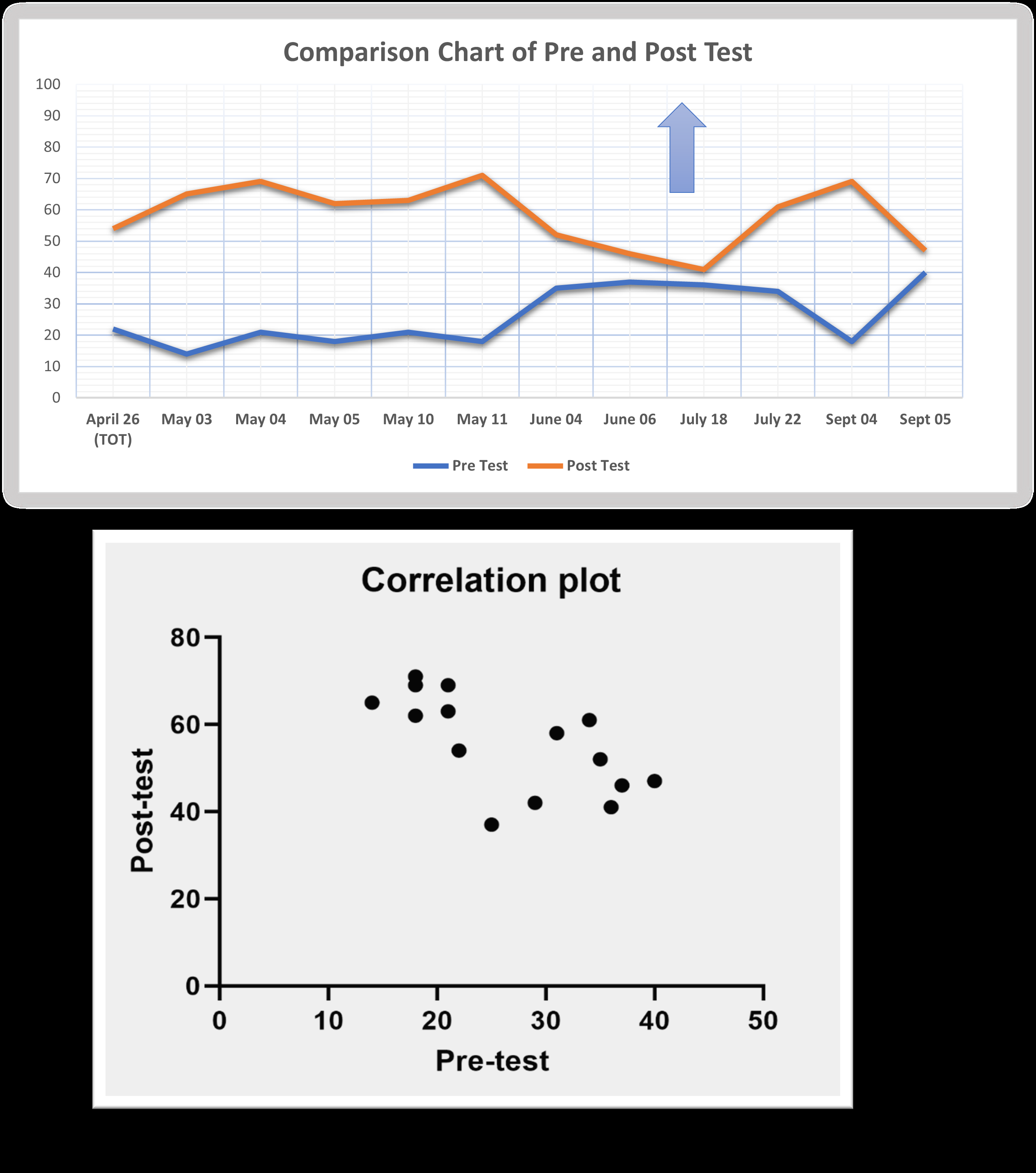
Results : We trained 318 HCWs over 15 days, using 10 instructors. Post-test scores showed individual and overall improvement. The average scores were 26.6% (14-40%) for the pre-test and 55.8% (37-70%) for the post-test, with an average improvement of 29% (P<0.005). Participant feedback was 77% positive and in favour of more training. The average instructor performance satisfaction score was 96.2% (92-99%).
Conclusion : We demonstrated the positive impact of SBT on communication skills for both clinical and administrative HCWs. We also demonstrated the sustainability and scalability of this course.
Keywords: Breaking bad news, Communication, NURSE, Simulation education, SPIKES
Healthcare worker (HCW)-patient communication has been shown to play an integral role in the suc- cess of therapeutic outcomes in all medical settings. Multiple studies have shown the potential negative impact of poor patient-centred communication on clinical outcomes [1-5]. A 2010 review [2] showed that “...communication has the potential to help regulate patients’ emotions, facilitate comprehen- sion of medical information, and allow for better identification of patients’ needs, perceptions, and expectations...” and that “... Patients reporting good communication with their doctor are more likely to be satisfied with their care, and especially to share pertinent information for accurate diagnosis of their problems, follow advice, and adhere to the prescribed treatment...”. It also showed that clini- cians tend to overestimate their skills when it comes to patient communication [2]. In addition to this over-estimation, the literature found other barriers to proper HCW-patient communication, including cultural differences, patient fears, provider anxiety, burden of work, and lack of training.
Simulation-based training (SBT) is a promising training modality that can be utilised to address this gap, improving patient communication and hence clinical outcomes. Hybrid simulation inte- grated training in communication and breaking bad news has resulted in improved providers’ commu- nication skills, as well as providing an opportunity to identify and address individual and system gaps [10,11].
As part of its continuous efforts, the Clinical Skills and Simulation Center (CSSC) at King Ab- dulaziz University (KAU) initiated this project with
the aim of improving the communication skills of its HCWs. The study includes possibly the highest number of participants out of any study in the lit- erature; we have not found any previous report that approaches more than tens of participants. Another unique feature of this study is the fact that we used Arabic translation of the tools for breaking bad news: SPIKES, NURSE and CUS. SPIKES (Setting up, Perception, Invitation, Knowledge, Emotions, Strategy/Summary) is a six-step tool for breaking bad news; NURSE (Naming, Understanding, Re- specting, Supporting, Exploring) is a helpful tool for addressing patient emotion; and CUS (Concerned, Uncomfortable, Safety) is a third tool for helping to improve communication [7-9].
These tools are described in the literature as having been used effectively in English and a few other languages, but our report contains the first mention of their use in the Arabic language. In addition, the training of administrative HCWs in such a project has not previously been reported in the literature.
In this study, we sought to develop a bilingual SBT programme in communication skills (including breaking bad news and difficult communication) for all HCWs at the King Abdulaziz University Hospital (KAUH), as part of a continuous effort to improve patient care, experiences and outcomes.
This is a quasi-experimental design, conducted in 2018 over a period of five months (April-September) in the CSSC at KAUH.
B. Study Tools:
The course was developed by simulation and education experts working at the CSSC. An interdis- ciplinary committee of physicians, nurses and edu- cators designed a bilingual, full-day (eight hours) SBT course for HCWs at KAUH. We recruited 10 instructors (simulation experts) from various disciplines (anaesthesiology, emergency medicine, paediatrics, quality improvement and education spe- cialists) and backgrounds (physicians, nurses, ad- ministration, management and professional actors). All instructors received unified training from the
course directors to ensure a standardised delivery method.
C. Study Participants:
Participants were recruited randomly. Both elec- tronic and written course invitations were distributed within the hospital and made available to all HCWs at KAUH. No preferences or exclusion criteria were used; seats were allocated on a first-come, first- served basis to avoid any biases by pre-selecting participants. We ensured that the invitations were extended to non-clinical as well as clinical HCWs.
D. Implementation:
The course consisted of four phases.
Phase A: Introduction and Pre-test (30 minutes):
Each course started with an introduction, which included a pre-test. The questions targeted the de- termined objectives of the course. The test was reviewed by 10 educators and was piloted on 20 participants to ensure its validity and reliability. It consisted of 14 multiple choice questions (MCQ) and one short answer question. The MCQs covered routes and modes of communication, verbal and non-verbal communication, while the short answer question was about tools used when breaking bad news (Appendix 1). Participants were also provided with handouts containing learning materials.
Phase B: Didactic sessions (240 minutes):
The introduction was followed by four didactic sessions of 60 minutes each, including breaks (Table 1).
Phase C: Practice Groups (180 minutes)
The didactic sessions were followed by two 90- minute practice sessions, using advanced illness sce- narios pre-written with the consensus of simulation experts (Table 2).
The instructions for scenario implementation were:
Divide participants into subgroups of three to five. In each subgroup, one participant will be assigned
Translation of validated communication and tools for breaking bad news, such as SPIKES, NURSE and CUS, into the Arabic language for clinical use
| Session 1 Modes of communication | |
|---|---|
| Session 2 Verbal and non-verbal communication | |
| Session 3 Small group communication | |
| Session 4 Difficult communication and tools | used to break bad news in a clinical setting |
| TABLE | II |
| LIST OF STANDARDISED PATIENT | CASE SCENARIOS |
| Case Sudden death of a family member from severe septic shock. | |
| 1 | |
| Case Unexpected lifesaving emergent Caesarean section with | severe post-partum haemorrhage, requiring vascular |
| 2 ligation and possible hysterectomy. | |
| Case Hospital staff termination of employment due to poor | performance. |
| 3 | |
| Case Medical error (medication administration error) resulting | in severe morbidity. |
| 4 | |
| Case Medical error (unnecessary intervention) resulting in complication | necessitating invasive treatment. |
| 5 | |
| Case A senior requesting fraudulent documentation upon a | patient’s death. |
| 6 | |
| Case Escalating situation wherein a patient requesting non-emergency | services at the Emergency Room becomes |
| 7 increasingly aggravated by delays. | |
| Case A co-worker requesting hospital registration and examination | of a family member under a different patient file |
| 8 due to administrative and financial issues. | |
| as “delivering the news (doctor)” and one as “receiv- | satisfaction. Given the timing of the pre- and post- |
| ing the news (patient, relative or another doctor)”, | tests just before and after the intervention (course), |
| while the rest of the subgroup actively observes the | we can conclude that the intervention is the only |
| communication process and documents their obser- | possible cause of the observed outcome. The pre- |
| vations. Each assigned participant is given two to | test and post-test scores were used as a measure |
| three minutes to read through their role. When they | of the improvement in knowledge that could reflect |
| are ready, they engage in the role-play for 7 to 10 | on employee performance and patient satisfaction in |
| minutes. When the role-play is finished, 15 minutes | future practice. Participant feedback and satisfaction |
| are allocated for feedback. The debriefing format | scores were collected as a supporting measure and |
| was based on the well-known Plus-Delta method | to provide ongoing formative assessment to the |
| [12], focusing simply on general description, what | course instructors, using open-ended questions and |
| went well (WWW) and things to improve (TTI), | Likert’s scale as appropriate. |
| followed by case conclusion, whereupon another | To ensure accuracy and completeness, data were |
| scenario commenced. | collected manually by an independent CSSC em- |
| ployee, who had no interest in the success of failure | |
| E. Phase D: Wrap-up and evaluation (30 minutes) | of the course, without any identifying information |
| Following the practice session, a summary ses- | and in such a way that answers could not be traced |
| sion was conducted which included the post-test | to individual participants. There was no missing |
| and evaluations. The post-test covered the course | data. |
| contents and the questions were identical to those | We conducted a descriptive analysis of the data. |
| in the pre-test. | Data collection, coding and analysis were completed |
| To measure the impact of the project, we analysed | manually, using GraphPad Prism 8. We used mul- |
| the pre test and post test scores collected feedback | tiple measures of dispersion and cross tabulations |
| ables as percentages or frequencies, as appropriate. | scenario exercises (7 comments), mandating the |
| To measure the difference between pre-test and | course to hospital staff (6 comments), providing cer- |
| post-test scores, we used a paired t-test with a | tificates of completion (1 comment), and providing |
| significance level of p ≤ <0.05. | more video materials (1 comment). |
| This training course involved minimal ethical | Instructor performance satisfaction indices: Ten |
| risks, with the participants’ privacy and well-being | instructors participated in this course. All partici- |
| assured prior to and throughout the course. Given | pants responded to the questionnaire, and the av- |
| the difficult nature of breaking bad news, partici- | erage instructor performance satisfaction score was |
| pants were offered access to appropriate resources | 96.2% (92-99%). |
| in case of any unanticipated psychological stress. | |
| Ethics committee approval was received for this | IV. DISCUSSION |
| study from the Unit of Biomedical Ethics at KAU | This study has demonstrated the feasibility, sig- |
| School of Medicine (Reference No. 413-20). Con- | nificance and reproducibility of a multidisciplinary |
| sents were waived during the ethical approval, since | SBT programme that focuses on improving HCWs’ |
| no personal or traceable data were collected. | communication and breaking bad news skills. The |
| number of participants in this project is one of the | |
| III. RESULTS | most sizable reported in the literature. Furthermore, |
| The course was repeated a total of 15 times | to the best of our knowledge, this project is the |
| (8 times in the Arabic language and 7 times in | first of its kind to include administrative staff, and |
| English), with a total of 318 participants (ranging | the first to translate communication tools such as |
| from 13-27 participants per course), representing | SPIKES, NURSE and CUS [7-9] into the Arabic |
| 10-15% of the total number of KAUH employees. | language for clinical practice. |
| Participants were interdisciplinary; 105 (33%) were | Our results demonstrated a positive impact on |
| female and 213 (67%) male; and they represented all | knowledge acquisition after completing the course. |
| the major clinical (69%) and administrative (31%) | These results are aligned with multiple previous re- |
| hospital departments (Table 3). | search protocols [6] that showed the positive impact |
| of communication training for General Practition- | |
| Pre-test/post-test analysis: All participants com- | ers, both on post-training test scores (similarly to |
| pleted the tests. All of the individual courses, as well | our study) and on behaviour during patient inter- |
| as the overall test results, showed an improvement | views [6]. Similar positive impacts were repeatedly |
| in test scores (figure 1). A paired t-test was used | demonstrated when role-play was used with stan- |
| for analysis where appropriate. The average pre- | dardised patients and/or training for clinical students |
| and post-test scores for the 15 courses were 26.6% | [10], trainees [11] and/or clinicians in different |
| (14-40%) and 55.8% (37-70%) respectively. The | specialties, including nurses, social workers and |
| statistically significant mean differences was 29.20, | chaplains. |
| standard deviation of difference was 17.86, and | Recent systematic reviews have not revealed a |
| standard error of mean of difference was 4.611, | single study that investigates the potential effect |
| with a 95% confidence interval; 19.31 to 39.09, | of communication training on non-clinical admin- |
| correlation coefficient (r) -0.6579 (figure 1). | istrative HCWs [13,14]. Our project demonstrated |
| a positive impact not only on clinical HCWs, but | |
| Participant feedback: Only 35 participants pro- | also on administrative HCWs. The integration of |
| vided the optional written feedback. Overall, 77% of | multidisciplinary participants, including non-clinical |
| the feedback was positive. The 23% negative feed- | HCWs, did not impede the learning process; rather, |
| back was related to centre facilities (5 comments) | it was viewed as an advantage to facilitate knowl- |
| and the provision of better materials (3 comments). | edge transfer across disciplines. |
| T l ti f lid t d i ti d t l |
| Case Sudden death of a family member from severe septic shock. | |
|---|---|
| 1 | |
| Case Unexpected lifesaving emergent Caesarean section with | severe post-partum haemorrhage, requiring vascular |
| 2 ligation and possible hysterectomy. | |
| Case Hospital staff termination of employment due to poor | performance. |
| 3 | |
| Case Medical error (medication administration error) resulting | in severe morbidity. |
| 4 | |
| Case Medical error (unnecessary intervention) resulting in complication | necessitating invasive treatment. |
| 5 | |
| Case A senior requesting fraudulent documentation upon a | patient’s death. |
| 6 | |
| Case Escalating situation wherein a patient requesting non-emergency | services at the Emergency Room becomes |
| 7 increasingly aggravated by delays. | |
| Case A co-worker requesting hospital registration and examination | of a family member under a different patient file |
| 8 due to administrative and financial issues. | |
| as “delivering the news (doctor)” and one as “receiv- | satisfaction. Given the timing of the pre- and post- |
| ing the news (patient, relative or another doctor)”, | tests just before and after the intervention (course), |
| while the rest of the subgroup actively observes the | we can conclude that the intervention is the only |
| communication process and documents their obser- | possible cause of the observed outcome. The pre- |
| vations. Each assigned participant is given two to | test and post-test scores were used as a measure |
| three minutes to read through their role. When they | of the improvement in knowledge that could reflect |
| are ready, they engage in the role-play for 7 to 10 | on employee performance and patient satisfaction in |
| minutes. When the role-play is finished, 15 minutes | future practice. Participant feedback and satisfaction |
| are allocated for feedback. The debriefing format | scores were collected as a supporting measure and |
| was based on the well-known Plus-Delta method | to provide ongoing formative assessment to the |
| [12], focusing simply on general description, what | course instructors, using open-ended questions and |
| went well (WWW) and things to improve (TTI), | Likert’s scale as appropriate. |
| followed by case conclusion, whereupon another | To ensure accuracy and completeness, data were |
| scenario commenced. | collected manually by an independent CSSC em- |
| ployee, who had no interest in the success of failure | |
| E. Phase D: Wrap-up and evaluation (30 minutes) | of the course, without any identifying information |
| Following the practice session, a summary ses- | and in such a way that answers could not be traced |
| sion was conducted which included the post-test | to individual participants. There was no missing |
| and evaluations. The post-test covered the course | data. |
| contents and the questions were identical to those | We conducted a descriptive analysis of the data. |
| in the pre-test. | Data collection, coding and analysis were completed |
| To measure the impact of the project, we analysed | manually, using GraphPad Prism 8. We used mul- |
| the pre test and post test scores collected feedback | tiple measures of dispersion and cross tabulations |
| ables as percentages or frequencies, as appropriate. | scenario exercises (7 comments), mandating the |
| To measure the difference between pre-test and | course to hospital staff (6 comments), providing cer- |
| post-test scores, we used a paired t-test with a | tificates of completion (1 comment), and providing |
| significance level of p ≤ <0.05. | more video materials (1 comment). |
| This training course involved minimal ethical | Instructor performance satisfaction indices: Ten |
| risks, with the participants’ privacy and well-being | instructors participated in this course. All partici- |
| assured prior to and throughout the course. Given | pants responded to the questionnaire, and the av- |
| the difficult nature of breaking bad news, partici- | erage instructor performance satisfaction score was |
| pants were offered access to appropriate resources | 96.2% (92-99%). |
| in case of any unanticipated psychological stress. | |
| Ethics committee approval was received for this | IV. DISCUSSION |
| study from the Unit of Biomedical Ethics at KAU | This study has demonstrated the feasibility, sig- |
| School of Medicine (Reference No. 413-20). Con- | nificance and reproducibility of a multidisciplinary |
| sents were waived during the ethical approval, since | SBT programme that focuses on improving HCWs’ |
| no personal or traceable data were collected. | communication and breaking bad news skills. The |
| number of participants in this project is one of the | |
| III. RESULTS | most sizable reported in the literature. Furthermore, |
| The course was repeated a total of 15 times | to the best of our knowledge, this project is the |
| (8 times in the Arabic language and 7 times in | first of its kind to include administrative staff, and |
| English), with a total of 318 participants (ranging | the first to translate communication tools such as |
| from 13-27 participants per course), representing | SPIKES, NURSE and CUS [7-9] into the Arabic |
| 10-15% of the total number of KAUH employees. | language for clinical practice. |
| Participants were interdisciplinary; 105 (33%) were | Our results demonstrated a positive impact on |
| female and 213 (67%) male; and they represented all | knowledge acquisition after completing the course. |
| the major clinical (69%) and administrative (31%) | These results are aligned with multiple previous re- |
| hospital departments (Table 3). | search protocols [6] that showed the positive impact |
| of communication training for General Practition- | |
| Pre-test/post-test analysis: All participants com- | ers, both on post-training test scores (similarly to |
| pleted the tests. All of the individual courses, as well | our study) and on behaviour during patient inter- |
| as the overall test results, showed an improvement | views [6]. Similar positive impacts were repeatedly |
| in test scores (figure 1). A paired t-test was used | demonstrated when role-play was used with stan- |
| for analysis where appropriate. The average pre- | dardised patients and/or training for clinical students |
| and post-test scores for the 15 courses were 26.6% | [10], trainees [11] and/or clinicians in different |
| (14-40%) and 55.8% (37-70%) respectively. The | specialties, including nurses, social workers and |
| statistically significant mean differences was 29.20, | chaplains. |
| standard deviation of difference was 17.86, and | Recent systematic reviews have not revealed a |
| standard error of mean of difference was 4.611, | single study that investigates the potential effect |
| with a 95% confidence interval; 19.31 to 39.09, | of communication training on non-clinical admin- |
| correlation coefficient (r) -0.6579 (figure 1). | istrative HCWs [13,14]. Our project demonstrated |
| a positive impact not only on clinical HCWs, but | |
| Participant feedback: Only 35 participants pro- | also on administrative HCWs. The integration of |
| vided the optional written feedback. Overall, 77% of | multidisciplinary participants, including non-clinical |
| the feedback was positive. The 23% negative feed- | HCWs, did not impede the learning process; rather, |
| back was related to centre facilities (5 comments) | it was viewed as an advantage to facilitate knowl- |
| and the provision of better materials (3 comments). | edge transfer across disciplines. |
| T l ti f lid t d i ti d t l |
| Participant distribution | by specialty |
|---|---|
| Administrative | 99 31.1% |
| Nurse | 94 29.5% |
| Physician | 44 13.8% |
| Technician | 24 7.5% |
| Dietitian | 17 5.3% |
| Pharmacist | 11 3.4% |
| Specialist | 7 2.2% |
| Security | 6 1.8% |
| Laboratory | 6 1.8% |
| Project & Maintenance | 8 2.5% |
| Nurse Educator | 2 0.6% |
| Attendance by department | |
| Emergency Medicine | 77 24.2% |
| Human Resources | 36 11.3% |
| Anaesthesia & Critical | Care 20 6.3% |
| Nursing Administration | 20 6.3% |
| Outpatient | 18 5.6% |
| CSSC | 17 5.3% |
| would have a great impact, both on Arabic-speaking | instructions and materials. |
| clinicians and on their patients, providing an easier | |
| way to build a therapeutic relationship. Moreover, | V. CONCLUSION |
| our results demonstrated sustainability and scala- | Using structured SBT has a positive impact on |
| bility to include a larger number of participants. | improving communication and breaking bad news |
| The cost to scale and sustain this project after its | skills for all HCWs, including administrative per- |
| establishment would be minimal, attributed mainly | sonnel. SBT has the potential to provide the sustain- |
| to staff time and availability of space. We mitigated | ability and scalability of such programmes. Future |
| the cost by recruiting and training local instructors | studies should continue to examine patient-related |
| and by using the hospital’s facilities to as a course | outcomes and quality improvement indices of hos- |
| venue. Participant recruitment is a potential obstacle | pital systems. |
| that could be overcome with strong support from | |
| higher leadership. | |
| SOURCE OF FUNDING: No funding was received. | |
| Our project had certain limitations. First, although | |
| we included 318 participants, representing 10-15% | CONFLICT OF INTEREST: The authors have no |
| of all of the hospital’s HCWs, the impact of the | conflicts of interest. |
| training on the overall quality of the hospital’s | ETHICAL APPROVAL: ethics committee approval |
| service was too small without training more HCWs. | was received for this paper from the unit of biomedical |
| Second, as with most SBT, demonstrating the direct | ethics at King Abdulaziz University school of medicine |
| effect on patient outcomes is difficult; a longer pe- | (reference no. 413-20). Approval date: august 2020. |
| riod to determine and a higher whether number a higher of participants level can be is required reached | acknowledge ACKNOWLEDGMENTS: the KAUH leadership The authors for their would invaluable like to |
| in Kirkpatrick’s model [15]. A third limitation was | support, with special mention to the Vice Dean and |
| the large number of instructors [10] required for | Director of KAUH, Dr. Amro Alhibshi. We would also |
| the project; on a larger scale this might result in | like to recognise the KAU Clinical Skills and |
| a variation in the quality of course delivery. We | Simulation |
| tried to minimize this latter limitation by focusing | |
| on instructor training and providing unified course | |
| Center (CSSC) and its working team for | their training assistance in this simulation |
| support and facilitation in running the project, | programme. Finally, we extend our sincere |
| with special mention to Mr. Jamal Alshomran. | appreciation to Stacy Brady, RN, and the |
| Furthermore, we would like to thank Dr. | Providence VA Medical Center for their support |
| Abdullah Bawarith and Ms. Abeer Alhazmi for | during the preparation of this manuscript. |
| from: | |
| https://www.ahrq.gov/hai/tools/ambulatory-s | |
| VI. REFERENCES | urgery/sections/implementation/training- |
| tools/cus-t ool.html | |
| 1. Lee SJ, Back AL, Block SD, Stewart SK | 9. October TW, Dizon ZB, Arnold RM, |
| Enhancing physician-patient communication | Rosenberg AR. Characteristics of Physician |
| Hema- tology 2002;2002(1 :464–83 | Empathetic State ments During Pediatric |
| 2. Ha JF, Longnecker N Doctor-patient | Intensive Care Conferences with Family |
| commu- nication: a review Ochsner J 2010;10(1 | Members: A Qualitative Study. JAMA Network |
| :38–43 | Open. 2018;1(3): e180351. Published 2018 Jul 6 |
| 3. Norouzinia R, Aghabarari M, Shiri M, | 10. Dennis D, Furness A, Parry S. |
| Karimi M, Samami E. Communication Barriers | Challenging conversations with simulated |
| Perceived by Nurses and Patients. Glob J Health | patients. Clin Teach. 2017;14(6):397–400. |
| Sci. 4. 2015;8(6):65–74. Jangland, Eva, Lena Gunningberg, and | 11. Lifchez SD, Redett RJ 3rd. A standardized |
| Maria Carlsson. “Patients’ and relatives’ | patient model to teach and assess |
| complaints about encounters and communication | professionalism and communication skills: the |
| in health care: evidence for quality | effect of personality type on performance. J Surg |
| improvement.” Patient Education and | Educ. 2014;71(3):297–301. |
| Counseling 2009; 199-204. | 12. Debriefing for clinical learning [Internet] |
| 5. Newell S, Jordan. The patient experience of | Pa- tient Safety Network [cited 2020 May5] |
| patient-centered communication with nurses in | Avail- able from: https://psnet ahrq |
| the hospital setting: a qualitative systematic | gov/primer/debriefing- clinical-learning |
| review pro- tocol. JBI Database System Rev | 13. Kozhevnikov D, Morrison LJ, Ellman MS. |
| Implement Rep. 2015;13(1):76–87. | Simulation training in palliative care: State of the |
| 6. Bensing JM, Sluijs EM. Evaluation of an | art and Future Directions. Advances in Medical |
| interview training course for General | Education and Practice. 2018;Volume 9:915–24. |
| Practitioners. Social Science & Medicine. | 14. Randall D, Garbutt D, Barnard M. Using |
| 1985;20(7):737–44. | simulation as a learning experience in clinical |
| 7. Baile WF, Buckman R, Lenzi R, Glober G, | teams to learn about palliative and end-of-life |
| Beale EA, Kudelka AP. SPIKES - A six-step pro- | care: A literature review. Death Stud. |
| tocol for delivering bad news: application to the | 2018;42(3):172–183. |
| patient with cancer. Oncologist. 2000;5(4):302- | 15. Johnston S, Coyer FM, Nash R. |
| 311. | Kirkpatrick’s Evaluation of Simulation and |
| 8. CUS tool - improving communication and | Debriefing in Health Care Education: A |
| teamwork in the surgical environment module | Systematic Review. J Nurs Educ. |
| [Internet]. AHRQ. [cited 2020 May5]. Available | 2018;57(7):393- 398. |