Full text rendered from the published PDF. The PDF is the version of record; if the two differ, the PDF governs.
The critical care transport service (CCT) is an important factor in the successful delivery of high-quality services by any healthcare system or programme. It is conducted by well-trained, qualified paramedics, nurses and respiratory therapists. The cornerstone of CCT is to ensure, during the transport of patients, continuity of the critical care initiated by the referring provider until arrival at the receiving provider. We report a case of a patient with acute aortic dissection who presented to a general hospital in Riyadh, requiring emergent advanced surgical intervention that is available only in tertiary hospitals. The coordination of the patient’s transfer was arranged by the emergency medical services’ team leader within the health cluster that includes both the general and tertiary hospitals involved in the case. This process resulted in the required service being provided within record time, with excellent outcomes. This case report highlights the impact and importance of inter-facility critical care transport systems.
Keywords: Critical care, Interfacility Transport, Aortic dissection, Emergency Medical Service
Acute aortic dissection (AAD) is a life-threatening condition caused by a tear in the intimal layer of the aorta or bleeding within the aortic wall, resulting in
Abdulrahman Alzahrani, Bandr Mzahim are with Adult Emergency Medicine Department, King Fahad Medical City, Riyadh, Saudi Arabia., e-mail: aakz1415@gmail.com, e- mail: bmzahim@kfmc.med.sa (Corresponding author: Abdul- rahman Alzahrani)
Abeer AlFadhliah, Shatha Alburayh are with the college of Medicine, Princess Nourah bint Abdulrahman University, Riyadh, Saudi Arabia. , e-mail: Abeerbf5@gmail.com, e-mail: Ishathanasser@gmail.com
Shabir Hussain Shah is with Cardiovascular and Thoracic Surgery Department, King Fahad Medical City, Riyadh, Saudi Arabia, e-mail: shshah@kfmc.med.sa
the separation of the different layers of the aortic wall [1]. The global incidence of AAD is estimated to be around 5 to 30 cases per million people per year [2]. AAD can be classified according to anatomical location and time of onset. The Stanford classification is the most widely used in clinical practice for anatomical location, and classifies AAD into type A dissections, which involve the ascending aorta, and type B dissections, which occur distal to the left subclavian artery. The acute phase of AAD has the highest morbidity and mortality rates and has been identified as a 14-day period from the onset of presentation [3]. The most frequent presentation of AAD is an abrupt onset of severe chest pain and/or back pain. Less frequently, patients can present initially with neurological signs such as syncope, paraparesis or paraplegia [4].
The mortality rate for an unrecognised and un- treated dissection is roughly 25% at 6 hours and 50% by 24 hours. If left untreated, two thirds of patients die within the first week, and approximately 20% of patients die on site before reaching the hospital. The mortality rate in treated patients for all dissections remains high despite medical and surgical management, and is estimated to be 27% according to the International Registry of Acute Aortic Dissection (IRAD) [5].
Early recognition of warning signs and prompt access to emergency medical services (EMS) is cru- cial to favourable patient outcomes. EMS is a first- line service that provides pre-hospital acute care and transports patients to medical facilities [6]. One of the EMS’ responsibilities is inter-facility transport, which is defined as the transport of patients be- tween two healthcare facilities and is accomplished via ground or air transport. Inter-facility transport by EMS allows facilities to transfer patients who
require specialised care that cannot be adequately provided by the sending facility, in a timely and safe manner [7].
Our case report focused on the impact of inter- facility critical care transport on acute aortic dis- section in Saudi Arabia. The hospitals involved in this report are the referring general hospital, referred to as Hospital A, and the receiving tertiary hospital, referred to as Hospital B, both of which are part of same health cluster. A health cluster is a system which includes multiple healthcare providers under the umbrella of one administration.
Case Presentation A 46-year-old male, smoker, known case of Ehlers Danlos syndrome and congenital hydrocephalus on ventriculoperitoneal (VP) shunt, referred with a history of chest pain from Emergency Department (ED) of the general hospital (Hospital A) to our tertiary hospital (Hospital B). The pain was centrally located in the chest, started suddenly two hours before arrival, was described as heavy in character, constant, non-radiating, and was associated with diaphoresis and nausea. The initial measured vital signs were blood pressure 66/57 mmHg, heart rate 89/min, respiratory rate 22/min, temperature 36.6 ◦ C (oral), and oxygen saturation 99% on room air. Clin- ically, the patient was conscious, alert, and oriented, with muffled heart sounds upon auscultation; other physical examinations were unremarkable.
A bedside ultrasound and echocardiography sug- gested a non-collapsing inferior vena cava (IVC) with massive pericardial effusion. Chest X-ray was unremarkable. Upon re-assessment the patient had developed dizziness and hand numbness and had become more hypotensive, with a blood pressure reading of 52/36 mmHg and heart rate of 89/min.
He received boluses of intravenous fluids with limited response, necessitating the initiation of va- sopressor support in the form norepinephrine vaso- pressin. Bedside echocardiography was repeated by a cardiologist and showed a hugely dilated aortic root and ascending aorta with mild aortic regurgitation, along with moderate pericardial effusion with collapsing right atrium and right ventricle (positive sign of tamponade). As aortic dissection could not be ruled out and Hospital A lacked a cardiac surgery service, the patient was referred to Hospital B as an emergent case. He was transferred by the EMS
using ground transport and accompanied by an emergency physician, because such a critical case must be transferred with a qualified team, including a physician to monitor the patient for any deterioration that necessitates intervention (airway support, basic and advanced life support, etc.).
Upon arrival at Hospital B, the patient’s blood pressure was 82/45 mmHg and heart rate was 86/min. The patient was drowsy but arousable with undetected lower limb pulses and cold extremities. A central line was secured, and inotropic and vaso- pressor support was escalated. Bedside echocardio- graphy was performed, revealing moderate to severe pericardial effusion with evidence of tamponade (right atrium/right ventricle collapse) and a severely dilated ascending aorta (diameter of 62 mm) with no evidence of dissection. Chest radiography indicated a widening of the mediastinum. In view of cardiac tamponade and his critical clinical state, the patient was transferred to the operating room (OR) without CT angiogram.
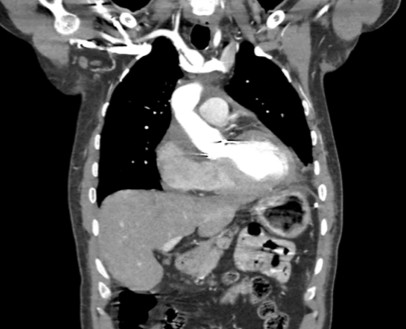
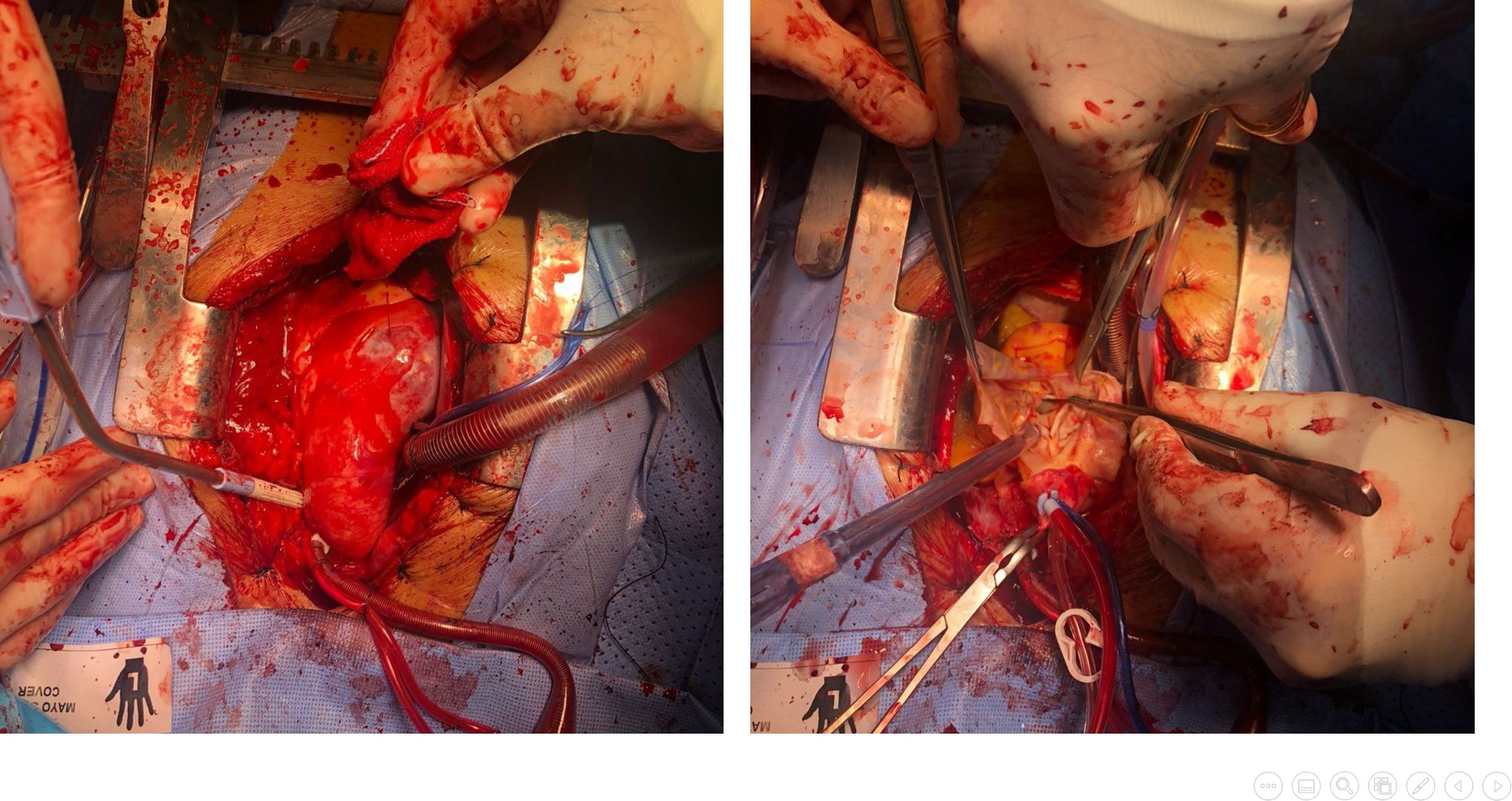
The patient’s transfer took 35 minutes, from diag- nosis at Hospital A to arrival at Hospital B. Intra- operative TEE showed a large pericardial collection causing a tamponade effect, aortic root aneurysm measuring 6.5 cm in diameter, and no evidence of aortic dissection. The aortic valve was bicuspid. The non-coronary sinus of Valsalva was leaking, and blood was leaking into the pericardial cavity. The patient underwent aortic root replacement with a mechanical composite valve graft (Bentall procedure) (Figure 1) ( Video 1 ). A post-operative computed tomography angiogram (CT angiogram) of the thoracic and abdominal aorta with contrast enhancement (Figure 2) did not reveal any aneurys- mal dilatation or dissection. The patient recovered well from the surgery and had an uneventful 10-day postoperative period. He was discharged home in a stable condition with clean and dry wounds.
Critical care transport service (CCT) is an im- portant factor in the successful delivery of high- quality health services. It is conducted by well- trained, qualified paramedics, nurses and respiratory therapists [8,9]. It is an advanced service during which critical care may need to be initiated, such as securing an advanced airway, changing mechanical
(Bentall procedure) (right).
ventilator settings, or commencing new circulatory support infusions. The cornerstone of CCT is to ensure the continuity of the critical care initiated by the referring provider until the patient’s arrival at the receiving provider [10-12].
The implementation of a well-developed inter- facility transport system is instructed by the new model of health care supported by the health cluster system (defined in the introduction). The traditional model of health care considers each hospital as an independent institution, both administratively and medically, and has faced numerous obstacles, es- pecially with regard to the transfer of patient care between facilities and between levels of health care (primary, secondary and tertiary). Conversely, new model of care, which is based around the health cluster system, aims to ease and facilitate access to healthcare services by individuals and society. In addition, it enhances the transfer of patient care between the various healthcare levels. Hospitals A and B in our case report are part of the same health cluster, which is considered one of the largest health clusters in Saudi Arabia. Led by Hospital B, it includes one medical city, nine general hospitals and
48 primary health care centres. The abovementioned health cluster has an inter- facility transport system directed by highly spe- cialised providers. In this report, upon our patient’s arrival at hospital A, the emergency medicine con- sultant (team leader), in cooperation with the other teams consulted, suspected acute aortic dissection. This necessitated advanced surgery at a tertiary hospital within the cluster (Hospital B), as such surgery is not available in the general hospitals. He informed the cluster’s on-call EMS team leader in the Disaster Management and Emergency Dispatch Centre that he had arranged with the emergency medicine consultant (team leader) at hospital B to prepare their ED to receive the case. The cardiotho- racic surgery service was thus consulted early and prepared the operating room to manage the case accordingly. This well-structured process (Figure 3) resulted in an excellent impact on the patient’s life and outcomes. Although the patient’s status was critical, he received the required care within record time, resulting in his discharge from the hospital within 10 days of admission, without any complications.
In conclusion, this case report highlighted the great impact and importance of inter-facility critical care transport systems. Our patient required emergent lifesaving intervention for acute aortic dissection, available only in a tertiary centre, and the process of transferring him was easily and quickly achieved owing to the CCT system within the health cluster.
III. REFERENCES [1] V Tchana-Sato, N Sakalihasan, J O Defraigne. Aortic dissection. Rev Med Liege. 2018;73(5- 6):290-295. [2] Goda M, Minami T, Imoto K, Uchida K, Masuda M, Meuris B. Differences of patients’ characteristics in acute type A aortic dissection - surgical data from Belgian and Japanese centers. J Cardiothorac Surg. 2018;13(1):92.
[3] Silaschi M, Byrne J, Wendler O. Aortic dissection: medical, interventional and surgical management. Heart. 2017;103(1):78-87.
[4] Christoph A Nienaber, Rachel E Clough. Management of acute aortic dissection. Lancet.
2015 28;385(9970):800-11. [5] Cherry, Kenneth J. Comprehensive Vascular and Endovascular Surgery || Aortic Dissection. Elsevier Health Sciences. 2009. 517–531.
[6] Maha Baabdullah, Hamsah Faden, Rawan Al- subhi, Ahmed Almalki, Basim Masri, Abdullah Al- harbi. The efficiency of the medical priority dispatch system in improving patient outcomes. Saudi Jour- nal of Emergency Medicine. 2020;1(2):110–120.
[7] Heaton J, Kohn MD. EMS Inter-Facility Transport. In: StatPearls. Treasure Island (FL): StatPearls Publishing; September 28, 2021.
[8] Roeder J. Flight team configuration of an air medical service. Top Emerg Med. 1994;16(4):66- 72. [9] Stone CK. The air medical crew: is a flight physician necessary? J Air Med Transp. 1991;10(11):7- 10. [10] Wilcox SR, Saia MS, Waden H. Improved
with patients in oxygenation after transport
J. Med Air failure. respiratory hypoxemic 2015;34(6):369-376.
The Journal of Medicine, Law & Public Health Vol 2, No 2. 2022 p115 [11] Alsofayan Y, Almakhalas K, Alabdali A, et al. An Innovative Curriculum Development Experience: Emergency Medical Dispatch Role in the Healthcare Transformation Vision of Saudi Arabia. Research Square; 2021. DOI: 10.21203/rs.3.rs-1111612/v1. [12] Inter-facility Critical Care Transportation Policy Web site. http://www.nhtsa.gov/people/ in- jury/ems/Interfacility/index.htm. Accessed Decem- ber 10, 2021.