Full text rendered from the published PDF. The PDF is the version of record; if the two differ, the PDF governs.
BACKGROUND
Trainees ought to master specific procedural skills throughout the course of the emergency residency programme they are enrolled in.
AIMS
We aim to assess the level of exposure to procedures, the confidence towards performing such procedures during each level of training, and an estimate of the minimum number of procedures required to influence trainee confidence and knowledge.
METHODS
The authors constructed a survey that was distributed using a snowball sampling method, targeting a sample of emergency trainees at nine training hospitals in Riyadh, Saudi Arabia. Participants were asked to answer multiple questions related to 6 different emergency procedures, including the amount of times the procedure had previously been performed and a personal assessment of confidence level related to each procedure using a five-point scale. The mean levels of knowledge and confidence were calculated and used as parameters to reflect on the training of participants.
RESULTS
The survey was completed by a total of 104 participants and revealed that the most common overall procedure performed was endotracheal intubation with the least common being vaginal delivery. A significant difference was noted between senior trainees and trainees at junior levels in the mean knowledge score for procedures [F(3,100)= 6.03, p= 0.001]. A positive correlation was found between the number of procedures performed and the confidence level. The minimum number of procedures according to the survey revealed the need for more than 15 intubation attempts, 6-10 central line insertions, 1-5 chest tube placements, 1-5 shoulder reductions and 6-10 lumbar punctures to build confidence in trainees.
CONCLUSION
Procedures that are less frequently performed in specific settings should be noted and attempts should be made to broaden exposure through simulations or rotations at other centres with higher procedural exposure rates.
Keywords: Emergency Medicine, Residency, Competency-Based Education
During the four-year emergency medicine resi- dency programme, trainees must learn and master specific skills in order to develop the ability and confidence to perform Emergency Department (ED) procedures. These procedures are an integral part of resuscitation and can be life saving for certain patients while reducing morbidity for many more. Emergency centres see patients who require urgent or critical care on a daily basis, and it is emergency medicine residents and trainees who are most com- monly assigned the task of intervening in these life- and-death scenarios through acquired expertise.
Although the proficiency of trainees in the emer- gency department has been evaluated using a variety of methods in existing medical literature, no such study has been conducted in the Kingdom of Saudi Arabia. In recent studies, emphasis was placed on the frequency of procedures performed by trainees to determine clinical competence [1,2]. Higher levels of training were also linked to greater ability
[2]. Thus, the number of procedures performed was seen as a surrogate to clinical competency.
However, variations in trainee exposure to critical ED procedures make it difficult to assess compe- tency [3]. Additionally, rare procedures are often overlooked, despite trainees being expected to pos- sess a standardized set of skills that they should be able to practice efficiently, irrespective of the setting or context. This influenced an amendment in some teaching curriculums to increase the exposure of emergency medicine residents to infrequently encountered procedures [4]. A study revealed that greater clinical exposure of trainees was crucial for increasing competence and knowledge [4].
Another issue of investigating trainee competence is compliance and procedural tracking [5]. Personal logbooks serve as reliable indicators of procedures performed by trainees, yet the practice of keeping a logbook is not widespread despite evidence indicat- ing that keeping track of the number of procedures successfully executed increases confidence.
Our study aims to quantify an estimated number of emergency medicine procedures that need to be performed in order to determine true competency and adequate knowledge, and intends to identify the points of weakness and potential improvement to guarantee procedural efficiency of emergency medicine trainees. This includes the possibility of insufficient exposure in Saudi Arabia’s teaching centres impeding optimal clinical training. Since this particular objective has never been addressed in our region, the results of this study may be of genuine benefit for future trainees.
Despite the availability of a set of pre-determined learning objectives for each level of post-graduate training, however, there is no reference available to ascertain whether trainees have achieved their learning goals. To the best of our knowledge, no study measuring the overall number of procedures performed by ED residents during the course of their training, their competency in each procedure, and the difference in exposure to procedures from one training centre to another has been conducted in Saudi Arabia. Different centres are likely to offer different environments; as such, the nature of cases as well as the influx of patients will vary. In this paper, we aim to evaluate the competency of residents in commonly performed ED procedures,
assess the level of exposure to such procedures during each level of training, and compare this across different training centres in Riyadh. Finally, we seek to obtain data for use by both training centres and residents as a guide to identify areas of improvement and potential knowledge gaps during the residency programme.
The authors constructed a survey comprising questions about the current training level of res- idents (from junior level, R1, to the most senior level, R4), the training centre, and the amount of times the procedures under investigation had been performed. Respondents were then asked to complete a knowledge score of 38-question exam supplied in the annex related to various emergency procedures developed by experts across various emergency medicine residency training programs.
Trainees were asked to rate their knowledge re- garding six different procedures using a five-point scale (1 = poor, 2 = fair, 3 = neutral, 4 = good, and 5 = excellent) and a mean score was then calculated representing trainee confidence “Confidence level”. For endotracheal intubation, residents were asked to evaluate their knowledge about anatomical variation and assessment of normal and difficult airways, indications and contraindications, medications used in rapid sequence intubation (RSI) and their side effects, and dealing with possible complications that may arise. Regarding chest tube placement, questions were asked about the anatomical location and the ability to identify it, indications and contraindications, knowledge about medications that may be used for anesthesia +/- procedural sedation and associated adverse effects, and dealing with complications that may arise from the procedure. Questions about central line insertion included the anatomical site of insertion and how to locate it (femoral, internal jugular, and subclavian), indica- tions and contraindications, knowledge of medica- tions that may be used for anesthesia +/- sedation, and how to handle difficulties faced during inser- tion. Shoulder reduction questions included differ- ent methods of shoulder reduction, indications and contraindications, knowledge of medications that can be used for anesthesia +/- procedural sedation,
and dealing with procedure-associated complica- tions. Assessing competence in conducting vaginal delivery comprised questions on the different tech- niques used to facilitate emergency vaginal deliv- ery (e.g.: McRobert’s manoeuvre), indications and contraindications of emergency vaginal delivery and episiotomy, and childbirth complications. Questions on lumbar puncture included the anatomical site and how to locate it, indications and contraindications, medications that may be used for anesthesia +/- procedural sedation, and dealing with possible complications that may arise from the procedure. Participants were also asked to report whether they were able to perform the procedure with or without assistance and supervision.
We targeted a convenience sample, using a snow- ball sampling method targeting a sample of emer- gency trainees across a number of training hospitals in Riyadh, Saudi Arabia to recruit participants for the survey. Data was analyzed using independent sample-t test, one-way analysis of variance, and the Pearson correlation. We used Cohen’s d to measure and interpret the effect size [6].
A total of 104 emergency medicine residents training at nine different hospitals in Riyadh City, Saudia Arabia participated in our study. Of these, 29 were in their first year (R1), 33 were in their second year (R2), 18 were in their third year (R3), and 24 were in their final year of training (R4).
The most common procedure performed by trainees was endotracheal intubation while the least common was vaginal delivery. Table 1 illustrates the number of procedures performed.
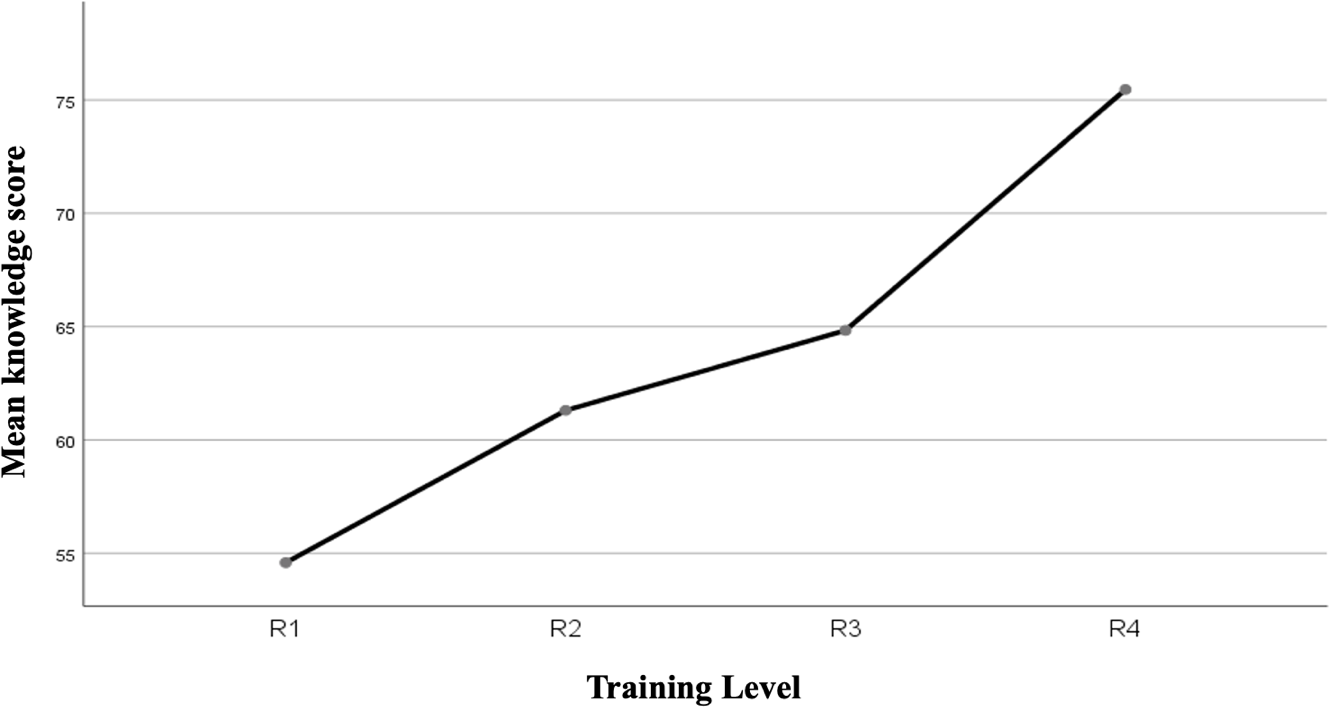
Knowledge score: The mean knowledge score for the procedures in our sample was 63.29 out of 100 (SD 19.29). A one- way between-groups ANOVA (analysis of variance) revealed a statistically significant difference in knowledge scores between R4 trainees and their juniors at levels R1 and R2 [F (3,100)= 6.03, p= 0.001]. The effect size was large – 0.15. As illus- trated in Figure 1, the knowledge score increased with higher training levels, though the knowledge score of R3 trainees did not reveal a statistically significant difference in relation to the other groups.
Confidence level:
There was a positive correlation between the number of procedures performed and the confidence level, as illustrated in Table 2. Only the number of vaginal deliveries did not show any correlation with confidence.
Except vaginal delivery, a positive correlation was also noted between the mean knowledge score and confidence level, as illustrated in Table 3.
An independent sample t-test was conducted to compare the confidence levels of those who re- ported the need for supervision and those who did not. There was a significant difference in confi- dence scores between those who reported being able to perform endotracheal intubation with assistance and supervision (M=63.39, SD=18.23), and those who did not require support in order to conduct the procedure (M=76.55, SD=15.39), t(103)=-3.78, p<0.0005.
Similar findings were also noted in trainees who required supervision and assistance while placing chest tubes (M=60.79, SD=18.58) versus those who did not (M=77.62, SD=16.57), t(103)=-4.74, p<0.0005. Likewise, confidence scores for perform- ing shoulder reduction were lower in those who needed assistance (M=58.46, SD=21.83) compared to the alternative (M=75.45, SD=18.16), t(103)=- 4.29, p<0.0005. Trainee confidence with regards to conducting vaginal delivery aligned with the previous findings, i.e., residents dependent on support had lower con- fidence scores (M=47.26, SD=21.59) versus their counterparts who did not need report such need (M=57.18, SD=21.76), t(103)=-2.03, p=0.045. The same applied to lumbar puncture, with the con- fidence scores of those requiring assistance and supervision (M= 63.67, SD= 17.93) notably lower than those who could perform the procedure in- dependently (M= 77.50, SD= 19.47), t(103)=-3.77, p<0.0005.
Contrary to other procedures, feedback on the ability to insert a central line revealed an inverse re- lationship between confidence level and assistance. Those who were able to insert a central line in the presence of supervision and/or assistance had higher confidence levels (M= 78.78, SD= 16.48) than those who denied the need of support in order to successfully insert a central line (M= 67.78, SD= 20.77), t(103)=2.79, p= 0.006.
One-way between-group analysis of variance was conducted to explore the impact that the number of times each of the six procedures had been previously performed had on trainee confidence, which re- vealed a statistically significant difference related to endotracheal intubation at p<0.05, F(4,100)=14.52, p<0.0005, with a large effect size of 0.37. Tukey’s HSD indicated a statistically significant difference in the mean score of individuals whose intubation attempts totaled more than 15 during the course of training.
There was also a statistically significant difference in confidence levels with regards to central line insertion [F(4,100)=9.12, p<0.0005 with a large effect size of 0.27]. Tukey’s HSD demonstrated that the mean score for those who had performed 6- 10 central line insertions was significantly different from that of the other groups. Likewise, 1-5 chest tube placements and 1-5 shoulder reduction pro- cedures revealed similarly significant differences, with a large effect size of 0.36, F(3,100)=3.55, p= 0.017, and a medium effect size of 0.1, F(4,100)= 13.792, p<0.0005, respectively. When it came to lumbar puncture, there was a significant difference in trainee confidence level when the procedure had
To the best of our knowledge, this study dis- cussing the performance of procedures in emer- gency medicine residency programmes is the first of its kind to be conducted in the Kingdom of Saudi Arabia. It includes assessment of what we consider to be the most commonly performed procedures in the emergency department, namely endotracheal intubation, central venous catheterization, tube tho- racostomy, lumbar puncture, vaginal delivery, and shoulder reduction. Other less frequently performed procedures such as surgical airway, paracentesis, arthrocentesis, and other forms of joint reduction were not included.
Using exam-like questions, we objectively tested the trainees’ knowledge based on anatomical lo- cation, procedure indications and contraindications, and each trainee’s ability to effectively handle com- plications arising from the procedures. Trainees were also asked to rate their confidence level re- garding a procedure from 1-5. Our findings reveal
satisfactory levels of knowledge and confidence re- garding common ED procedures, especially among senior-level trainees in their final year of training, though further skill refinement is still required. The knowledge of participants at the R3 level did not differ considerably from the rest, which may be explained by the small sample size. Regardless, more attention should be directed towards this level of training as their senior-level duties and responsi- bilities find them struggling to enhance their knowl- edge. These findings align with recent research demonstrating that R3 residents, in particular, were the strongest advocates of accessible mentorship and guidance during ED procedures [7].
It is challenging to estimate the number of proce- dures required to build ability-related trainee con- fidence and competence. For instance, one study [8] found that intubation attempts were more suc- cessful as residents advanced in training levels. In contrast, another study [9] showed that more than 200 endotracheal intubations were statistically significant in order to achieve successful intubation within the first attempt. In our study, the minimum number of procedures influencing trainee confidence and knowledge varies; however, it is crucial to assert that ED procedures have two dimensions – theoretical and practical – that should be viewed jointly. Nonetheless, the practical aspect of endo- tracheal intubation may be more challenging than the theoretical part, which explains the advocacy of residents for the need of exposure to build confidence.
We also discovered that the trainees’ confidence in performing ED procedures correlated with their knowledge score and their reported ability to per- form the procedure without assistance and supervi- sion. Likewise, the number of procedures performed corresponded with confidence levels and emerged as the most significant determinant of confidence score. For instance, endotracheal intubation was the most commonly performed procedure overall, and hence was reported by trainees to be the procedure they were most confident at executing.
Residents who claimed they were confident in their ability to perform a procedure were then asked if they could do so independently or would require assistance. For endotracheal intubation, shoulder reduction, lumbar puncture, vaginal delivery and
tube thoracostomy, there was a significant differ- ence in confidence between residents who reported the need for supervision and assistance and those who did not. Those who reported the need for supervision and assistance had less confidence level. Surprisingly, the same could not be said for central venous catheterization because the data showed an inverse relationship with confidence level; residents with higher confidence levels reported greater needs for assistance and supervision. This outcome may suggest a need for more exposure to different tech- niques rather than increased amounts of exposure itself, though further analysis is necessary in this aspect.
Competency in performing vaginal deliveries re- quires further elucidation. Vaginal delivery was the least common procedure performed generally, most likely due to obstetrics and gynecology emergency departments operating as solitary units that are sepa- rate from the adult emergency departments. As a re- sult, confidence levels related to conducting vaginal deliveries without assistance or supervision, and the confidence in relation to the number of procedures performed could not be affirmed. Subsequently, the knowledge score was affected by vaginal delivery being the least commonly performed procedure, irrespective of trainee level. One study [4] advocated a curriculum to increase emergency medicine resi- dents’ exposure to rarely encountered procedures, which helped 50 percent of residents reach their goal numbers of performing procedures such as vaginal delivery and chest tube insertion. Furthermore, it helped trainees understand and perform both common and uncommon procedures. Thus, trainees may benefit from more simulation-based practice and educational courses to increase learning and exposure to achieve the confidence necessary for conducting successful vaginal deliveries.
While we did our best to adopt an evidence- based approach in evaluating trainee performance and competency, there may be some limitations to our study design that could affect our results. The level of confidence, for instance, regarding each procedure in this study was subjective. Although trainees were asked to report the number of attempted procedures, there were no specific questions asked related to the actual completion and success of performed procedures. Other aspects
of confidence also require determination, such as the number of complications encountered, the exact number of procedures performed, and the settings of such procedures. Further investigation into these factors is required. Details such as the kind of instrument utilised during endotracheal intubation, direct or video laryngoscopy, and which were truly successful during first-pass attempts were also not sought. In addition, no details were asked regarding the use of ultrasound to guide central line insertion, the possibility of performing it blindly, or the possibility of encountering complications during the procedure.
We believe that more exposure to ED procedures is crucial for the training journey. Procedures that are less common in specific settings should be noted, and the experience of trainees may then be enhanced through simulations or rotations at centres with higher exposure rates. Oversight of the procedures performed by the trainees can be enhanced through the use of a logbook or a reporting platform. It should be noted that the minimum number of procedures performed in order to gain confidence and knowledge are recorded here on the basis of subjective reports from trainees, and therefore do not guarantee an increase in confidence or knowledge.
VI. REFERANCES
[1] Bucher JT, Bryczkowski C, Wei G, et al. Procedure rates performed by emergency medicine residents: a retrospective review. Int J Emerg Med. 2018;11(1):7. [2] Douglass A, Yip K, Lumanauw D, Fleis- chman RJ, Jordan J, Tanen DA. Resident clinical experience in the emergency department: patient encounters by postgraduate year. Dong T, ed. AEM Education and Training. 2019;3(3):243-250.
[3] Hayden SR, Panacek EA. Procedural com- petency in emergency medicine: the current range of resident experience. Acad Emergency Med. 1999;6(7):728-735. [4] Grall KH, Stoneking LR, DeLuca LA, Wa- terbrook AL, Pritchard TG, Denninghoff KR. An innovative longitudinal curriculum to increase
emergency medicine residents’ exposure to rarely encountered and technically challenging proce- dures. Adv Med Educ Pract. 2014;5:229-236.
[5] Dire DJ, Kietzman LI. A prospective survey of procedures performed by emergency medicine residents during a 36-month residency. The Journal of Emergency Medicine. 1995;13(6):831-837.
[6] Cohen J. (1988). Statistical Power Analysis for the Behavioral Sciences. New York, NY: Routledge Academic
[7] Alqahtani A. Challenges facing emergency medicine residents in saudi arabia: a cross-sectional study. The Journal of Medicine, Law & Public Health. 2021;1(3):59-63.
[8] Sagarin MJ, Barton ED, Chng YM, Walls RM, National Emergency Airway Registry Investigators. Airway management by US and Canadian emergency medicine residents: a multicenter anal- ysis of more than 6,000 endotracheal intubation attempts. Ann Emerg Med. 2005;46(4):328-336.
[9] Bernhard M, Mohr S, Weigand MA, Martin E, Walther A. Developing the skill of endotracheal in- tubation: implication for emergency medicine. Acta Anaesthesiol Scand. 2012;56(2):164-171.
| Procedure/ Number of | Endotracheal | Central line | Chest tube | Shoulder | Vaginal | Lumbar |
|---|---|---|---|---|---|---|
| times performed | intubation | insertion | placement | reduction | delivery | puncture |
| Never | 14 | 14 | 46 | 26 | 76 | 34 |
| 1-5 | 24 | 31 | 47 | 49 | 23 | 49 |
| 6-10 | 15 | 19 | 8 | 13 | 4 | 14 |
| 11-15 | 13 | 9 | 3 | 13 | - | 5 |
| > 15 | 39 | 32 | - | 4 | 2 | 3 |
| Name of procedures | Trainees’ confidence | level p-value |
|---|---|---|
| Endotracheal intubation | 0.59 | p < 0.000 |
| Central line insertion | 0.50 | p < 0.000 |
| Chest tube placement | 0.25 | p = 0.01 |
| Shoulder reduction | 0.55 | p < 0.000 |
| Vaginal delivery | 0.147 | p = 0.134 |
| Lumbar puncture | 0.33 | p = 0.001 |
| Procedure | Confidence score p-value |
|---|---|
| Endotracheal intubation mean knowledge | score 0.46 p < 0.000 |
| Central line insertion mean knowledge score | 0.45 p < 0.000 |
| Chest tube placement mean knowledge score | 0.26 p = 0.007 |
| Shoulder reduction mean knowledge score | 0.36 p < 0.000 |
| Vaginal delivery mean knowledge score | -0.05 p = 0.643 |
| Lumbar puncture mean knowledge score | 0.29 p = 0.003 |
| Levels of training and confidence in performing | been performed 6-10 times, with a large effect size |
| procedures: | of 0.14, F(4,100)=4.06, p= 0.004. |
| There was a statistically significant difference in | The number of vaginal deliveries performed did |
| the confidence scores of senior trainees in their final | not have any significant impact on trainee confi- |
| year of residency (R4) versus other trainees with | dence [F(3,101)= 1.80, p= 0.151]. |
| regards to conducting endotracheal intubation | Minimum number of procedures required to in- |
| [F(3,100)= 11.25, p<0.0005, with a large effect size | fluence trainee’s knowledge score: |
| of 0.25] and placing chest tubes [F(3,100)= 7.66, | A one-way analysis of variance was conducted |
| p<0.0005, with a large effect size of 0.19]. | again to explore the impact of the number of proce- |
| Interestingly, R3 trainees demonstrated statisti- | dures performed on the knowledge test score. There |
| cally greater overall confidence levels in their sur- | was a statistically significant difference for endo- |
| vey responses when enquired about the ability to | tracheal intubation after conducting 6-10 intuba- |
| perform central line insertions [F(3,100)= 9.57, | tions, [F(4,100)=11.69, p<0.0005, with large effect |
| p<0.0005, with a large effect size of 0.22], shoulder | size of 0.32]. More than 15 central line insertions |
| reductions [F(3,100)=11.48, p<0.0005, with a large | [F(4,100)=7.02, p<0.0005, with large effect size of |
| effect size of 0.26], and lumbar punctures [F(3,100)= | 0.22], and 11-15 shoulder reductions [F(4,100)= |
| 5.31, p= 0.002, with a large effect size of 0.14]. | 3.191, p= 0.016, with medium effect size of 0.11], |
| There was no significant difference, however, in | were required for a significant difference. The num- |
| confidence scores with regards to vaginal delivery | ber of vaginal deliveries also influenced knowledge |
| among residents at different training levels. | scores, with 6-10 deliveries being significant |
| Minimum number of procedures required to in- | [F(3,101)=5.283, p= 0.002, with large effect size of |
| fluence trainees’ confidence: | 0.14]. Neither the number of chest tubes placed nor |
| One-way between-group analysis of variance was | the number of lumbar punctures performed revealed |
| conducted to explore the impact that the number of | any significant difference in relation to the |
| times each of the six procedures had been previously | knowledge score for those procedures, p>0.05. |
| performed had on trainee confidence, which re- |