Full text rendered from the published PDF. The PDF is the version of record; if the two differ, the PDF governs.
BACKGROUND
Diphenhydramine, commonly prescribed as an antihistamine drug, is not known for its analgesic effect and its use in acute pain management has not been thoroughly investigated.
AIM
In this study, we aim to explore the analgesic properties of diphenhydramine and its role in acute pain reduction in the emergency department (ED).
METHOD S
A systematic review and meta-analysis were performed. The inclusion criteria were randomised controlled trials that investigated the effect of intravenous diphenhydramine on the management of acute pain. Acute pain reduction was defined as a reduction in the visual pain score within one hour of drug administration. We excluded non-English articles, articles that measured the impact of diphenhydramine beyond the acute period, and those that used a pain score other than the 10-point visual pain scale.
The information sources included PubMed, Google Scholar, Cochrane, PROSPERO, and grey literature (ClinicalTrials.gov and the World Health Organization International Clinical Trials Registry Platform) databases for articles published between 1963 and January 2022, along with the articles referenced at the end of the reviews, for the keywords ‘diphenhydramine’, ‘antihistamine’, ‘pain’, and ‘analgesia’. The researchers used the RoB 2 Cochrane risk-of-bias tools for randomised controlled trials.
RESULTS
We included four studies out of 128,902 involving 438 patients, out of whom 218 received diphenhydramine for pain control. The mean pain score in patients who received diphenhydramine was reduced by 28%; t(6)= -2.879, 95% CI [-2.87 to -0.23], p=0.028. When the baseline pain score was included in the analysis, we noted a reduction of 48% from the initial pain score. The pooled effect size or mean difference in acute pain reduction favouring diphenhydramine, taken from a random-effects model, was -1.53 (95% CI: [-2.35 to -0.70]) using Cohen’s d.
CONCLUSION
This meta-analysis confirms the analgesic advantages of diphenhydramine and supports its consideration as an adjunct for acute pain management in the ED.
Keywords: English, Diphenhydramine, acute pain, pain management
Relief of suffering is the core principle of medical practice [1], and the practice of acute medicine, in particular, reveals the high incidence of pain-related hospital visits [2]. Despite having a primary health- care provider, most patients prefer to seek pain relief in the ED [3]. This holds emergency medicine providers responsible for providing patients with adequate pain management after consideration of their conditions, responses and expectations.
More importantly, under-treatment of pain re- mains a concern. This may be attributed to treatment bias, lack of objective pain assessment, or incorrect drug prescriptions [4-7]. Nonetheless, it calls for more consideration regarding the choice and admin- istration time of analgesia.
Histamine’s implication in pain transmission has been noted in several experimental studies [8,9]. Antihistamine medications are known to augment the effect of opioids and reduce post-operative opi- oid intake, however, this class of drugs has not
attracted much attention in pain management lit- erature [9-11]. Diphenhydramine, a common, inex- pensive, H 1 histamine receptor antagonist is widely used in emergency and prehospital care to treat allergic reactions and nausea. Its analgesic effect is often overlooked despite it being advocated as an adjunct for oncology patients with refractory pain [12] and patients with headache [13], and in older studies for the use of thalamic pain and dysmenor- rhoea [14,15]. Nonetheless, its analgesic properties in the ED require further evaluation. Therefore, in this study, we aim to explore the analgesic effect of diphenhydramine and its effect on acute pain reduction in the ED.
A. Research question
Does the addition of intravenous diphenhydramine to treatment regimens reduce the pain score of pa- tients with acute pain in the emergency department?
B. Search strategy
We searched the PubMed, Google Scholar, Cochrane, PROSPERO, and grey literature (Clin- icalTrials.gov and the World Health Organization International Clinical Trials Registry Platform) databases for articles published between 1963 and January 2022, along with the articles referenced at the end of the reviews, for the keywords ‘diphen- hydramine’, ‘antihistamine’, ‘pain’, and ‘analgesia’. This study has been registered with PROSPERO, approved by the IRB, and has been assigned the number 21-554.
C. Selection criteria
Our inclusion criteria included randomised con- trolled trials that discussed the effect of intravenous diphenhydramine on the management of acute pain. Acute pain reduction was defined as a reduction in the visual pain score within one hour of drug admin- istration. We excluded non-English articles, articles that measured the impact of diphenhydramine be- yond the acute period, and those that used a pain score other than the 10-point visual pain scale.
D. Data extraction, quality assessment, and qual- itative synthesis
Two independent researchers examined the stud- ies’ eligibility for inclusion or exclusion; a third researcher was approached in the event of any disagreement. We expected that the control groups and the associated medications given with the inter- vention would vary between studies, and calculated a 95% CI to better estimate diphenhydramine’s true analgesic effect. The researchers used the RoB 2 Cochrane risk-of-bias tools for randomised con- trolled trials [16].
E. Data analysis
We analysed the data using three approaches: first, an independent t-test was run to compare the mean pain score between the intervention and the control groups. Second, we used the paired t- test to explore the difference in pain score before and after administering diphenhydramine. Third, we used Review Manager Web [17] and applied the random- effects model, employing mean imputation for missing data. This review was detailed following the Preferred Reporting Items for a Review and Meta- analysis of Individual Participant Data [18].
F. Outcome measures
This review aims to measure the mean pain score one hour after administration of intravenous diphen- hydramine.
Four out of 128,902 articles were considered, as illustrated in the PRISMA chart (Figure 1). We ex- cluded one article with a control group that received a drug with antihistamine properties. In one article [19] exploring the effect of diphenhydramine admin- istered alongside induction agents for laparoscopic sleeve gastrectomy on patients with a pain score of zero, the pain score was measured during the recovery period, which is assumed to be within one hour of the surgery. These patients were assumed to have a missing baseline pain score since the exact level of pain during surgery is difficult to determine. We contacted the author of two studies [20,21] to request the standard deviation of their included
studies. The included studies represent 438 patients, 218 of whom received diphenhydramine for pain control [19-22]. The included studies are shown in Table 1, while Table 2 illustrates the quality of the included studies using the RoB 2 tools.
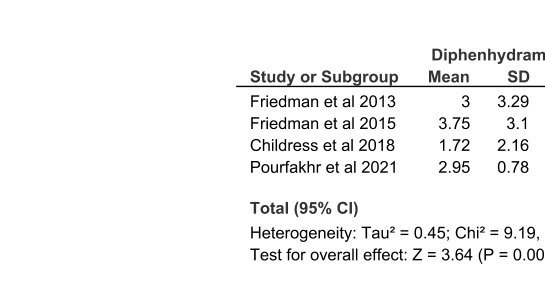
Pain score: The mean pain score was 2.86 (SD 0.84) in the diphenhydramine groups vs 4.41 (SD 0.68) in the control groups; t(6)= -2.879, 95% CI [-2.87 to - 0.23], p =0.028. When the baseline pain score was included in the analysis, we noted a mean difference in the pain score of 4.8, 95% CI [3.0 to 6.64] in the diphenhydramine group vs 3.18, 95% CI [0.68 to 5.67] in the control group. The pooled effect size or the mean difference in acute pain reduction favouring diphenhydramine and taken from a random-effects model was -1.53 (95% CI: [-2.35 to -0.70]) using Cohen’s d. The uniform outcome measures permit using the mean difference. However, the studies showed significant heterogeneity, which precludes any firm judgement (Figure 2).
Within one hour of administering intravenous diphenhydramine – irrespective of the initial pain score – the mean pain score was reduced to 29%, representing a visual pain score of 3 out of 10. When the initial pain score was taken into consideration, the pain scores were reduced by 48% from the initial score, with a variable response rate ranging from 30% to 66%. Although the control groups (paracetamol, metoclopramide or ketorolac) also showed improvement in the acute pain score, the effectiveness was 65% to 70% less than the effect of diphenhydramine. Furthermore, it revealed a wide confidence interval that reflects a variable response to the different medications used in the studies’ control groups. Despite the significant heterogeneity of the meta-analysis, which can be explained by the various medications used alongside diphenhy- dramine, the alignment of the findings from the in- dependent t-test and paired t-test affirms the results of acute pain reduction. In our review, the effective intravenous dose of diphenhydramine ranges from 25 to 50 mg. Such dose range is shown to be safe and within the recommended therapeutic dose [23,
24]. While peak plasma concentration occurs two hours after administration [25], we noted the manifestation of the analgesic effect within one hour of administration. Thus, diphenhydramine should be included in the initial pain medication regimen.
Systemic diphenhydramine is a pregnancy cate- gory B drug; there are still questions surrounding its adverse events when used in the first trimester of pregnancy [26-28]. We were unable to reach a conclusion regarding the effect of diphenhydramine in pregnant patients, given that such patients were not included in all of the included studies.
Likewise, most of the included studies examined the role of diphenhydramine on headaches, and this may limit generalisability to other pain conditions. Moreover, the combination with metoclopramide might augment or reduce the true analgesic effect of diphenhydramine since metoclopramide has been shown to have an analgesic effect, especially on headaches [29,30]. Additionally, patients with pain often use over-the-counter medication, including paracetamol or non-steroidal drugs, which makes isolating the analgesic prosperities of the studied medicine even more difficult. Nonetheless, investi- gating diphenhydramine as a monotherapy medica- tion is not ethically plausible. Our analysis provides evidence for its proven analgesic effect beyond its already-recognised sedative properties.
Future research ought to include the exploration of diphenhydramine’s effect via different routes, any influence of gender on its effect, and its effect on chronic pain disorders like acute sickle cell crises.
Diphenhydramine is a useful adjunct to pain man- agement in the acute setting. We have explored its advantageous effect when used as an adjunct to acute pain management in the ED, and we support its use for the treatment of pain in the emergency setting. Furthermore, we advocate the inclusion of diphenhydramine in the predefined pain management protocols. We refute the notion that diphenhydramine’s analgesic effect results from its sedative effect, as the analgesic effect was measured in relation to the visual pain score rather than to the amount of analgesia required or the number of times analgesia is called for. Relying on the patients’
Figure. 1. PRISMA Chart of the included studies
laparoscopic sleeve gastrectomy
subjective assessment of their pain further affirms their alertness to pain.
We would like to thank Professor Benjamin W. Friedman from Albert Einstein College of Medicine, the author of two of the included articles, for his support in providing the data required for this review.
| Studies | Pourfakhr et al. | Childress et al. | Friedman et al. | Friedman et al. |
|---|---|---|---|---|
| (2021) | (2018) | (2015) | (2013) | |
| Total number | of 79 | 36 | 203 | 120 |
| patients | ||||
| Dose of IV | 0.4 mg/kg | 25 mg | 50 mg | 25 mg |
| diphenhydramine | ||||
| Combined | Ondansetron 4 | Metoclopramide 10 | Metoclopramide | Metoclopramide 20 |
| medication(s) | mg and | mg | 10 mg | mg |
| paracetamol 1 g | ||||
| Compared with | Ondansetron 4 | Paracetamol 650- | Metoclopramide | Ketorolac 30 mg |
| mg and | 1000 mg followed | 10 mg | ||
| paracetamol 1 g | by codeine 30 mg | |||
| IV if needed | ||||
| Clinical condition | Pre-induction for | Headache in | Headache | Headache |
| laparoscopic | pregnant patients | |||
| f , | , | p158 | ||
| Inclusion criteria | Obese patients | Normotensive | Adult patients | Adult patients |
| between 19 and | pregnant patients | younger than 65 | younger than 65 | |
| 50 years of age | with primary | years of age with | years of age with | |
| headache in the | moderate or severe | acute primary | ||
| second or third | primary headache | headache | ||
| trimester | ||||
| Exclusion criteria | Smokers; drug | Age below 16 | Suspicion of | Suspicion of |
| abusers; nausea | years; first trimester | secondary cause | secondary severe | |
| or vomiting | patients with | (including patients | cause (including | |
| (chronic); severe | secondary | with fever, new | patients with fever, | |
| obstructive sleep | headache; patients | neurological | new neurological | |
| apnoea | in active labour; | deficit(s), and | deficit(s)); allergy to | |
| (uncontrolled); | patients who used | those admitted for | the medication under | |
| psychiatric | pain relief other | imaging or lumbar | investigation; | |
| disorder | than acetaminophen | puncture); allergy, | patients with peptic | |
| (uncontrolled); | within the last 24 | intolerance, or | ulcer disease, active | |
| history of | hours; history of | contraindication to | gastritis, or history | |
| glaucoma; | allergy to the drug | the medication | of upper | |
| prostatic | under investigation; | under investigation | gastrointestinal | |
| enlargement; | abnormal | bleeding; organ | ||
| inability to empty | intracranial | transplant; patients | ||
| the bladder | anatomy | with history of | ||
| monoamine oxidase | ||||
| inhibitor use; | ||||
| pregnant patients or | ||||
| lactating females at | ||||
| the time of the study |
| Inclusion Sequence Allocation Blinding of Blinding | Incomplete | Selective | Other |
|---|---|---|---|
| generation concealment participant of | outcome | outcome | sources |
| and trial outcome | data | reporting | of bias |
| personnel assessor | |||
| Pourfakhr + + + + | + | - | - |
| et al., 2021 | |||
| Friedman + + (-) * + + | - ** | - | - |
| et al., 2015 | |||
| Friedman + + (-) * + + | - ^ | - | - |
| et al., 2013 | |||
| Childress + + + + | - ^^ | - | - |
| et al., 2018 | |||
| * Blinding of participant and trial personnel; only the pharmacist was aware | |||
| ** only 202 out of 208 analysed in the outcome; six lost to follow-up | |||
| ^ only 114 out of 123 analysed in the outcome; six lost to follow-up and three | excluded after | randomisation | |
| ^^ one developed pre eclampsia and was delivered |