Full text rendered from the published PDF. The PDF is the version of record; if the two differ, the PDF governs.
Background
Patients seeking emergency department (ED) care for non-acute conditions are a major contributor to ED overcrowding, which results in longer wait times.
Method
This was a cross-sectional study, conducted using an online survey among the Saudi population to assess their awareness about primary healthcare clinics (PHCCs) and urgent care clinics (UCCs), their role, and their scope of practice.
Results
A total of 565 participants were included in this study. Most of the respondents (81.1%) reported lengthy waiting times in the ED. Moreover, most (81.6%) stated that they had never visited a family doctor, yet they (92.6%) favoured having one for follow-up care. Close to half of the participants (50.3%) reported attending PHCCs without an appointment, and the majority of them (69.2%) said that PHCCs were overcrowded. Finally, most participants (92.4%) had not heard aboutUCCs.
Conclusion
ED overcrowding and prolonged waiting times remain a public concern. PHCCs and UCCs are underutilised, and this is attributed to the lack of awareness about their scope and their services.
Keywords: Awareness, Emergency department, Primary healthcare center, Overcrowding
The term “emergency department (ED) over- crowding” refers to a situation in which the demand for emergency services exceeds the capacity of nurses and physicians to deliver appropriate care promptly [1]. Globally, patients seeking care for
Atheer Alotaibi, Bandar Alotaibi are with King Saud Medical City, e-mail: Atheerr-1994@hotmail.com, e-mail: dr.bandaralruwais@hotmail.com Dania Farooq is with Alfaisal University, e-mail: daniafarooq187@gmail.com (Corresponding author). DOI: 10.526 09/jmlph.v3i1.66
non-acute conditions lead to ED overcrowding, re- sulting in longer wait times for medical intervention regardless of severity [2]. This may lead to patient dissatisfaction and a higher risk of death, and con- tribute to higher health system costs [3, 4].
ED crowding has been identified as a problem that occurs in most developed countries, and is described as a worldwide public health problem [5]. Some of the increased demand is related to patients with primary care problems who use emergency department settings to access care [6], although a large proportion of those patients (10%–60%) can be managed using lower-acuity care services [7].
A recent review of various studies identified the main reasons for ED and urgent care clinic (UCC) attendance, which included a lack of access to primary care; perceptions of urgency or anxiety; recommendations from friends, family, or healthcare professionals; and convenience in terms of better opening hours or being closer to home than alter- natives [8].
One solution to the problem is to improve guid- ance and enhance access to primary care services. Primary care physicians are not limited to a specific disease; they are trained to manage any kind of ill- ness through a holistic, patient-centred approach and in connection with every other medical speciality [9].
In Saudi Arabia, a study conducted at an urgent care clinic found that most participants were un- aware of urgent care and the service that can be delivered [5]. Meanwhile, studies showed a positive impact of PHCC on ED length of stay, patient satisfaction, patient safety, and departure before completion of service [10]. Also in Saudi Arabia, studies showed a significant association between overcrowding and length of stay [11].
The main objective of our study is to investigate the potential of PHCC and urgent care to improve ED crowding and to explore the importance of PHCCs as an alternative to treat mild cases that do not constitute a emergency. We also aim to explore the awareness of the general population of the role of PHCCs and UCCs.
We estimated a sample size of the total population of Saudi Arabia (34 000 000) to be 385 participants, using the Raosoft calculator, with a 5% level of significance, 5% margin of error, 95% confidence and expected response distribution of 50%. We used the chi-square (X 2 ) statistic and Fisher’s exact test where appropriate. Data analysis was conducted using SPSS version 25.
Perception toward the primary healthcare scope of practice:
| ciodemographic charac- | |
|---|---|
| articipants’ age, gender, | Frequency of ED visits: |
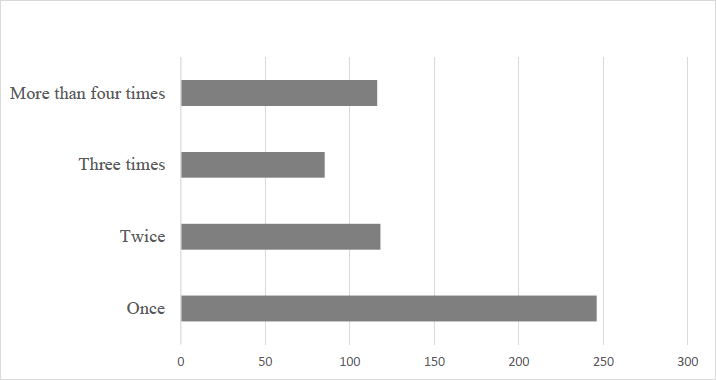
| bout nd ED PHCC health waiting the frequency status. accessibility, time, The family of other ED | is differ p=0.718, The illustrated with frequency gender; regard in of Figure X2 to ED (3, age; N=565) visits 1. X2 This within (9, = frequency 2.003, N=565) the current p=0.575, = did 6.209, year not or |
| imary healthcare scope of | province; X2 (12, N=565) = 10.570, p=0.566. |
| owards UCCs. An initial | Perception toward ED waiting time: |
| ed; however, a reliability | The waiting time was perceived to be prolonged by |
| ut. | 81.1% (n=458) of respondents. This perception of |
| lt male and female partici- | prolonged waiting times did not differ with regard to |
| population who agreed to | age X2 (3, N=565) =5.416, p=0.131; gender X2 (1, |
| excluded incomplete sur- | N=565) = 1.389, p= 0.277; or province X2 (4, |
| nly adult participants with | N=565) = 8.628, p=0.071. In quantifying the accept- |
| mart devices, and who are | able ED waiting time, the majority, 88.8% (n=502), |
| ld be able to answer the | reported less than one hour to be an acceptable time. |
| nvenience sample, which | Family physician’s follow-up; |
| ing the survey using the | When queried about the availability of a family |
| hod. Distribution of the | physician for regular follow-up, only 5.7% (n=32) |
| cial media platforms. | reported having a family physician with whom to |
| ize of the total population | follow up, while the vast majority did not. More- |
| 00) to be 385 participants, | over, 81.6% (n=461) said they never visited a family |
| tor, with a 5% level of | physician. On the other hand, 92.6% (n=523) sup- |
| tribution of error, of 95% 50%. confidence We used | ported for regular the idea follow-up. of having Such a specific support family did not physician differ |
| ic and Fisher’s exact test | with regard to the participants’ age; Fisher’s exact |
| analysis was conducted | test=1.043, p= 0.808, or province; X2 (4, N=565) |
| =2.249, p=0.690. | |
| ESULTS | Accessibility to PHCCs: |
| Overcrowding at PHCCs was reported by 69.2% | |
| (n=391) of respondents. In addition, 50.3% (n=284) | |
| rticipants who completed | reported visiting a PHCC without an appointment. |
| the surveys received were | The perception of overcrowding did not differ in |
| uded in the analysis. The | different provinces; X2 (4, N=565) =8.019, p=0.091. |
| icipants are illustrated in | |
| When asked where influenza symptoms should be | Furthermore, most participants in our study |
| treated, 60.9% (n=344) noted that this should be | (81.6%) reported that they had never visited a family |
| treated in the PHCC, rather than the ED. The | physician. However, 92.6% supported having a |
| percentage increased to 66.4% (n=375) for the | family physician to follow up with. There is a |
| treatment of sore throat and sinusitis, in particular. | positive correlation between patients’ awareness of |
| Furthermore, 53.3% (n=301) believed that chronic | and use of PHCC services, according to several re- |
| diseases such as hypertension (HTN) and Diabetes | search articles [13,14]. According to one study that |
| Mellitus (DM) should be treated in the PHCC rather | looked at variables influencing the use of PHCCs in |
| than the ED. Patients from different age groups did | Saudi Arabia, the patients’ educational level and |
| not differ in their opinions as to whether influenza | awareness of the quality of primary healthcare were |
| symptoms, sore throat, and sinusitis should be | crucial factors in determining the degree of primary |
| treated in a PHCC or ED (p>0.05). Moreover, the | healthcare consumption [15]. However, in our |
| perception toward the PHCCs’ scope of practice (flu | analysis, we noted a knowledge gap with regard to |
| treatment, sore throat/sinusitis, and treatment of | where minor health issues should be treated. This is |
| chronic diseases) did not differ in different | evident in the perception that influenza/ common |
| provinces; p>0.05. | colds symptoms should be treated in the ED rather |
| than a PHCC. Hence, increasing awareness of the | |
| Urgent care clinics: | care provided by PHCCs should be the first step. |
| Most participants had not heard about UCCs; | Elagi et al. reported that participants’ perceptions |
| 92.4% (n=522). Only 3.4% (n=18) of those who had | of family physicians as crucial elements of the |
| heard about them had visited a UCC. Such | healthcare system were generally positive. However, |
| perception did not differ between provinces X2 (4, | there may be some communication gaps between |
| N=565) =1.801, p=0.772. We also noted that 65.1% | doctors and patients, which may be a factor in the |
| (n=368) believed that the UCC is for emergency | dissatisfaction experienced by the majority of the |
| cases; we believe this is a linguistic bias as the name | studied group [16]. |
| implies an urgent nature. | Most participants in this study (69.2%) reported |
| IV. DISCUSSION | overcrowding in PHCCs, and nearly half of them |
| (50.3%) reported visiting PHCCs without an ap- | |
| In this study, most participants (81.1%) reported a | pointment. Albalahi et al. reported similar results: |
| prolonged waiting time in the ED, while the | about 45% of patients in their survey said they visited |
| perceived acceptable waiting time was less than one | the UCC in Riyadh, Saudi Arabia, without making |
| hour. This indicates a consensus that the ED waiting | an appointment [5]. Patients were drawn to the |
| time is an issue within the community. It is clear that | scheduling flexibility, indicating that comparable |
| strategies must be developed to address or mitigate | scheduling in traditional primary care systems would |
| the overcrowding in EDs, given its growing | also be effective in attracting patients. Previous |
| significance and potential effects on both patient and | research has shown that the idea of “open access” |
| employee wellness. The causes of ED overcrowding | appointment scheduling allows patients to receive |
| have been discussed previously, and they include | continuous, normal care while still accommodating |
| factors related to input, throughput, and output. Only | their urgent medical requirements [17]. |
| by being aware of the problem and understanding it | Most of the Saudi population (92.4%) in this study |
| can we implement the best strategies for dealing with | had not heard about UCCs. Although most of the |
| and controlling it. In this regard, a review was | Saudi population (92.4%) in this study had not heard |
| undertaken, beginning with a study of the causes and | about UCCs, nonetheless, in other countries, the |
| effects and concentrating primarily on the techniques | public’s increased recognition of UCCs as |
| that might be utilised to combat this phenomenon | trustworthy care providers has been speculated to be |
| [12]. This cross-sectional study identified the role of | the cause of the recent acceleration in UCC industry |
| Parameter | N (%) |
|---|---|
| Age | |
| Younger than 20 years | 2 0.4 |
| 20-30 years | 161 28.5 |
| 30-50 years | 363 64.2 |
| Older than 50 years | 39 6.9 |
| Gender | |
| Male | 54 9.6 |
| Female | 511 90.4 |
| Provinces | |
| Western Province | 126 22.3 |
| Northern Province | 40 7.1 |
| Eastern Province | 39 6.9 |
| Southern Province | 132 23.4 |
| Central province | 228 40.4 |
| Education | |
| Primary school | 2 0.4 |
| Elementary school | 7 1.2 |
| High school | 28 5 |
| University degree and higher | 528 93.5 |
| it is advised that any non-life-threatening medical | health. Emerg Med J. 2003 Sep;20(5):402-5. doi: |
| problem requiring immediate attention be taken to a | 10.1136/emj.20.5.402. PMID: 12954674; PMCID: |
| UCC rather than an ED. However, given their longer | PMC1726173. |
| office hours during the week and on weekends, | 5. Albalahi NM, Al Bargawi M, Kofi M. Aware- |
| which the majority of primary care physicians do not | ness and utilisation of urgent care services among |
| offer, it is advised to visit a UCC in addition to | patients attending Al-Wazarat PHCC in Riyadh, |
| primary care services, rather than using a UCC as a | Saudi Arabia 2020. J Family Med Prim Care. 2021 |
| substitute for a primary care physician [5]. | Dec;10(12):4452–62. |
| Our study provides new insight into public aware- | 6. Skinner HG, Blanchard J, Elixhauser A. Trends |
| ness of the importance of PHCCs and UCCs. We | in Emergency Department Visits, 2006–2011. 2014 |
| provide a thorough analysis of how those services | Sep. In: Healthcare Cost and Utilisation Project |
| are underutilised at the expense of the ED. On the | (HCUP) Statistical Briefs [Internet]. Rockville |
| other hand, our analysis is limited in that the majority | (MD): Agency for Healthcare Research and Quality |
| of the participants were female and that the survey | (US); 2006 Feb–. Statistical Brief #179. PMID: |
| was not validated prior to its distribution. | 25473724. |
| 7. Penson R, Coleman P, Mason S, Nicholl J. Why | |
| V. CONCLUSION | do patients with minor or moderate conditions that |
| ED overcrowding and prolonged waiting times | could be managed in other settings attend the |
| remain a public concern. Meanwhile, PHCCs and | emergency department? Emerg Med J. 2012 |
| UCCs are underutilised; such underutilisation is | Jun;29(6):487-91. doi: 10.1136/emj.2010.107276. |
| attributed to the lack of public awareness regarding | Epub 2011 May 11. PMID: 21561984. |
| their scope and available services. Investment in | 8. Coster JE, Turner JK, Bradbury D, Cantrell |
| public awareness appears justifiable, whether through | A. Why Do People Choose Emergency and Urgent |
| the media or by shifting patients from the ED to the | Care Services? A Rapid Review Utilising a Sys- |
| UCC. Collaboration with family physicians for their | tematic Literature Search and Narrative Synthesis. |
| perspective, and another look at the geographical | Acad Emerg Med. 2017 Sep;24(9):1137-1149. doi: |
| coverage of PHCCs in relation to population density, | 10.1111/acem.13220. Epub 2017 Jun 19. PMID: |
| are both warranted. | 28493626; PMCID: PMC5599959. |
| 9. Kirschner K, Braspenning J, Maassen I, Bonte | |
| VI. REFERENCES | A, Burgers J, Grol R. Improving access to primary |
| 1. Sinclair D. Emergency department | care: the impact of a quality-improvement strategy. |
| overcrowding - implications for paediatric | Qual Saf Health Care. 2010 Jun;19(3):248-51. doi: |
| emergency medicine. Paediatr Child Health. 2007 | 10.1136/qshc.2008.031526. Epub 2010 Apr 27. |
| Jul;12(6):491-494. doi: 10.1093/pch/12.6.491. | PMID: 20427305. |
| PMID: 19030415; PMCID: PMC2528760. | 10. Jeyaraman MM, Alder RN, Copstein L, Al- |
| 2. Jones D, Carroll L, Frank L. After-hours care | Yousif N, Suss R, Zarychanski R, Doupe MB, |
| in suburban Canada: influencing emergency | Berthelot S, Mireault J, Tardif P, Askin N, Buchel T, |
| department utilisation. J Prim Care Community | Rabbani R, Beaudry T, Hartwell M, Shimmin C, Ed- |
| Health. 2011 Oct 1;2(4):250-4. doi: | wards J, Halas G, Sevcik W, Tricco AC, Chochinov |
| 10.1177/2150131911408431. Epub 2011 May 25. | A, Rowe BH, Abou-Setta AM. Impact of employ- |
| PMID: 23804843. | ing primary healthcare professionals in emergency |
| 3. Hong M, Thind A, Zaric GS, Sarma S. Emer- | department triage on patient flow outcomes: a sys- |
| gency department use following incentives to pro- | tematic review and meta-analysis. BMJ Open. 2022 |
| vide after-hours primary care: a retrospective cohort | Apr 20;12(4):e052850. doi: 10.1136/bmjopen-2021- |
| study. CMAJ. 2021 Jan 18;193(3):E85-E93. doi: | 052850. PMID: 35443941; PMCID: PMC9058787. |
| 10.1503/cmaj.200277. PMID: 33462144; PMCID: | 11. Al-Qahtani MF, Khubrani FY. Exploring Po- |
| a University Hospital in Saudi Arabia. Open Access | |
| Emerg Med. 2021 Jun 22;13:257-263. doi: | |
| 10.2147/OAEM.S305885. PMID: 34188561; PM- | |
| CID: PMC8235939. | |
| 12. Lindner G, Woitok BK. Emergency de- | |
| partment overcrowding : Analysis and strategies to | |
| manage an international phenomenon. Wien Klin | |
| Wochenschr. 2021 Mar;133(5-6):229-233. doi: | |
| 10.1007/s00508-019-01596-7. Epub 2020 Jan 13. | |
| PMID: 31932966. | |
| 13. Burnham G, Taylor CH, Hung YW, Ferati A, | |
| Dyer A, Hifi TA, Aboud R, Hasoon T. Perceptions | |
| and utilisation of primary healthcare services in Iraq: | |
| findings from a national household survey. World | |
| Health Popul. 2012;13(3):68-79. doi: | |
| 10.12927/whp.2012.22873. PMID: 22555121. | |
| 14. Kim KY, Lim K, Park EW, Choi EY, Cheong | |
| YS. Patients’ Perceived Quality of Family | |
| Physicians’ Primary Care with or without ‘Family | |
| Medicine’ in the Clinic Name. Ko- rean J Fam | |
| Med. 2016 Sep;37(5):303-7. doi: | |
| 10.4082/kjfm.2016.37.5.303. Epub 2016 Sep 21. | |
| PMID: 27688865; PMCID: PMC5039123. | |
| 15. Al-Omar BA, Saeed KS. Factors influencing | |
| patients’ utilisation of primary health care providers | |
| in Saudi Arabia. J Family Community Med. 1998 | |
| Jul;5(2):23-30. PMID: 23008586; PM- CID: | |
| PMC3437084. | |
| 16. Elagi AAA, Jaber BA, Wassly AHA, Ahmed | |
| RMS, Bosily FAA. Public’s perception and satis- | |
| faction on the role and services provided by family | |
| physicians in Saudi Arabia: A cross-sectional study. | |
| J Family Med Prim Care. 2019 Oct 31;8(10):3282- | |
| 3286. doi: 10.4103/jfmpc.jfmpc_621_19. PMID: | |
| 31742156; PMCID: PMC6857371. | |
| 17. Kellermann AL. Nonurgent emergency depart- | |
| ment visits: Meeting an unmet need. JAMA. 1994 | |
| Jun 22-29;271(24):1953-4. PMID: 8201741. | |
| 18. Le ST, Hsia RY. Community characteristics | |
| associated with where urgent care centers are lo- | |
| cated: a cross-sectional analysis. BMJ Open. 2016 | |
| Apr 7;6(4):e010663. doi: 10.1136/bmjopen-2015- | |
| 010663. PMID: 27056591; PMCID: PMC4838716. |