Full text rendered from the published PDF. The PDF is the version of record; if the two differ, the PDF governs.
BACKGROUND : The use of butyrophenones for headaches became plausible when the association was established between dopamine and headache. However, despite their positive effect on acute headaches, their use remains controversial.
AIM : The goal of this study is to ascertain whether the addition of haloperidol or droperidol to the treatment regimen for acute primary headache lowers the pain score of adult patients in the emergency department.
METHODS : A systematic review and meta-analysis was conducted. We searched the following databases for randomised controlled trials (RCTs): PubMed, Cochrane databases, and grey literature, from 1963 to October 2022. Included were RCTs conducted on the use of butyrophenones (IV haloperidol or IV/IM droperidol) in the acute management of primary headaches (diagnosed or undiagnosed), designated prospective, double-blind or open, using only the Visual Analogue Scale (VAS) with a specific measurement time. We excluded non-English studies that lacked translation, studies conducted on paediatric age groups, and studies conducted on animals.
RESULTS: Out of 49 articles we included seven, three of which investigated haloperidol. The mean difference in VAS score favoured haloperidol; -2.46 (95% CI: [-4.11 to -0.81]), indicating a drop in VAS score of 2.5/10 units. The mean difference in VAS score for the use of droperidol was -0.35 (95% CI: [-1.24 to 0.54]).
CONCLUSION : Haloperidol can induce an acute 25% reduction in VAS score when added to the regimen for acute headache management. It also reduces the need for rescue medications and improves patient satisfaction. Nonetheless, considerable side effects cannot be overlooked.
Headache is a commonly-managed symptom in the emergency department (ED) setting. One study reported that, in one year, more than three million patients presented to the ED complaining of headache, making this a common chief complaint [1]. Nonetheless, the diagnosis and management of primary headache disorders receive inadequate attention and the undertreatment of such patients is prevalent [2,3]. This can be attributed to the fact that the management approach of ED physicians is tailored toward life-threatening causes of headaches, including but not limited to meningitis, subarach- noid haemorrhage (SAH), and intracranial mass.
The high burden of primary headaches is not limited merely to their prevalence [4]. The sequelae of absenteeism and reduced productivity also carry economic costs [5,6]. Lower satisfaction with ED management, and with health care in general, is another important but often-overlooked factor that results from undertreatment. Conversely, the earlier and the more successfully a patient’s headache is addressed, the higher their satisfaction rate [7].
The literature on the acute treatment of primary headache disorders is extensive, spanning decades. The use of butyrophenones for headaches became plausible when the association was established be- tween dopamine and headache [8]: these medica- tions’ action as a dopamine receptor antagonist made them a treatment of choice for such disorders. However, despite their positive effect in several randomised controlled trials, their use remains dis- couraged given the low level of evidence and the concern regarding their side effects [9].
The incidence of side effects from the use of butyrophenones was as high as 45% [10]. Those side effects include akathisia, anxiety, prolonged QT interval, and sedation. The resulting risk of torsade de pointes and sudden death was reported in several analyses [11, 12]. However, further knowledge of the medications’ delivery routes and the underlying risk factors might influence our understanding of the cause-and-effect relationships involved [13-15].
A previous systematic review attempted to explore the effect of butyrophenones on primary headaches [10]; it concluded that these medications are effec- tive, yet their side effects should not be disregarded. Nevertheless, the small number of included articles, the combination of haloperidol with droperidol, as well as the different outcome measures, might have exaggerated the positive findings. Hence, despite the performance of several randomised controlled trials (RCTs), the literature still lacks a solid conclusion as to whether butyrophenones should be advocated for acute primary headache.
Thus, in this review, we aim to investigate the effi- cacy of butyrophenones (haloperidol and droperidol) for the acute management of primary headache in the ED. We also aim to explore their effect on patients’ return to the ED, their side effects, and patients’ reported satisfaction rates.
Research question: Does the addition of butyrophenones (haloperidol or droperidol) to the treatment regimen for acute primary headache reduce the pain score of adult patients in the emergency department?
Search strategy: We searched the following databases: PubMed, Cochrane databases, and grey literature (ClinicalTri-
als.gov and World Health Organization International Clinical Trials Registry Platform). We also searched the reference lists of included articles.
Search method MeSH terms was: Exp headache, 2 exp migraine, 3 exp haloperidol, 4 exp droperidol, 5 exp butyrophenones, 6 exp 1 and 3, 7 exp 2 and 3, 8 exp 1 and 4, 9 exp 2 and 4, 10 exp 1 and 5, 11 exp 2 and 5.
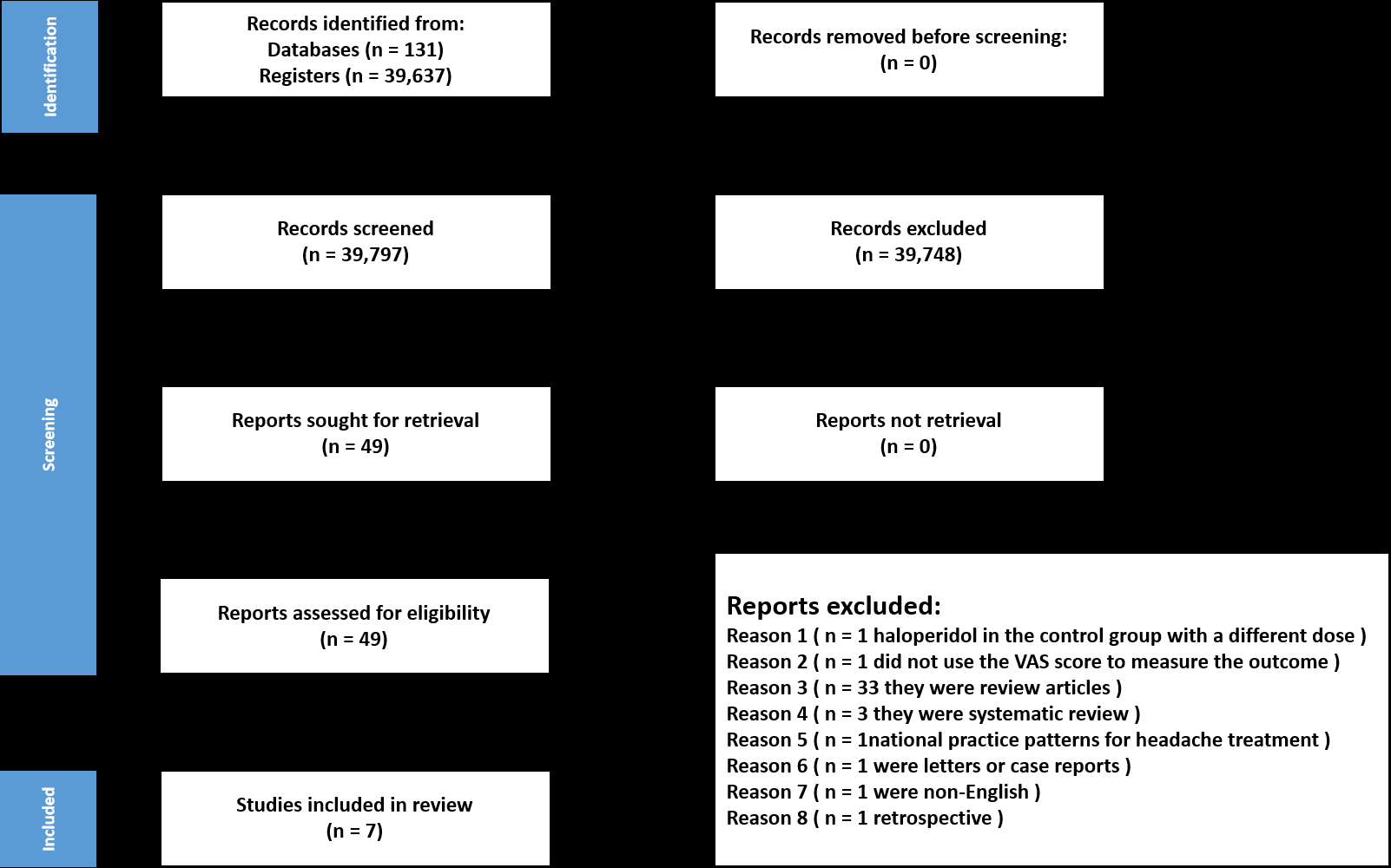
The search aimed to identify randomised con- trolled trials comparing butyrophenones (haloperi- dol or droperidol) with placebo or an active control in adult patients with acute headaches. This search strategy yielded 49 articles, of which 33 were ex- cluded because they were review articles, 3 were excluded because they were systematic reviews, 1 described national practice patterns for headache treatment, 1 was a letter or case report, 1 was non- English, and 1 was retrospective. The remaining 9 articles were retained and reviewed, and 2 of those were excluded: the first due to use of haloperidol at a different dose in the control group, and the second because it did not use the VAS score to measure the outcome. The 7 included articles are summarised in Table 1 and Table 2.
Selection criteria: The inclusion criteria were all RCTs conducted on the use of butyrophenones (haloperidol and droperidol) in the acute management of primary headaches (diagnosed or undiagnosed), designated prospective, double-blind or open, using only the Vi- sual Analogue Scale (VAS) with a specific measure- ment time. We excluded non-English studies that lacked translation, studies conducted on paediatric age groups, and studies conducted on animals. We also excluded articles that did not use the Visual Analogue Scale (VAS) to measure the intensity of headache pain.
Data extraction, quality assessment, and qualita- tive synthesis:
The studies’ eligibility for inclusion in our review was examined by the first two authors indepen- dently; another researcher was consulted in the event of any disagreement regarding a study’s inclusion. As illustrated in Table 3, we applied the RoB 2, a revised Cochrane risk-of- bias tool for randomised controlled trials, to assess the bias of the included studies [16].
Data analysis: Continuous variables were used and a mean difference was calculated. The data were analysed using the mean difference in pain score between pre- and post-administration of the medications. We used the maximum (or longest) reported patient observation period. Review Manager Web was used to perform the meta-analysis, employing a random- effects model on the assumption that the true effect size would vary from one study to another [17]. We used the I 2 statistic to assess for heterogeneity. In the event that data was missing from any included study, we planned to contact the authors before applying a mean imputation strategy according to the Cochrane guidelines for imputing missing data [18]. This review was written in accordance with the Preferred Reporting Items for a Review and Meta- analysis of Individual Participant Data [19], and was approved by the IRB committee with log number 22-579.
Outcomes: The primary outcome was the difference in VAS score after administering butyrophenones (haloperi- dol or droperidol) for patients visiting the ED with primary headaches. The secondary outcome was the effect of butyrophenones on the need for rescue medication, patients’ return to ED, patient satisfac- tion, and side effects.
Study selection: Out of 49 articles we included seven, three of which investigated haloperidol, as illustrated in the Prisma chart (Figure 1). Two studies [20, 21] were excluded: the first used haloperidol in the control group with a different dose, and the second did not use the VAS score to measure the outcome. The included articles are illustrated in Tables 1 and 2. We calculated the standard deviation (SD) from the 95% confidence interval using the formula:
SD= N * (upper limit-lower limit)/3.92
We attempted to contact the authors of one of the included studies to retrieve the SD [22], but failed to receive an answer; we therefore imputed the missing SD. Table 4 illustrates the risk of bias in the included articles.
Demographic characteristics: A total of 608 patients were included in this analysis, of which 198 (32.6%) were male and 410 (67.4%) female. The mean age of the patients was 32.4 years. All of the haloperidol studies excluded patients with a prolonged QT interval at baseline, while patients with possible secondary headache were excluded from all of the studies.
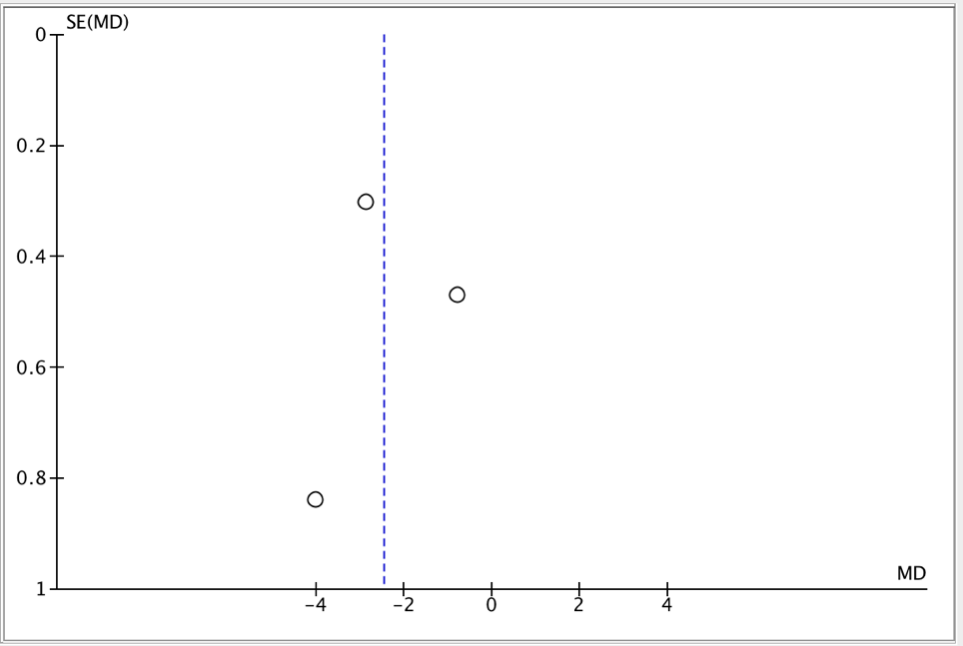
Efficacy of IV haloperidol: The total number of patients in the haloperidol analysis was 222, of whom 109 received intravenous haloperidol and 113 were in the control group. The mean VAS score in the treatment group was 7.6 (SD 0.91) at baseline, and in the control group 7.4 (SD 0.89). The mean difference between pre- and post- medication VAS scores in those receiving haloperi- dol was 5.29 (SD 0.47), compared with 2.56 (SD 2.09) in the control group. The pooled effect size or mean difference in VAS score favoured haloperidol; -2.46 (95% CI: [-4.11 to -0.81]). The total effect size indicates a drop in VAS score of 2.5 units out of 10, or 25 mm of the 100 mm scale. However, significant substantial heterogeneity was noted; the forest plot is illustrated in Figure 2. A funnel plot revealed no evidence of publication bias, as illustrated in Figure 3.
Need for rescue medication after administering haloperidol:
The use of haloperidol significantly reduced the need for rescue medication by 35% (p=0.002), as illustrated in Figure 4. However, one study [24] was omitted from this analysis as haloperidol was used as a rescue medication, and it was unclear whether any other drug was used thereafter.
Return to ED and patient satisfaction: Of the included patients who received haloperi- dol, 6.42% (n=7) returned to the ED after dis- charge, whereas 11.5% (n=13) returned from the control group. The rate of satisfaction after receiving haloperidol was 72% (n=79).
Side effects: Nausea and vomiting were excluded from our analysis given the variation in the control groups, as well as the fact that those are symptoms of several primary headache disorders. Akathisia, agitation and anxiety were reported in 32 patients who received
Table 1. Summary of included studies assessing droperidol
Table 2. Summary of included studies assessing haloperidol
Table 3. Risk of bias in the included articles
haloperidol (29.4%), whereas sedation was reported in 14 patients from two studies, comprising 27.5%.
In two articles on haloperidol, McCoy et al. [23] and Gaffigan et al. [25] reported a change in the QT interval. The average change in the treatment group was 6.37 ms, whereas the average change in the control group was 9.25 ms. However, the latter study did not capture all of the patients’ readings, and thus a firm judgement cannot be reached regarding such findings.
Quality assessment: As per Table 3, an overall quality assessment re-
vealed a low risk of bias, and therefore our findings from these articles can be generalisable. However, some information may be missing with regard to ECG changes and QTc prolongation or arrhythmias, which precludes our effort to further investigate the side effects.
Efficacy of IV/IM droperidol: The total number of patients in the droperidol analysis was 380, of whom 187 received droperidol and 193 were in the control group. The mean VAS score for the treatment group was 7.99 (SD 1.89) at baseline, and 7.84 (SD 1.96) for the control group.
The mean difference between pre- and post- medication VAS scores in those receiving droperidol was 5.39 (SD 1.12), compared with 5.17 (SD 1.26) in the control group.
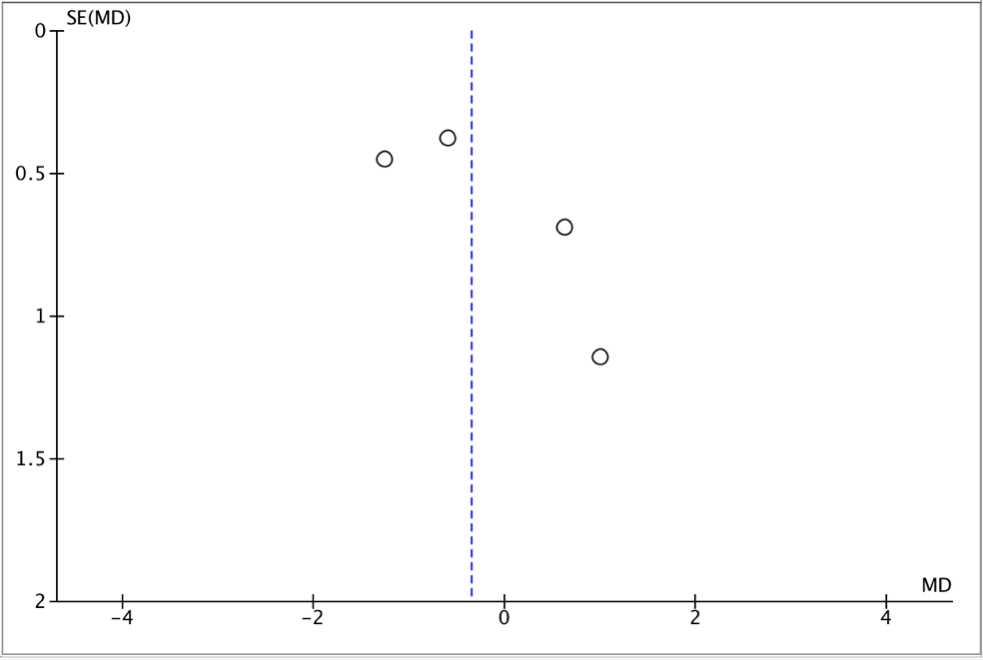
The pooled effect size or mean difference in VAS score was -0.35 (95% CI: [-1.24 to 0.54]) using Cohen’s d. The finding, although favouring intervention, was not statistically significant; a non- significant heterogeneity was also noted. Figure 5 illustrates the forest plot. In addition, a funnel plot did not reveal any publication bias, as shown in Figure 6.
The lack of a statistically positive effect for droperidol obviates further analysis of the need for rescue medication following its administration, patients’ return to ED, and patient satisfaction.
The benefits of butyrophenones as a treatment for patients presenting to ED with primary headaches appear significant. The changes in VAS scores, the total effect size of the reduction in VAS score by 25%, the reduced need for rescue medication, and the reduced incidence of patients returning to the ED, all hint at its effectiveness. Nonetheless, akathisia, agitation and anxiety were observed in one-third of the patients, and the effect on the QTc interval was difficult to ascertain. Taking a benefit/risk approach, haloperidol would continue to be a less desirable medication in this population.
From the perspective of patient satisfaction, such medication may be favoured as patients were less likely to return to ED and less likely to require rescue medication, indicating that their headache had improved. However, we believe that physicians who choose to use this class of drug should monitor patients for possible side effects, especially agitation and anxiety. Although we aimed in this analysis to examine haloperidol’s effectiveness, other important drug safety should also be considered, including its use in those with severe cardiovascular disease, Myasthenia gravis, Parkinson and Thyroid dysfunc- tion [29].
The effect of droperidol was analysed in two different groups by administering it IV/IM and measuring the VAS score. A comparison of the two groups demonstrated a negligible difference in VAS scores between those who received droperidol and
those in the control group, which was not statistically significant.
Our results aligned with the findings of multiple systematic review studies that have been conducted on the effect of butyrophenones such as haloperidol and droperidol [30] [31] [32] [33].
Haloperidol’s effect on the reduction of pain and the need for rescue medication was statistically significant and it was favoured by some patients, but the incidence of side effects was considerable. Reported side effects included akathisia, agitation, anxiety, and sedation. Thus, it is not recommended as a first-line treatment, but could be theorised. Based on the available evidence, we believe that haloperidol’s negative effects should be taken into consideration before administering the medication. As for droperidol, most of the systematic reviews do not strongly recommend it [30] [31] [32] [33]; this medicine carries a considerable risk of side effects which is thought to exceed any potential advantage it might have in the short-term management of headaches.
This analysis has an important limitation. We were unable to fully assess the risk of the studied medications on the QTc, as some of the included articles did not include an ECG in their methods and one article did not quantify the QTc in all of the patients.
Haloperidol can induce a 25% reduction in VAS score for headache in the ED setting, as well as a 35% reduction in need for rescue medication, and improved patient satisfaction rate by 72%. The improvement was statistically significant; nonetheless, akathisia, agitation and anxiety were reported in 29.4% of patients who received haloperidol, while sedation was reported in 27.5%. Since the rate of return visits to the ED after receiving haloperidol could be as little as 6.42%, versus 11.5% in the control group, the benefit appears to outweigh the harm.
As for droperidol, the high risk of adverse re- actions seems to outweigh any potential benefit it might offer for the short-term treatment of headaches.
First, we would like to thank the research centre staff at King Fahad Medical City, for their guidance and support. Special thanks to Ms. Alaa Ashraf Alqurashi, for her contribution in editing this paper.