Full text rendered from the published PDF. The PDF is the version of record; if the two differ, the PDF governs.
Background: Sepsis is a serious medical condition and a major cause of morbidity and mortality, and poses challenges in terms of recognition and management. Although studies have investigated the early identification of sepsis and early use of broad-spectrum antibiotics, no clear criteria exist to identify those patients needing additional coverage for resistant organisms.
Aims: This study aims to evaluate the utility of previous positive blood or urine culture results in predicting the presence of resistant organisms in septic patients in the emergency department (ED).
Methods: This retrospective observational study was conducted at King Fahad Medical City (KFMC), a tertiary care centre in Riyadh, Saudi Arabia, between March and August 2021. Patients aged 18 years or older, who visited the ED at KFMC during the study period, were included if they had a positive blood or urine culture and met the sepsis definition.
Result: A total of 133 patients were enrolled (mean age 61.6 [18.3] years), of whom approximately half were male (67, 50.4%). We found that previous colonisation with resistant organisms was more likely in patients with resistant organisms at the time of the enrolled visit (n = 17, 77.3%) than in patients with non-resistant organisms (n = 22, 19.8%, p < .05). Therefore, one statically significant predictor of a current resistant organism is a prior colonisation with a resistant organism (OR = 13.8; 95% CIs 3.6, 51.9; p < .05).
Conclusion: Previous cultures, from within the last 12 months, are useful predictors of current resistant organisms, and are therefore essential in guiding empirical antibiotic treatment in septic patients in the ED. Further more extensive and prospective cohort studies on this subject are now needed to mitigate the burden of sepsis on healthcare systems worldwide.
Keywords: Sepsis, Emergency, Resistant organisms
Sepsis is a serious medical condition and a major cause of morbidity and mortality. 1 The recognition and management of sepsis, as well as antibiotic choices for its treatment, continue to pose challenges — especially in the emergency department (ED), due to limited data and short clinical courses. It is established, however, of initiation early that
and mortality reduce antibiotics can limit complications. 2
Although extensive studies and guidelines have investigated the role of early identification and early broad-spectrum antibiotics for sepsis, 2 , 3 no clear cri- teria exist to identify patients who need additional coverage for resistant organisms. Some suggest a review of previous cultures to guide empirical treat- ment; however, the available evidence is limited. Some studies are based on throat swabs in intensive care unit (ICU) settings, with no blood cultures included. 4 Others included screening swabs taken a few days before infection onset. 4 − 7 In addition, most of the included patients in previous studies were in ICU settings, rather than in ED settings. 5 − 7 Some of the studies investigated specific Gram classes but not all organisms. 8 − 10
We hypothesise that positive blood or urine cul- ture results from within the previous 12 months can
predict the presence of resistant organisms in septic ED patients. Therefore, this study aims to evaluate the utility of previous positive blood or urine culture results as predictors of current resistant organisms in septic patients in the ED.
Study design and patient selection: This retrospective observational study was con- ducted at King Fahad Medical City (KFMC), a tertiary care centre in Riyadh, Saudi Arabia. Patients aged 18 years or older, who visited the ED at KFMC between March and August 2021, had a positive blood or urine culture, and met the sepsis definition, were included. Patients with microbiology reports older than 12 months, as well as any patients discharged from the ED, were excluded. A total of 133 patients were enrolled. If a patient had multiple visits that met the inclusion criteria during the study period, only the most recent visit was included.
We defined sepsis as documented bacteraemia or bacteriuria and a positive systemic inflammatory response syndrome (SIRS) or positive Lactate- enhanced-qSOFA (LqSOFA) in the absence of alter- native conditions. 11 − 14 Prior antibiotic exposure is any receipt of antibiotics within 90 days preceding the enrolled visit. 8 , 15 , 16 An infection was deemed hospital-acquired if the patient was previously ad- mitted in the 90-day period preceding the enrolled
visit. 8 Immunosuppressive therapy is the current use, or use within 30 days preceding the enrolled visit, of the following medication: corticosteroids, cyclosporine A, tacrolimus, rapamycin, cyclophos- phamide, azathioprine, mycophenolate mofetil, methotrexate, etanercept, infliximab, daclizumab, basiliximab, chlorodeoxyadenosine, fludarabine, or
alemtuzumab. 17 Cancer treatment therapy is any exposure to chemotherapy, radiation therapy, or hormonal therapy during or preceding the enrolled
visit by 14 days. 18 An immunocompromised pa- tient is any patient with the following conditions: neutropenia, splenectomy, haematopoietic stem cell transplant, solid organ transplant, or HIV-AIDS. 17
Data sources: Subjects were identified automatically from the electronic medical record, and two trained data collectors obtained the following variables from the same record.
Study variables: Age, gender (male/female), comorbidities (car- diopulmonary disease, medical disease, oncological diseases, neurological disease, rheumatological and immunological diseases, infectious disease, surgical disease, none), prior antibiotic exposure, admission diagnosis (medical/surgical), community-acquired infection, hospital-acquired infection, ICU admis- sion, immunosuppressive therapy, cancer treatment therapy, immunocompromised, organisms identified in the enrolled visit (blood or urine), prior microbi- ology results (blood, urine).
Data management and analysis plan: The analysis used the Statistical Package for So- cial Sciences (SPSS) version 25.0 (IBM-SPSS, Ar- monk, New York, USA). Descriptive statistics were reported as mean and standard deviation for con- tinuous variables and as frequency and percentages for categorical variables. An independent samples t- test was used to compare means for two groups, and analysis of variance was used for three or more groups. The chi-square test was used to determine significant association between categorical groups. A logistic regression analysis was carried out to determine the significant factors associated with current resistance. p-values 0.05 were considered statistically significant.
Ethical considerations: All obtained data were treated with strict con- fidentiality, and any identifying information was excluded from all reports or published documents. Approval was obtained from the Research Ethics Board at KFMC.
A total of 133 patients were enrolled (mean age 61.6 [18.3] years), about half of whom were male (n = 67, 50.4%). The patients were divided into two groups, the first consisting of patients with non- resistant organisms at the time of the enrolled visit (n = 111, 83.5%), and the second group consisting of those with resistant organisms at the time of the enrolled visit (n = 22, 16.5%). No significant differences in age, gender or comorbidities were found between the two groups; however, the second group was less likely to have cardiopulmonary dis- eases (n = 14, 63.6%) than those with non-resistant organisms (n = 92, 82.9%) p < 0 .05. Patients with
resistant organisms were more likely to have prior antibiotic exposure (n = 21, 95.5%) than those with non-resistant organisms (n = 99, 89.2%), although this was not statistically significant (p = 0.36). Fur- thermore, all those in the second group had hospital- acquired infections (n = 22, 100%) and were more likely to have had ICU admissions (n = 19, 86.4%) than patients with non-resistant organisms (n = 77, 69.4%). Overall, the study population consisted of sick patients with an ICU admission rate of 72.2%, 60% receiving immunosuppression therapy, and almost a third receiving cancer treatment (n = 37, 27.8%). In addition, 9.8% were identified as im- munocompromised. Notably, previous colonisation with resistant organisms was more likely in patients with resistant organisms during the enrolled visit (n = 17, 77.3%) than in those with non-resistant organisms (n = 22, 19.8%, p< 0.05). (Table 1).
septic patients and selecting antimicrobial agents; it should also alert the healthcare systems to the real need for efforts aimed at fighting and decreasing hospital- acquired infections.
Multiple factors are advised to guide the admin- istration of empirical antibiotics, one of which is local hospital susceptibility. 2 , 19 , 20 Thus, the predic- tive utility of previous cultures should be paramount in clinical practice, alongside other factors, to avoid unnecessary antibiotic administration and to ensure that appropriate antibiotics are received in the short- est possible time — even before culture results — as these patients’ condition is usually critical. Early appropriate antibiotics are essential, as advised by the guidelines. 2
Although this is an essential outcome of the study, it is crucial to highlight that this study’s population is unique, as it was conducted in a tertiary centre with 38% of the population being oncology and sicker patients. Nevertheless, it is unlikely that this fact affected the results or their application.
Although the literature review was limited on this subject, some studies discussed the utility of previ- ous cultures and examined other risk factors for pre- dicting resistant organisms. For example, MacFad- den’s study concluded that “prior resistant culture results are useful in the selection of empiric therapy for bloodstream infections due to confirmed Gram- negative pathogens”. 8 Other studies found that a history of detected methicillin-resistant Staphylo- coccus aureus on cultures was highly specific for subsequent infection with Staphylococcus aureus. 9
| results are useful in the selection of empiric therapy | |
|---|---|
| IV. DISCUSSION | for bloodstream infections due to confirmed Gram- |
| Reviewing culture results, either blood or urine, | negative pathogens”.8 Other studies found that a |
| from the previous 12 months is crucial in assessing | history of detected methicillin-resistant Staphylo- |
| and managing septic patients. Reviewing previous | coccus aureus on cultures was highly specific for |
| cultures along with historical data such as prior | subsequent infection with Staphylococcus aureus.9 |
| antibiotic exposure, history of recent hospitalisation, | When assessing patients with current infection, it is |
| and comorbidities can help to identify those patients | helpful to review the previous microbiological data |
| more likely to develop sepsis secondary to a resis- | and cultures and recommend empirical antibiotic |
| tant organism. | coverage for the identified resistant organisms.21,22 |
| The results of this study demonstrate that prior | A limitation of this study is that it is a retrospec- |
| colonisation with a resistant organism is a strong | tive observational study conducted in a single centre |
| predictor of a current resistant organism in the same | with a relatively small sample size. |
| patient. The study also found that patients with | |
| resistant organisms are less likely to be suffering | V. CONCLUSION |
| from cardiopulmonary disease. | Cultures taken within 12 months prior to the |
| All of the patients in our study who developed | current infection, are useful in predicting current |
| resistant organisms had a history of recent hospi- | resistant organisms, and are therefore essential in |
| talisation, their infection was considered hospital- | guiding empirical antibiotic treatment of sepsis in the |
| acquired, and they had a higher rate of exposure to | ED. More in-depth studies are needed on this topic |
| antibiotics. This information highlights the importa- | to lower the impact of sepsis on global health- care |
| ance of identifying these factors when assessing | systems. |
| organisms in blood or | urine culture (N=133) |
|---|---|
| Variables Patients with non- | Patients with p-value All patients |
| resistant | resistant (current) |
| organisms | organisms n=133 |
| (current) | (current) |
| N=111 | N=22 |
| Age, mean (SD) 61.9 ± 18.7 | 60.5 ± 19.5 0.7* 61.6 ± 18.3 |
| Gender | |
| Male 57 (51.4%) | 10 (45.5%) 0.6 67 (50.4%) |
| Female 54 (48.6%) | 12 (54.5%) 66 (49.6%) |
| Mean number of comorbidities 2.75 ± 1.5 | 2.45 ± 1.4 0.3* 2.70 ± 1.5 |
| Comorbidities | |
| Cardiopulmonary 92 (82.9%) | 14 (63.6%) 0.04 106 (79.7%) |
| Medical disease 93 (83.8%) | 17 (77.3%) 0.4 110 (82.7%) |
| Oncological 42 (37.8%) | 9 (40.9%) 0.7 51 (38.3%) |
| Neurological 56 (50.5%) | 12 (54.5%) 0.7 68 (51.1%) |
| Rheumatological 12 (10.8%) | 0 0.1 12 (9.0%) |
| Infectious 47 (42.3%) | 7 (31.8%) 0.3 54 (40.6%) |
| Surgical disease 54 (48.6%) | 10 (45.5%) 0.7 64 (48.1%) |
| Admission diagnosis | |
| Medical 106 (95.5%) | 20 (90.9%) 126 (94.7%) |
| Surgical 5 (4.5%) | 2 (9.1%) 0.3 7 (5.3%) |
| Prior antibiotic exposure 99 (89.2%) | 21 (95.5%) 0.3 120 (90.2%) |
| Community-acquired infection 10 (9.0%) | 0 0.1 10 (7.5%) |
| Hospital-acquired infection 101 (91.0%) | 22 (100%) 0.1 123 (92.5%) |
| Current ICU admission 77 (69.4%) | 19 (86.4%) 0.1 96 (72.2%) |
| Immunosuppressive therapy 72 (64.9%) | 12 (54.5%) 0.3 84 (63.2%) |
| Cancer treatment therapy 31 (27.9%) | 6 (27.3%) 0.9 37 (27.8%) |
| Immunocompromised 10 (9.0%) | 3 (16.7%) 0.5 13 (9.8%) |
| Previous colonisation with 22 (19.8%) | 17 (77.3%) 39 (29.3%) |
| resistant organisms | < 0.001 |
| No previous colonisation with 89 (80.2%) | 5 (22.7%) 94 (70.7%) |
| resistant organisms | |
| * tested by independent samples t-test; the rest by chi-square | test |
| 4. Sanders KM, Adhikari NKJ, Friedrich JO, Day | |
| VI. REFERENCES | A, Jiang X, Heyland D. Previous cultures are not |
| 1. Adhikari NKJ, Fowler RA, Bhagwanjee S, | clinically useful for guiding empiric antibiotics in |
| Rubenfeld GD. Critical care and the global burden | suspected ventilator-associated pneumonia: Secondary |
| of critical illness in adults. Lancet. | analysis from a randomised trial. J Crit Care. |
| 2010;376(9749):1339–46. | 2008;23(1):58–63. |
| 2. Rhodes A, Evans LE, Alhazzani W, Levy | 5. Baba H, Nimmo GR, Allworth AM, Boots RJ, |
| MM, Antonelli M, Ferrer R, et al. Surviving sepsis | Hayashi Y, Lipman J, et al. The role of surveillance |
| campaign: international guidelines for management | cultures in the prediction of susceptibility patterns of |
| of sepsis and septic shock: Intensive Care Medicine. | Gram-negative bacilli in the intensive care unit. Eur J |
| 2017;43:304–377. | Clin Microbiol Infect Dis. 2011;30(6):739–44. |
| 3. American Thoracic Society, Infectious Dis- | 6. Blot S, Depuydt P, Vogelaers D, Decruyenaere J, |
| eases Society of America. Guidelines for the man- | Waele J De, Hoste E, et al. Colonisation status and |
| agement of adults with community-acquired pneu- | appropriate antibiotic therapy for nosocomial bacteremia |
| Variable B | OR (95% CI) p-value |
|---|---|
| Age 0.01 | 1.01 (0.9, 1.06) 0.6 |
| Gender -0.3 | 0.6 (0.1, 2.2) 0.5 |
| Number of comorbidities 1.3 | 0.2 (0.003, 22.74) 0.5 |
| Cardiopulmonary disease 2.3 | 0.09 (0.010, 0.855) 0.03 |
| Medical disease 2.7 | 15.6 (0.09, 248.5) 0.2 |
| Oncological disease 0.7 | 2.0 (0.01, 274.6) 0.7 |
| Neurological disease 1.7 | 5.6 (0.04, 690.2) 0.4 |
| Rheumatological disease 17.4 | 0 (0) 0.9 |
| Infectious disease 0.4 | 1.5 (0.01, 211.2) 0.8 |
| Surgical disease 1.6 | 5.1 (0.03, 757.0) 0.5 |
| Admission diagnosis 0.2 | 1.3 (0.08, 21.5) 0.8 |
| Prior antibiotic exposure 0.3 | 1.4 (0.1, 18.9) 0.7 |
| Community-acquired infection 18.7 | 0 (0) 0.9 |
| Current ICU admission 0.7 | 2.1 (0.3, 12.4) 0.3 |
| Immunosuppressive therapy 0.8 | 0.4 (0.1, 1.8) 0.2 |
| Cancer treatment therapy 0.8 | 2.2 (0.2, 22.2) 0.4 |
| Immunocompromised 1.4 | 4.4 (0.5, 38.3) 0.1 |
| Previous colonisation with resistant organisms 2.6 | 13.8 (3.6, 51.9) < .001 |
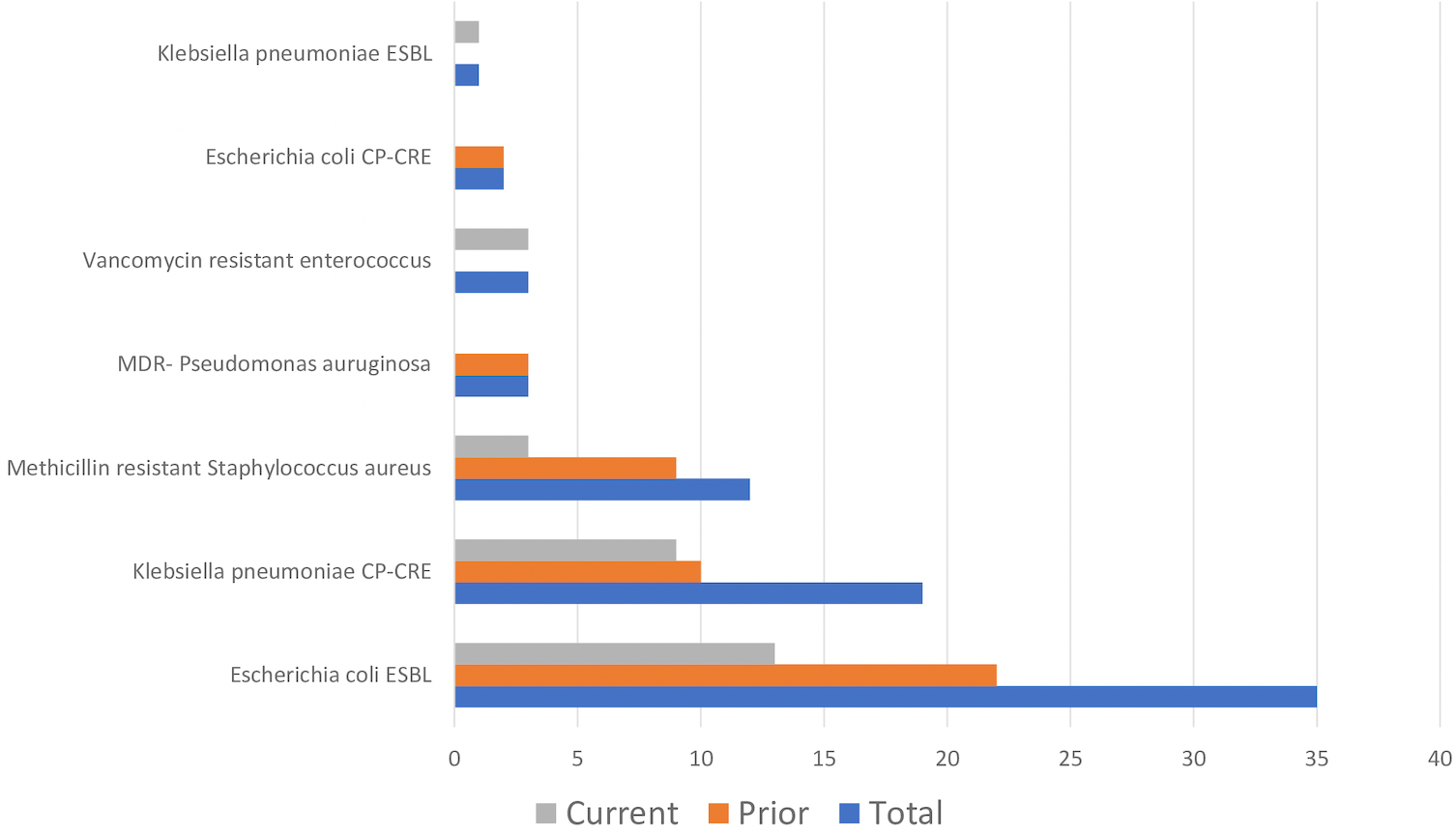
| Figure 1. The prevalence | of resistant organisms. |
| 2005;26(6):575–9 | |
| 7. Papadomichelakis E, Kontopidou F, | exposure and antimicrobial resistance in invasive |
| Antoniadou A, Poulakou G, Koratzanis E, Kopterides | pneumococcal disease: Results from prospective |
| P, et al. Screening for resistant Gram-negative | surveillance. Clin Infect Dis. 2014;59(7):944–52. |
| microorganisms to guide empiric therapy of | 17. Gea-Banacloche JC, Opal SM, Jorgensen J, |
| subsequent infection. Intensive Care Med. | Carcillo JA, Sepkowitz KA, Cordonnier C. Sepsis |
| 2008;34(12):2169–75. | associated with immunosuppressive medications: An |
| 8. MacFadden DR, Coburn B, Shah N, Robicsek | evidence-based review. Crit Care Med. 2004;32(11 |
| A, Savage R, Elligsen M, et al. Utility of prior cultures | SUPPL.). |
| in predicting antibiotic resistance of bloodstream | 18. Cantwell L, Perkins J. Infectious disease |
| infections due to Gram-negative pathogens: a | emergencies in oncology patients. Emerg Med Clin |
| multicentre observational cohort study. Clin Microbiol | North Am. 2018;36(4):795–810. |
| Infect. 2018;24(5):493–9. | 19. Kalil AC, Metersky ML, Klompas M, |
| 9. Butler-Laporte G, Cheng MP, Cheng AP, | Muscedere J, Sweeney DA, Palmer LB, et al. |
| McDonald EG, Lee TC. Using MRSA screening tests | Management of adults with hospital-acquired and |
| to predict methicillin resistance in Staphylococcus | ventilator- associated pneumonia: 2016 clinical |
| aureus bacteremia. Antimicrob Agents Chemother. | practice guidelines by the Infectious Diseases |
| 2016;60(12):7444–8. | Society of America and the American Thoracic |
| 10. MacFadden DR, Elligsen M, Robicsek A, | Society. Clin Infect Dis. 2016;63(5):e61–111. |
| Ricciuto DR, Daneman N. Utility of prior screening for | 20. Stevens DL, Bisno AL, Chambers HF, |
| methicillin-resistant Staphylococcus aureus in | Dellinger EP, Goldstein EJC, Gorbach SL, et al. |
| predicting resistance of S. aureus infections. CMAJ. | Executive summary: Practice guidelines for the |
| 2013;185(15):725–30. | diagnosis and management of skin and soft tissue |
| 11. Singer M, Deutschman CS, Seymour C, | infections: 2014 update by the Infectious Diseases |
| Shankar-Hari M, Annane D, Bauer M, et al. The third | Society of America. Clin Infect Dis. 2014;59(2):147– |
| international consensus definitions for sepsis and septic | 59. |
| shock (sepsis-3). JAMA - J Am Med Assoc. | 21. Pien BC, Sundaram P, Raoof N, Costa SF, |
| 2016;315(8):801–10. | Mirrett S, Woods CW, Reller LB, Weinstein MP |
| 12. Vincent JL, Moreno R, Takala J, Willatts S, | (2010). The clinical and prognostic importance of |
| De Mendonça A, Bruining H, et al. The SOFA (Sepsis- | positive blood cultures in adults. Am. J. Med., 123(9), |
| related Organ Failure Assessment) score to describe | 819–828. |
| organ dysfunction/failure. Intensive Care Med. | 22. Dickstein Y, Geffen Y, Andreassen S, |
| 1996;22(7):707–10. | Leibovici L. Paul M (2016). Predicting antibiotic |
| 13. Bone RC, Balk RA, Cerra FB, Dellinger RP, | resistance in urinary tract infection patients with prior |
| Fein AM, Knaus WA, et al. Definitions for sepsis and | urine cultures. Antimicrobial Agents and |
| organ failure and guidelines for the use of innovative | Chemotherapy, 60(8), 4717–4721. |
| therapies in sepsis. Chest. 1992;101(6):1644–55. | |
| 14. Shetty A, MacDonald SPJ, Williams JM, van | |
| Bockxmeer J, de Groot B, Esteve Cuevas LM, et al. | |
| Lactate ≥2 mmol/L plus qSOFA improves utility over | |
| qSOFA alone in emergency department patients | |
| presenting with suspected sepsis. EMA - Emerg Med | |
| Australas. 2017;29(6):626–34. | |
| 15. Bidell MR, Opraseuth MP, Yoon M, Mohr J, | |
| Lodise TP. Effect of prior receipt of antibiotics on the | |
| pathogen distribution and antibiotic resistance profile | |
| of key Gram negative pathogens among patients with |