Full text rendered from the published PDF. The PDF is the version of record; if the two differ, the PDF governs.
Introduction:
Efficient planning is crucial for the safe evacuation of dialysis patients during a disaster. The lack of evidence-based approaches for evacuating these patients highlights the need to explore the associated challenges and develop a comprehensive plan to address the unique vulnerabilities of this cohort.
Methods:
Information was gathered using three methods: First, a thorough literature search was conducted. Secondly, a focus group was established, comprising experts in nephrology, biomedical engineering and safety engineering, as well as senior dialysis nurses. Finally, the research team visited a dialysis centre to examine the dialysis machines and engage in discussions regarding evacuation plans.
Results:
Three procedures were identified to promptly release patients from a dialysis machine: the ‘clamp and cut’ method, the ‘clamp and cap’ method, and the hand crank method. Factors such as the size and weight of the dialysis machine, battery life, and potential blood loss resulting from immediate interruption of the dialysis process were noted as important considerations.
Conclusion:
It is essential that dialysis patients be recognized as a vulnerable group, and that time and effort be invested in the design of an evacuation plan specific to their needs.
Keywords: Disasters, Disaster Planning, Dialysis, Hemodialysis, Renal Dialysis
During emergencies such as electricity/power outages, fires, water shutdowns, or imminent threats to site or patient safety, immediate evacuation becomes imperative [1]. However, disaster evacuation policies often overlook a specific group of patients — those undergoing dialysis [2]. This oversight may be attributed to the infrequency of such events, or to the prioritisation of critically ill and intubated patients in
patients dialysed Nevertheless, larger hospitals. require special attention due to their unique vulnerabilities that extend beyond their health status.
Once the dialysis process is initiated, patients become immobile and reliant on the machine for a duration of 2-6 hours. The necessity of a power supply, as well as a water source for haemodialysis, further restricts their mobility. From a physiological standpoint, any sudden interruption of an ongoing dialysis procedure can lead to hypovolaemia as blood and fluids have already been transferred from the patient to the machine [3]. Given that patients with end-stage renal disease frequently experience anaemia, failure to return the blood to the patient prior to ending the dialysis session can result in symptomatic anaemia.
Effective evacuation planning for such cases re- quires the consideration of three key factors: the pa- tients’ vulnerabilities, the evacuation setting, and the patients’ destination. These factors are connected and interdependent, thus requiring a comprehensive approach involving patients, caregivers, emergency medical services, and disaster planners. While dis- cussions have taken place concerning the evacuation of various patient groups, there remains a dearth of guidance regarding the appropriate course of action for patients undergoing dialysis during an evacua- tion. The objective of this discussion, therefore, is to address the evacuation of dialysed patients and develop evidence-based evacuation plans. By taking into account the specific needs and vulnerabilities of
these patients, we can ensure their safety and well- being in emergency situations.
This is a qualitative study, including a focus group discussion, conducted in Saudi Arabia from July to August, 2023. To address the research question, three methods were employed: a literature search, the establishment of a focus group, and site visits to a dialysis centre. The focus group interviews, facilitated by the researcher, aimed to gather in- depth insights and understand the participants’ ex- periences and perspectives. Field observations were also conducted to observe and document the context and interactions related to the research question. The collected data were then thematically analysed.
The literature search was conducted using the PubMed database, with the keywords ‘uninterrupted dialysis’, ‘evacuation’, and ‘dialysis patient during a disaster’. Additionally, protocols and policies re- lated to the topic were screened for relevant infor- mation.
The enrolment criteria for the focus group were their assigned roles at the dialysis centre, their assigned roles in safety/engineering, and their as- signed roles in the event of evacuation.
For the research team’s visit to a dialysis centre, the city’s largest dialysis facility was chosen due to its surge capacity of 600 dialysis beds, and also being a referral centre for other hospitals. The team also visited the dialysis ward of a tertiary hospital to compare dialysis machines and assess competency and training. The site selection was based on bed ca- pacity, dialysis services provided, and the potential significance of an interruption to dialysis services in that centre. An evacuation demonstration was given to illustrate how to interrupt dialysis; verbal consent was obtained from the patient.
Literature Search: Of 527 results using the specified keywords, five references were identified, including a guideline, a recorded lecture, and pamphlets from medical centres [4-8]. One article was in pre-press and therefore unobtainable. These available resources provided information on various manoeuvers em- ployed in the event of immediate evacuation. Such
procedures aim to minimise downtime and ensure smooth patient transitions to safer locations, thereby maintaining continuity of care and reducing adverse effects during unforeseen events [9].
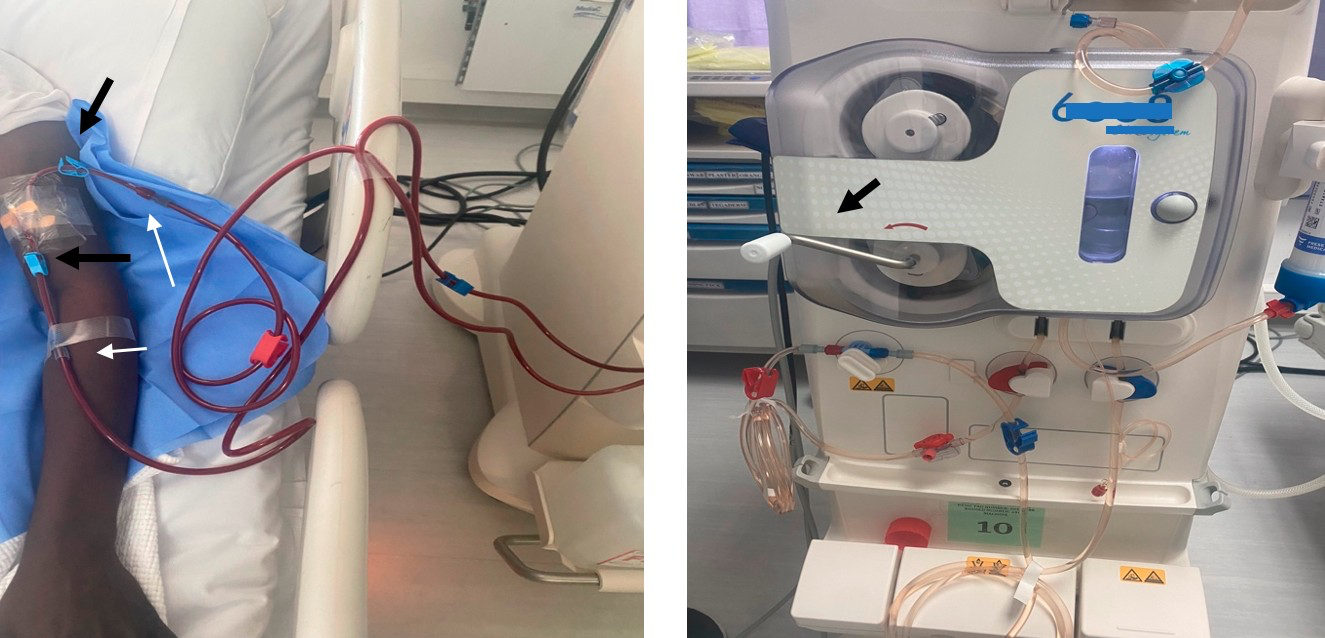
One critical technique identified in the literature is the ‘clamp and cut’ procedure, used during haemodialysis emergencies, which involves imme- diately clamping and cutting the dialysis lines [10]. The procedure is performed using the emergency kit available at the patient’s chairside machine.
Another manoeuver highlighted in the literature is the ‘clamp and cap’ procedure. This technique involves temporarily sealing the dialysis lines, using specialised caps, to maintain the system’s integrity and prevent contamination or clot formation [11].
Additionally, the hand crank method serves as an alternative technique for sustaining dialysis treat- ment in the absence of power. This method involves manually operating the hand crank of the dialysis machine to maintain blood flow and prevent clotting until power is restored or the issue is resolved [11]. By employing the hand crank method, healthcare providers can ensure uninterrupted therapy for pa- tients until the situation has been resolved.
Focus group: In the interest of diversity, the focus group con- sisted of five people: experts in nephrology, biomed- ical engineering and safety engineering, as well as senior dialysis nurses. Participation was voluntary. Semi-structured interviews were conducted, the topic identified in advance, as illustrated in Table 1. Several interviews of approximately 20 minutes were held at different times to explore opinions and insights regarding the subject matter.
Our content analysis shed light on the specific challenges and considerations that need to be ad- dressed when developing effective evacuation plans for dialysis patients. The focus group discussions identified several challenges associated with the evacuation of this patient group, one major chal- lenge being the lack of specific evacuation plans for dialysis centres. The group emphasised the need for detailed protocols that address the unique needs and vulnerabilities of dialysis patients during emergency situations.
The discussions also highlighted the importance of considering factors such as the connection of the dialysis machine to a water source, and the battery
The evacuation of a dialysis patient involves similar principles to that of other patients, with certain notable differences. One key distinction is the need to evacuate the patient along with their dialysis machine, as this machine is essential for the patient’s survival. While patient safety is the priority, the importance of machine mobilisation should not be underestimated. Factors such as the weight, size, and mobility of the machine, as well as the width of emergency doors and the capacity of ambulances to transport both machine and patient, must be taken into account. The choice between vertical and horizontal evacuation must also be considered, particularly when elevators are not designed to accommodate
Figure. 1. The clamp and cap procedure: The dialysis line is clamped using the clips (black arrows) and closed using the caps (white arrows).
Such training enhances their preparedness to handle emergency situations safely and effectively [13]. It is crucial that healthcare facilities prioritise comprehensive training programs that cover all three methods to ensure readiness for various emergency scenarios.
In addition to the above, it is important to address the needs of regular dialysis patients who may require urgent dialysis due to conditions such as fluid overload and hyperkalemia [14]. For these patients, a specific plan should be in place for the completion or initiation of dialysis after evacuation. Factors such as missed or delayed dialysis sessions should be taken into account, as some patients may depend on dialysis for their survival [15]. Planners should also consider the spectrum of severity among patients, including those with severe uraemia who may have a
of consciousness. decreased level Stable and unstable patients should be considered, with provisions made for invasive procedures such as intubation, if necessary. It is also important to note that paediatric patients may be on peritoneal dialysis rather than haemodialysis [16]. However, this paper focuses on planners addressing the needs of stable adult dialysis patients. When choosing a destination for evacuation, it is
vital to consider the availability and accessibility of a dialysis machine or, at the very least, a dialysis emergency bag with compatible medical supplies [17]. Such bags may be required in extreme cases and should be included in the evacuation plan. Where it is possible to transfer patients to other facilities with dialysis centres, priority should be given to those who have not completed their session or are experiencing symptoms. It may be necessary to bypass other hospitals that are not ideal for this particular patient group. The use of private sector dialysis machines, whether within their own facilities or moved to other locations, requires early agreements, financial considerations, and technical measures [18]. Staff members accompanying evac- uated patients must also be knowledgeable about operating different machines, and must be able to be assigned to other facilities [18].
Another important consideration involves the evacuation of a large number of patients from a dial- ysis centre [19]. In such situations, a mass casualty incidents protocol should be followed, prioritising those with a severe need for dialysis to receive treatment first. Prioritisation can be based on venous blood gas, vital signs, ECG, and clinical judgment. If there is a need to dialyse multiple patients im- mediately, we believe a two-hour dialysis session can
ensure a fair allocation of scarce resources, along with additional measures such as treatment for hyperkalemia.
Effective communication plays a crucial role in coordinating transport and preparing alternative fa- cilities. These facilities should have dialysis ma- chines ready and dialysis nurses standing by. Often, when patients are transferred to new facilities, there is a policy of requesting laboratory tests such as hepatitis screens. This issue can be addressed by ensuring that accessible documentation is shared between the evacuated facility and the receiving facilities. To facilitate this, a MOU can be agreed during the planning phase, outlining the sharing of documentation through a mutual point.
Knowledge and use of the ‘clamp and cut’, ‘clamp and cap’, or hand crank methods in the evacuation of haemodialysis patients is crucial for ensuring patient safety and efficient emergency response. Dialysis centre staff need to know when to evacuate, and how to do so effectively. The competency of dialysis nurses in operating dialysis machines entails practical knowledge of the procedure for emergency interruption; it is therefore paramount that these skills are checked periodically during drills and hands-on exercises. Regular drills and training (habitual or as part of facility accreditation) can improve proficiency, reinforce knowledge and en- hance awareness about these emergency procedures, ultimately improving patient outcomes during unex- pected events. Learning about specific and different machines within the facility is also imperative.
There are several recommendations that we be- lieve are integral to the successful evacuation of patients with ongoing dialysis. These include iden- tifying dialysis patients as special segment in every evacuation plan; exploring, through drills and tabletop exercises, the knowledge and skills related to immediate, emergency discontinuation of dial- ysis; and ensuring the transfer of knowledge and experience of the required procedural techniques, including hand crank operation.
Moreover, biomedical engineering, safety engi- neering and facility design must be incorporated into evacuation plans, and scenarios must be explored in which the dialysis machine is evacuated with the
patient, be it a vertical or horizontal evacuation. Overall, to formulate effective plans requires con- sideration of the facility design, the type of dialysis machine and the ambulance design, as well as the existence of MOUs with other facilities for evacua- tion events. Effective and timely communication is also key in any evacuation.
This study is limited by the small size of the focus group used, the fact that software was not used for coding the interview data, the lack of repeated interviews, and the fact that transcripts were not returned to the participants for comments.
| Topic Sub-topic | |
|---|---|
| Existing disaster plans Plans for | patients with ongoing dialysis |
| Dialysis interruption Theories | and practical steps for immediate interruption |
| Competency Education | and training |
| life of the machine. Furthermore, the exact process | patients with their machines. While it may be |
| of immediately interrupting dialysis, with or without | relatively simple to relocate patients to a non-affected |
| waiting for the blood return, was discussed as an area | area within the same facility, challenges arise when |
| that requires clear guidelines. | evacuation to external facilities is necessary. In such |
| Identifying suitable destinations for evacuation | cases, efforts should be made to plan for the |
| was another significant challenge identified by the | continuity of care, ensuring that patients who cannot |
| focus group. Establishing memoranda of under- | timeously receive their regular dialysis are provided |
| standing (MOU) with other centres that can provide | with appropriate support. |
| dialysis services was recognised as an important step | In situations where immediate evacuation is immin- |
| in ensuring appropriate care for evacuated patients. | nt, adopted. a benefit/risk It is important assessment to mindset acknowledge should that be |
| Site visit: | interrupting dialysis, be it haemodialysis or con- |
| Several challenges were identified during the site | tinuous renal replacement therapy (CRRT), will result |
| visit, including the size and weight of the dialysis | in anaemia and hypovolaemia due to the |
| machines, which could potentially hinder navigation | approximately 300 ml of blood inside the dialysis |
| through emergency evacuation routes. Additionally, | machine [12]. In order to address this issue, it is |
| a question arose regarding the capacity of ambu- | important to establish mitigation strategies for use |
| lances to accommodate both the heavy machine and | during immediate evacuations. One such strategy is |
| the patient when evacuating. Furthermore, consider- | to wait for the blood to return to the patient using the |
| ations were raised regarding the possibility of using | installed batteries (in case of a power outage). This |
| dedicated respective vehicles alternative to facilities. transport the machines to the | allows the patient, a 10-minute the same period period for providing the blood a to window return of to |
| Education and training emerged as an essential | time situations for safe where mobilisation site safety to concerns the ambulance necessitate in |
| component of safe and successful evacuation. The | emergency evacuation. If the ambulance is not |
| manoeuvres employed to immediately interrupt dial- | designed to accommodate the dialysis machine, the |
| ysis were explored, and are illustrated in Figures 1 | en-route period is sufficient for the blood to return to |
| and 2. | the patient. In cases where the batteries are not |